
RC Differential Oils Guide for the Right Setup
29/11/2026
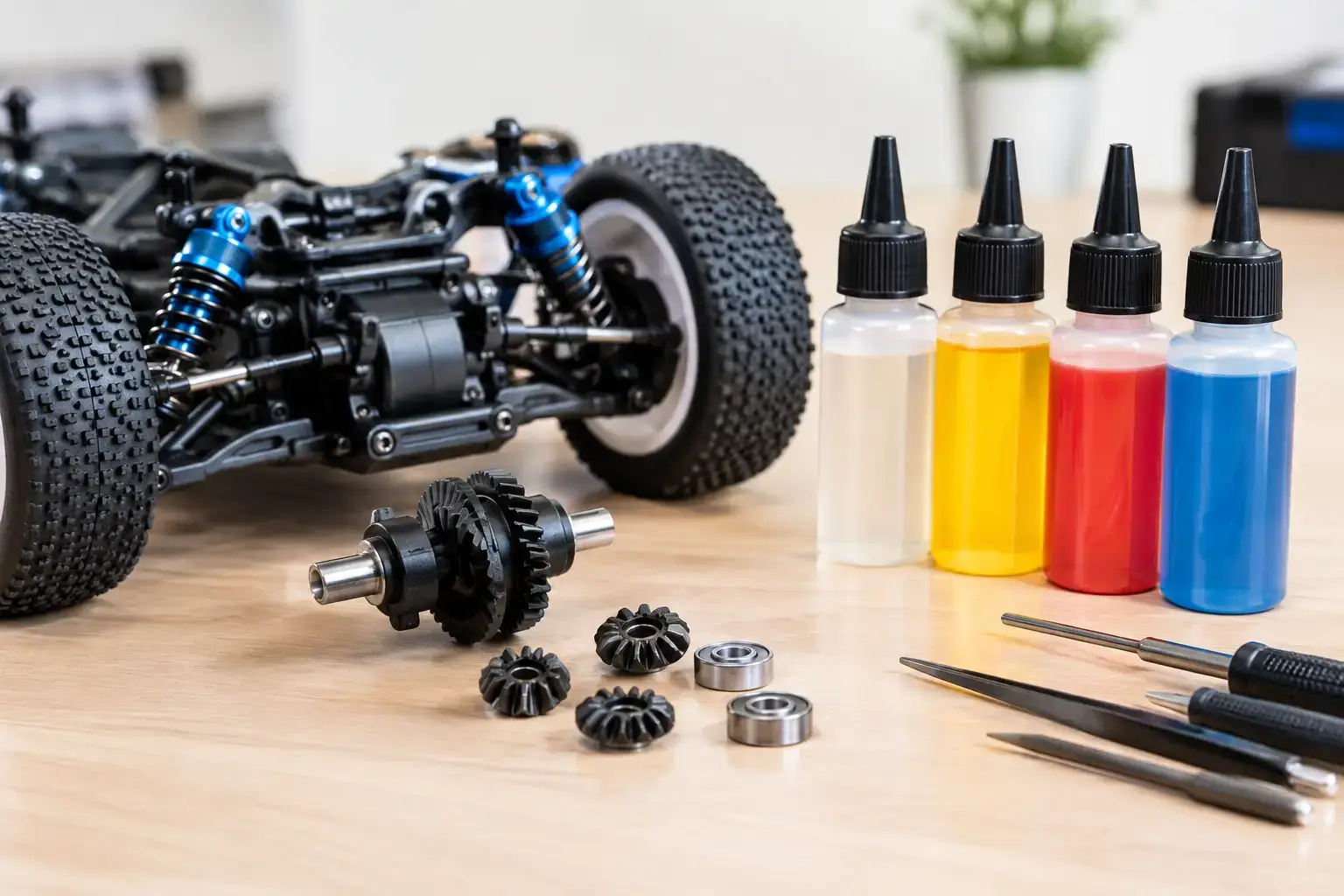
A differential that feels wrong can make an otherwise excellent RC car frustrating to drive. This RC differential oils guide explains what the numbers mean, how oil changes affect handling, and how to choose a sensible starting point without chasing setup changes that do not suit your model or driving surface.
Differential oil is not simply a maintenance item. It is a tuning tool. In a sealed gear differential, silicone oil controls how easily the wheels on the same axle, or the front and rear of a four-wheel-drive model, can turn at different speeds. Change the oil weight and you change how the vehicle puts power down, turns into corners and behaves over rough ground.
What RC differential oil actually does
A differential allows driven wheels to rotate at different speeds. That matters in every turn: the outside wheel travels farther than the inside wheel. A freely operating differential makes turning smoother, but it can also allow power to escape to the wheel with the least grip.
Silicone differential oil creates resistance inside the diff. A thinner oil allows the gears to move through the oil more easily, making the differential feel more open. A thicker oil slows that action, making the differential act closer to a locked unit.
Neither is automatically better. An open-feeling diff can improve steering and keep a model predictable on loose terrain. A thicker setup can give stronger drive out of a corner or stop a lightly loaded wheel from spinning away the power. The right answer depends on the vehicle, tyres, surface and how you use the throttle.
Do not confuse differential oil with grease. Silicone diff oil is designed for sealed differentials. Grease is commonly used on exposed gears, metal ring and pinion sets where specified, or in some non-sealed differential designs. Filling a sealed diff with general-purpose grease can create inconsistent action and may leak or contaminate the seals.
RC differential oils guide: understanding weights
Differential oil is normally labelled in cSt, meaning centistokes, such as 10,000 cSt, 30,000 cSt or 100,000 cSt. The higher the cSt number, the thicker the oil. Some brands also use a weight label, such as 10K or 30K, which usually refers to the same approximate cSt value.
Use cSt figures when comparing oils wherever possible. Unlike shock oil, where “weight” markings can vary significantly between manufacturers, diff oils are generally easier to compare by cSt. Still, use one quality silicone oil range where practical, particularly when following a setup sheet, as exact formulations and labelling can differ.
Very thin oils, around 1,000 cSt to 10,000 cSt, allow a relatively free differential. Mid-range oils such as 30,000 cSt to 100,000 cSt provide more drive while retaining differential action. Extremely heavy oils, including 500,000 cSt and above, can make a diff behave almost locked. Silicone putty takes this a step further and is used in certain applications where near-locked action is wanted without a traditional oil fill.
The number alone does not tell you what will work. A 30,000 cSt front differential may be mild in one 1/10 buggy but noticeably restrictive in a lightweight crawler. Internal gear design, tyre diameter, motor power and the rest of the drivetrain all influence the result.
Front, centre and rear diff changes
On a model with front and rear differentials, changing one end affects the balance of the whole vehicle. On a centre-diff-equipped buggy, truggy or basher, the centre oil has an especially large effect on power delivery.
Front differential oil
A thicker front diff generally pulls both front wheels harder under power. This can improve forward drive and make the front end feel more planted when accelerating out of a turn. Go too thick, however, and the car may resist turning under power, push wide in corners or feel less willing to rotate.
A thinner front diff can give more steering and a freer feel through tighter turns. On high-grip surfaces, that may be useful. On loose dirt or when using high power, it can allow the inside front wheel to unload and spin, reducing useful drive.
Centre differential oil
A centre differential divides power between the front and rear of the vehicle. Thinner centre oil lets power transfer more readily to the end of the car with less resistance. Under acceleration, that often means more power can escape towards the front as weight shifts rearward, creating a model that feels less eager to wheelie but may lose rearward punch.
Thicker centre oil keeps the front and rear more closely coupled. It normally delivers stronger acceleration, better jump control and more consistent power to the rear tyres. Too thick can make a powerful basher harder to control, increase wheelies and place more strain on the drivetrain.
For many 4WD bashers, the centre diff is the best place to make one controlled change at a time. If the car balloons the front tyres and feels lazy leaving corners, a heavier centre oil may help. If it wheelies constantly, pushes on power or becomes difficult to settle on rough ground, a lighter centre fill may be more useful.
Rear differential oil
A thicker rear diff can improve traction and make the rear axle work more as a pair. This is often useful for strong drive on loose surfaces, but too much rear locking can make the car rotate aggressively or feel nervous when getting back on the throttle.
A thinner rear diff usually gives a calmer, more forgiving rear end and can help a vehicle turn through a corner. If it is too thin, the inside rear wheel may unload and spin, leaving the model short of drive where you need it most.
Starting points for different RC uses
There is no universal oil chart, but a sensible baseline saves time. Always check the manufacturer’s manual first, especially for models with recommended front, centre and rear fills. Those values are your reference point, not a rule that cannot be changed.
For racing buggies and truggies, setup is closely tied to track grip, bumps and driving style. Racers often make measured changes of one oil grade at a time, then test on the same track. A small adjustment can be felt clearly when the rest of the setup is consistent.
For bashers, durability and controllability are often more useful than chasing maximum corner speed. Many drivers prefer a moderately heavier centre diff setup to manage brushless power, but the correct grade depends heavily on whether the model runs on grass, gravel, skate park concrete or loose soil.
Crawlers are a special case. Many use locked axles rather than oil-filled differentials because maximum low-speed traction is the priority. Models with selectable or open diffs may use lighter oils to preserve steering. Thick oil can improve climbing drive, but it may make the vehicle harder to place accurately around tight scale obstacles.
RC road cars usually benefit from more precise, incremental changes. High-grip tarmac exposes an overly thick or thin diff quickly, while tyre compound and temperature can alter the result from one session to the next.
How to choose your first oil change
Start by identifying the problem rather than choosing a number because it worked in somebody else’s model. If your vehicle drives well but lacks traction only on one surface, tyres may be the real answer. If it pulls, clicks, leaks or feels inconsistent from corner to corner, inspect the differential before treating it as a tuning issue.
When the diff is healthy, change one location at a time. On a centre-diff vehicle, begin with the centre. On front-and-rear-diff models, choose the end that matches the handling problem. Make a meaningful but not extreme step, such as moving from 30K to 50K rather than jumping straight to 500K.
Test on the same battery, tyres and surface where possible. Pay attention to acceleration, mid-corner steering, steering under power, wheel lift and landing stability. A setup that feels quick for one minute but becomes tiring to drive is rarely the best setup.
Servicing differentials properly
Oil tuning only works when the differential is assembled cleanly. Remove the diff, clean away old oil and inspect the internal gears, cross pins, O-rings and gasket. Worn O-rings are a common cause of leaks, while damaged gears can make the diff feel notchy regardless of the oil grade.
Use a small amount of suitable silicone grease on the O-rings if the manufacturer recommends it. This helps prevent them from tearing during assembly and can improve sealing. Fill the diff around the gears rather than to the absolute top of the case. Overfilling creates pressure when the cover is fitted and can force oil past the seals.
Turn the internal gears slowly to release air bubbles, then fit the cover evenly. After rebuilding, rotate the outdrives by hand. The action should feel smooth and consistent, not gritty or excessively tight.
Diff oil does not need changing after every run. Service intervals depend on use, temperature, power level and whether the diff is leaking. Check it after a hard season of bashing, before an important race meeting, or whenever the handling has changed without another clear cause.
RC Model Shop stocks differential oils across the useful range, along with seals, rebuild kits and the tools needed to keep your drivetrain working as intended. If you know your model and the behaviour you want to change, choosing the next sensible grade becomes far simpler.
The best differential setup is the one that gives you predictable control on the ground you actually drive on. Start with the manufacturer’s baseline, make one change, and let the model tell you what it needs.