
Buggy Versus Truggy - Which Is Right for You?
11/11/2026
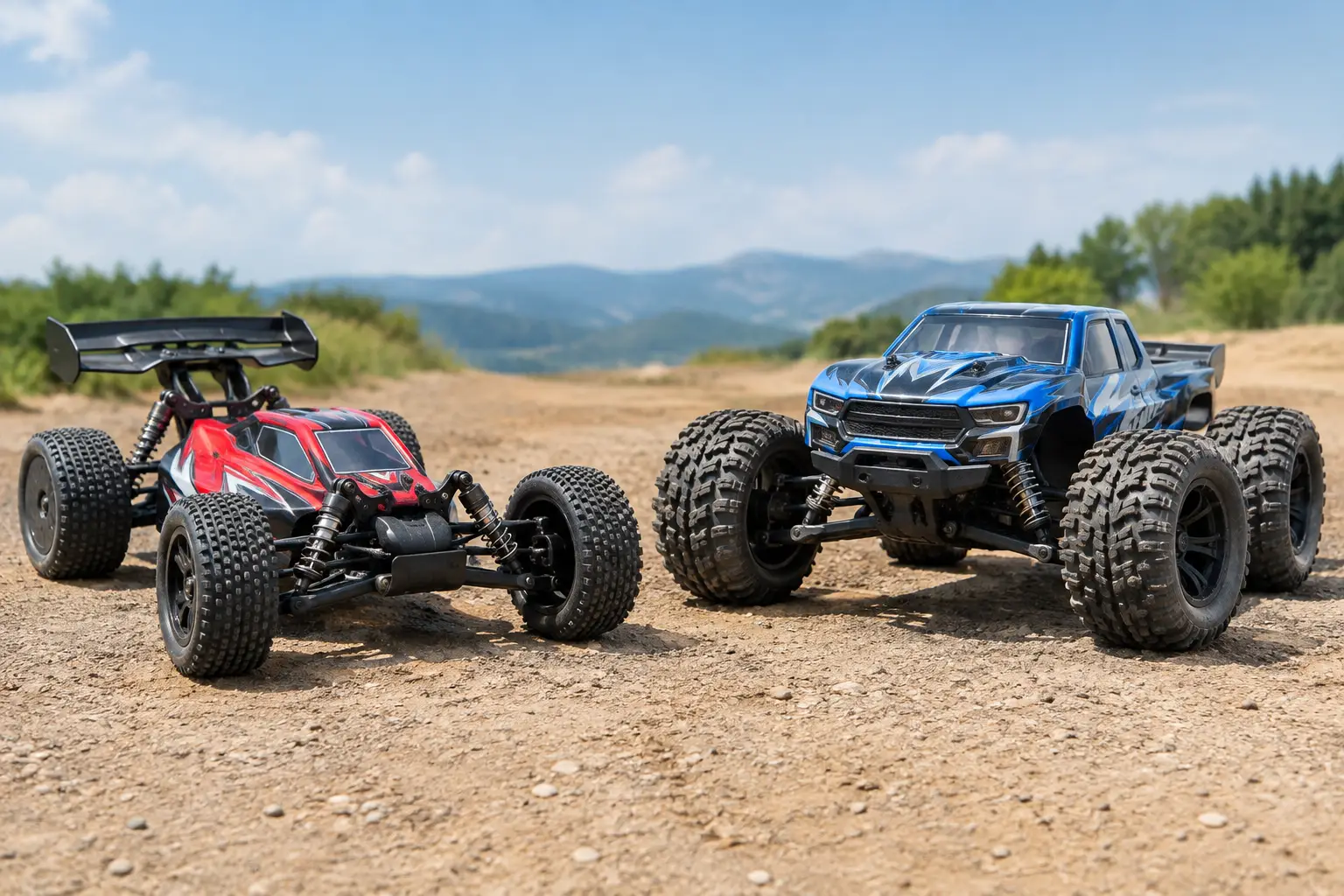
A hard-packed BMX track, a dusty gravel car park and a cut-grass field can give the same RC model three very different days out. That is why the buggy versus truggy question is less about which looks better on the shelf and more about where, how and how hard you plan to drive.
Both are fast, capable off-road RC classes with loyal followings. They share plenty of design DNA, particularly in 1/8 scale, but their proportions change the driving experience considerably. A buggy rewards precise inputs and a smoother surface. A truggy adds wheel size, ground clearance and stability for drivers who want to cover rougher ground with confidence.
Buggy versus truggy: the main differences
A buggy is generally lower, narrower and lighter-looking, with smaller wheels and a low body that keeps weight close to the ground. Its wheelbase can still be long, especially on a 1/8 competition buggy, but the overall stance is designed for corner speed, jumping accuracy and responsive handling.
A truggy sits between a racing buggy and a monster lorry. It normally uses a buggy-based chassis, drivetrain and suspension layout, but adds a wider track, larger tyres, more ground clearance and a lorry-style body. Those changes make it less delicate over uneven terrain and more settled when the surface is loose, rutted or bumpy.
There are exceptions. Model names and categories vary between manufacturers, and electric models in particular can blur the lines. Always compare the actual wheel size, width, ground clearance, recommended battery and spare-parts support rather than choosing purely by the label on the box.
Handling: sharp precision or planted stability?
On compact dirt, short grass, tarmac or a properly prepared RC track, a buggy feels direct. The low centre of gravity helps it turn quickly, hold a line and change direction with less body roll. A well-set-up buggy can feel incredibly connected to the surface. For drivers who enjoy improving lap times, placing the car neatly through a corner and clearing jumps with control, that responsiveness is a major part of the appeal.
The trade-off is that a buggy asks more of the driver and the terrain. Hit a deep rut, a stone or a patch of long grass at speed and its smaller wheels are more likely to be deflected. It may pitch forward on a rough landing where a truggy would simply absorb the impact and continue.
A truggy is usually calmer at speed. Its wider footprint and larger tyres give it more mechanical grip over loose ground, while the added suspension travel helps it cope with imperfect landing zones. It will not usually rotate into tight corners as eagerly as a buggy, but it is more forgiving when your driving area is far from race-track smooth.
For casual bashing, this can be the deciding factor. A truggy lets you spend more time driving and less time walking over to turn the car upright after a bad bounce or a nose-first landing.
Terrain matters more than most specifications
The best choice often comes down to your regular running spot. A buggy suits compact surfaces, loose dirt, skate parks with predictable ramps, dry short grass and dedicated tracks. It can run on rougher ground, but performance falls away when the wheels are constantly fighting holes, thick grass and scattered debris.
A truggy is at home on mixed terrain. It handles short grass, gravel, woodland paths, packed soil and uneven fields more effectively than a buggy, especially if the ground is dry. Its larger tyres roll over obstacles that would slow a buggy, and the wider stance makes high-speed passes less nervous.
Neither is the perfect answer for very long or wet grass. Even a capable truggy can overheat its motor and electronic speed control if it is forced through heavy vegetation, particularly on a high-voltage battery. A monster lorry may be better for that kind of terrain, while a crawler is the sensible choice for slow, technical woodland driving.
British weather also deserves a mention. Damp grass and loose mud reduce grip quickly, and mud adds rotating weight to tyres. Before running, check that your model's electronics are suitable for wet conditions, then clean and dry it properly afterwards. Water resistance is useful, but it does not remove the need for maintenance.
Jumps, bashing and durability
Both platforms can take serious punishment when they are built and maintained for it. Durability is not simply a truggy win. A high-quality buggy with sensible gearing and tyres suited to the surface can survive repeated jumps very well. Equally, a powerful truggy driven flat-out into a kerb can break suspension parts, wheels or steering components.
That said, truggies often have an advantage for general bashing. The larger tyres cushion landings and the extra ground clearance reduces chassis strikes. They are also naturally easier to drive over rough run-ups, so jumps tend to be approached more consistently.
Buggies reward a more measured approach. Their lower stance makes them excellent on ramps with clean take-offs and landings, where you can use throttle and brake control to adjust the car in the air. On unpredictable terrain, they can be more likely to bottom out or catch a front wheel.
If upgrading for tougher use, focus first on the parts that match your driving. Tyres, shock oil, springs, gearing and a sensible battery choice can make a bigger difference than fitting metal parts everywhere. Alloy upgrades are useful in the right places, but adding unnecessary weight can make an RC car harder on its drivetrain and less effective in the air.
Battery power, running costs and maintenance
A buggy can be the more economical route, though this depends heavily on scale and specification. Smaller wheels generally place less load on the motor and use less expensive tyres. A lighter vehicle can also be easier on batteries, provided it is geared correctly.
Truggies commonly use larger tyres and are often run with powerful brushless systems. That delivers impressive acceleration and speed, but it can increase battery demand, tyre wear and the cost of replacement wheels. Larger models may also need higher-capacity LiPo packs, a suitable charger and more space to transport them.
Maintenance is similar for both. After each run, remove dirt from the suspension arms, driveshafts and shock shafts, inspect wheel nuts, and check for worn bearings or bent turnbuckles. For electric models, make sure the cooling fan and heatsink are clear before the next battery pack. For any RC vehicle, a small issue found early is usually cheaper than a failure during the next outing.
Spare-parts availability deserves real weight in a buying decision. Popular platforms from established brands are easier to keep running because arms, hubs, gears, body shells and drivetrain parts are widely supported. This matters more than an impressive top-speed claim when you are choosing a model for regular use.
Who should choose a buggy?
Choose a buggy if you have access to a proper RC circuit, compact dirt area or other relatively smooth ground and you enjoy a precise, involving driving style. It is a strong option for racers, drivers who want to learn vehicle setup, and anyone who values sharp steering over all-terrain ability.
A buggy also makes sense when transport space is limited. Depending on the scale, its narrower tyres and body can make it a little easier to carry than an equivalent truggy. Do not assume it is a beginner-only or low-power class, however. Modern brushless buggies can be extremely quick and need a careful trigger finger on higher-voltage batteries.
Who should choose a truggy?
Choose a truggy if your local spot is a field, gravel area, compact woodland trail or mixed off-road space. It is often the more relaxed option for a first serious brushless model because it handles poor surfaces and imperfect landings without demanding constant precision.
It is also an excellent choice for the driver who wants one fast model for varied weekend use. You can run it on a dirt track one day and a short-grass field the next without feeling that the terrain is working against the vehicle. The compromise is a larger, heavier model with tyres and batteries that may cost more over time.
Make the choice around your real running spot
Before choosing, picture the ground you will use most often, not the best-looking place you might visit once. A buggy makes sense when smooth handling and accuracy are the priority. A truggy earns its place when rough ground, high-speed bashing and forgiving control matter more.
If you are still between the two, measure the grass, look for ruts and think honestly about how often you will jump it. Matching the model to that regular patch of ground will give you more enjoyable runs, fewer avoidable repairs and a better starting point for every future upgrade.