
Brushless Motor Upgrade Guide for RC Cars
20/07/2026
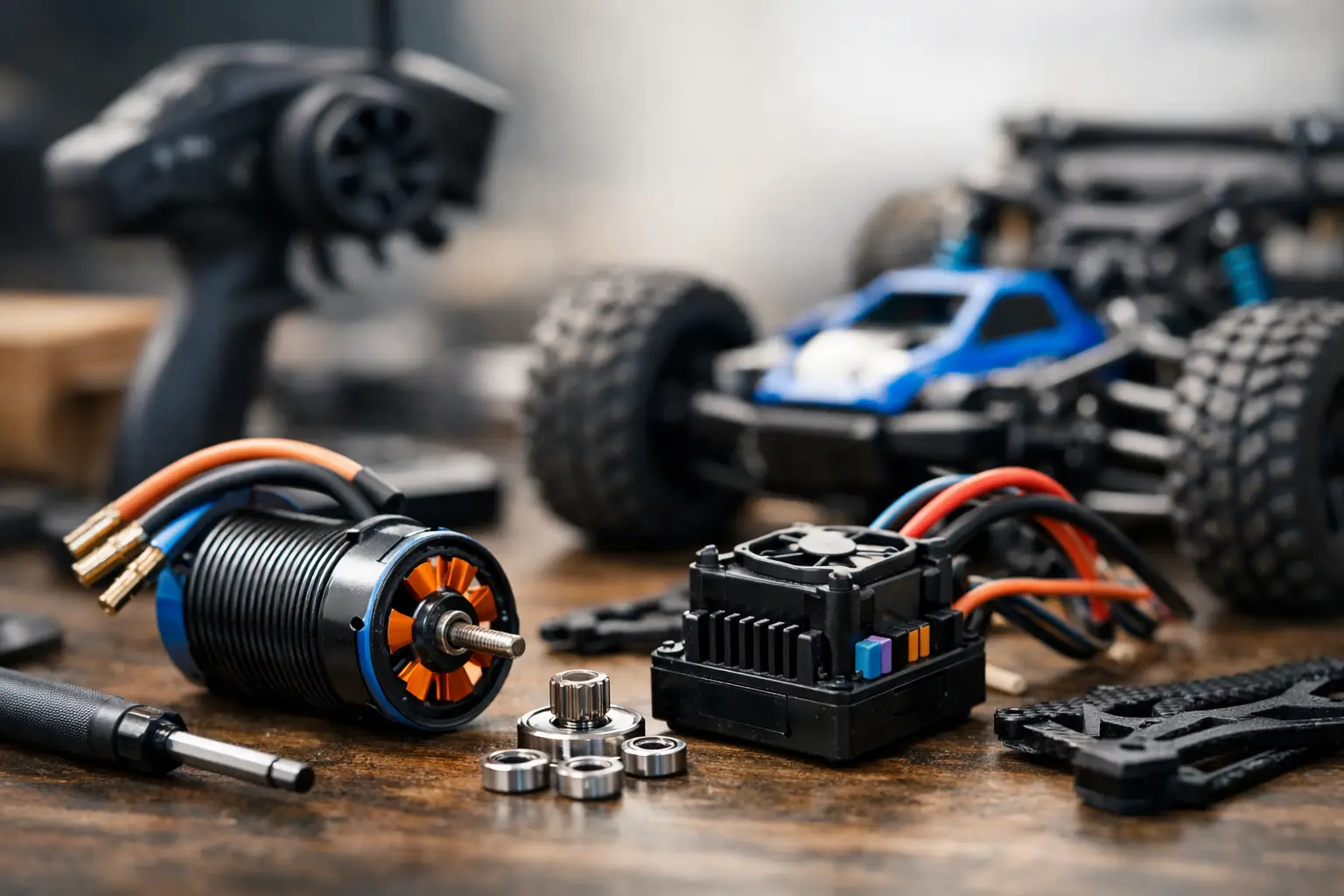
Brushless Motor Upgrade Guide – Choosing the Right RC Motor and ESC
A brushless upgrade is one of the best improvements you can make to a hobby-grade RC car, truck or crawler. More power, faster acceleration and greater efficiency are all possible, but fitting the highest KV motor or running the biggest battery is rarely the best solution.
The ideal brushless setup isn't simply the fastest. It's the one that suits your vehicle, your driving style and where you actually drive. A basher has very different requirements to a race buggy, while a crawler benefits from torque and low-speed control rather than outright speed.
Whether you're upgrading your first RC model or replacing an ageing power system, this guide explains everything you need to know before choosing a brushless motor and ESC.
Start with the Vehicle, Not the Motor
Before choosing a brushless motor, check what your RC model can realistically handle.
Look at:
-
Motor mount size
-
Battery tray dimensions
-
Existing ESC specifications
-
Gear condition
-
Driveshafts
-
Bearings
-
Differentials
A lightweight 1/10 2WD buggy won't respond to a powerful 3S brushless setup in the same way as a heavy 1/8 4WD truggy.
Your vehicle's manual is always a good place to start. Most manufacturers specify compatible motor sizes, battery voltages and gearing options. While experienced hobbyists sometimes go beyond these recommendations, they're an excellent baseline for building a reliable setup.
Before adding more power, inspect the drivetrain carefully. Worn bearings, loose wheel hexes, damaged differential gears or a slipping slipper clutch can quickly become major failures once brushless torque is introduced.
Hobby Grade RC Models Are Built to Be Upgraded
One of the biggest advantages of hobby-grade RC vehicles is that they're designed to be repaired, maintained and upgraded.
Unlike toy-grade RC cars, hobby-grade models allow you to replace or upgrade almost every component, including:
-
Brushless motors
-
ESCs
-
Servos
-
Suspension parts
-
Bearings
-
Gears
-
Differentials
-
Driveshafts
-
Tyres
This means you can gradually improve your model over time rather than replacing the entire vehicle.
Sometimes upgrading worn components before adding more power provides a much bigger improvement than simply fitting a faster motor.
Choosing the Correct Motor Size
Brushless motors are usually identified by their diameter and length.
For example:
3652
-
36mm diameter
-
Approximately 52mm long
Larger motors generally offer:
-
Greater torque
-
Better cooling
-
Increased thermal capacity
However, they also require:
-
Enough room within the chassis
-
A suitable ESC
-
Correct gearing
Always check the motor shaft diameter too.
Many 1/10-scale vehicles use a 3.175mm shaft, while many 1/8-scale systems use a 5mm shaft.
Your pinion gear must match both the shaft diameter and the gear pitch. Even if it physically fits the shaft, using the wrong gear pitch will quickly damage the spur gear.
Understanding Brushless Motor KV
KV tells you how many revolutions per minute (RPM) a motor will spin for every volt supplied with no load.
A higher KV motor spins faster.
A lower KV motor generally delivers smoother power and more manageable torque.
Higher numbers don't automatically mean better performance.
Higher KV Motors
Generally suited to:
-
Lightweight vehicles
-
Smaller tyres
-
2S LiPo batteries
-
Higher wheel speed
Lower KV Motors
Usually better for:
-
Larger tyres
-
Heavier vehicles
-
Higher voltage batteries
-
Cooler running
-
Greater torque
As a rough guide:
1/10 Scale Bashers
Approximately 3300KV–4500KV
1/8 Scale Buggies & Truggies
Approximately 1900KV–2500KV
These are only general guidelines.
Vehicle weight, tyre size, terrain, gearing and driving style all influence the best choice.
Crawlers Need Torque, Not Speed
Rock crawlers are very different from bashers.
Rather than maximum speed, crawler drivers usually want:
-
Smooth throttle response
-
Precise low-speed control
-
Strong climbing torque
A lower KV sensored brushless system is often the best choice because it offers much finer throttle control when tackling technical obstacles.
Sensorless vs Sensored Brushless Systems
Sensorless Systems
Sensorless systems are extremely popular because they're:
-
Affordable
-
Reliable
-
Powerful
-
Easy to install
They're ideal for:
-
General bashing
-
High-speed driving
-
Jumping
-
Everyday use
Some sensorless systems can feel slightly rough when pulling away at very low speeds.
Sensored Systems
Sensored systems use a sensor cable between the ESC and motor to monitor rotor position.
Benefits include:
-
Smoother starts
-
Better throttle precision
-
Improved low-speed control
They're particularly well suited to:
-
Crawlers
-
Race vehicles
-
Scale builds
Sensored systems are usually more expensive and the sensor cable should be protected from dirt, moisture and damage.
Your ESC Is Just as Important
The motor is only one part of the power system.
Your Electronic Speed Controller (ESC) must comfortably handle:
-
Your battery voltage
-
Your motor size
-
The expected current draw
Running a 3S LiPo through an ESC designed only for 2S isn't a performance upgrade—it's a quick route to damaged electronics.
Choosing an ESC with a little spare capacity helps improve reliability, particularly if you regularly drive:
-
Long grass
-
Sand
-
Loose dirt
-
Large tyres
-
Heavy vehicles
-
Hot weather
Don't Forget the Battery
Your battery needs to supply enough current for the brushless system.
Choose a quality LiPo battery with:
-
The correct cell count
-
Suitable discharge capability
-
Physical dimensions that fit your battery tray
Always ensure your ESC has the correct LiPo low-voltage cut-off enabled to help protect your battery from over-discharge.
If you decide to change connectors, replace both sides with connectors rated for the expected current. Permanent adaptors are best avoided on high-power brushless systems.
Gearing Is Just as Important as the Motor
One of the biggest mistakes after fitting a brushless motor is increasing the pinion size too much.
A larger pinion gives:
-
Higher top speed
-
Increased motor load
-
Higher operating temperatures
A smaller pinion usually provides:
-
Better acceleration
-
Cooler running
-
Greater reliability
Whenever you install a new brushless setup, start conservatively.
Drive the vehicle normally for around five to ten minutes before checking motor and ESC temperatures.
If temperatures become excessive, reduce the gearing before fitting cooling fans.
Cooling fans certainly help, but they can't compensate for unsuitable gearing.
Set the Gear Mesh Correctly
Poor gear mesh can destroy spur gears surprisingly quickly.
A simple method used by many hobbyists is placing a strip of ordinary printer paper between the pinion and spur gear while tightening the motor.
Once the paper is removed, the gears should rotate smoothly with only a tiny amount of free play.
Taking a few extra minutes here can prevent costly repairs later.
Installing Your Brushless System
Before starting installation:
-
Disconnect the battery.
-
Secure the motor using the correct screws.
-
Route wires away from rotating components.
-
Mount the ESC where it receives good airflow.
After installation:
-
Calibrate the ESC.
-
Set the correct battery type.
-
Enable the LiPo cut-off.
-
Adjust punch settings if required.
Reducing punch can make powerful 2WD vehicles much easier to control on loose surfaces.
If the motor rotates backwards on a sensorless setup, simply swap any two of the three motor wires.
More Power Doesn't Always Mean More Fun
A brushless upgrade won't solve:
-
Poor steering
-
Worn bearings
-
Damaged differentials
-
Incorrect suspension setup
-
Lack of grip
Sometimes fresh tyres, servicing the drivetrain or replacing worn bearings will improve your RC model more than increasing the motor power.
It's often best to upgrade gradually.
Start with a sensible 2S brushless system, learn how your model behaves and monitor temperatures before considering higher voltages or more aggressive gearing.
Remember, hobby-grade RC vehicles are designed to be repaired and upgraded. A reliable setup will always provide more enjoyment than one that's constantly overheating or breaking drivetrain parts.
Brushless Motors at RC Model Shop
Whether you're upgrading your first basher, building a competition buggy or improving your crawler, choosing the correct brushless motor and ESC combination makes all the difference.
Browse our range of Brushless RC Motors:
https://www.rcmodelshop.co.uk/products/444/motor?F388=Brushless&openfilter=388
If you're unsure which brushless system is compatible with your model, get in touch with the RC Model Shop team. We'll help you choose a motor, ESC, battery and gearing combination that delivers reliable performance and excellent value.
Frequently Asked Questions
Can I fit a brushless motor to any RC car?
Most hobby-grade RC vehicles can be upgraded to brushless, provided there's a compatible motor mount, ESC and drivetrain capable of handling the additional power.
Is brushless better than brushed?
Generally, yes. Brushless motors are more efficient, require less maintenance, produce more power and usually provide longer run times.
What KV motor should I choose?
It depends on your vehicle, tyres, gearing, battery and where you drive. Higher KV isn't automatically better.
Do I need a new ESC?
Yes. A brushed ESC cannot run a brushless motor. Your ESC must also support the battery voltage you intend to use.
Can I run a 3S LiPo battery?
Only if both your ESC and motor are rated for 3S operation and your vehicle's drivetrain is capable of handling the extra power.
Do brushless motors require maintenance?
Very little. Keep them clean, periodically inspect the bearings and avoid repeatedly overheating the motor.
Should I upgrade the drivetrain too?
If you're making a significant increase in power, upgrading worn gears, bearings or driveshafts is often worthwhile and will improve long-term reliability.
Written by RC Model Shop
This guide was written by the team at RC Model Shop, specialists in hobby-grade RC cars, trucks, crawlers, boats and aircraft. We supply quality RC models, brushless motors, ESCs, batteries, chargers, servos, upgrade parts and spare parts from many of the world's leading RC brands.
We regularly help customers choose compatible brushless systems based on their model, battery setup, driving style and budget. Our advice focuses on creating reliable, enjoyable RC vehicles that perform well without placing unnecessary strain on the drivetrain or electronics.
If you're unsure which brushless motor, ESC or battery is right for your RC model, get in touch with the RC Model Shop team and we'll be happy to help you choose the right setup.