
LiPo versus NiMH Runtime: What Really Lasts?
06/10/2026
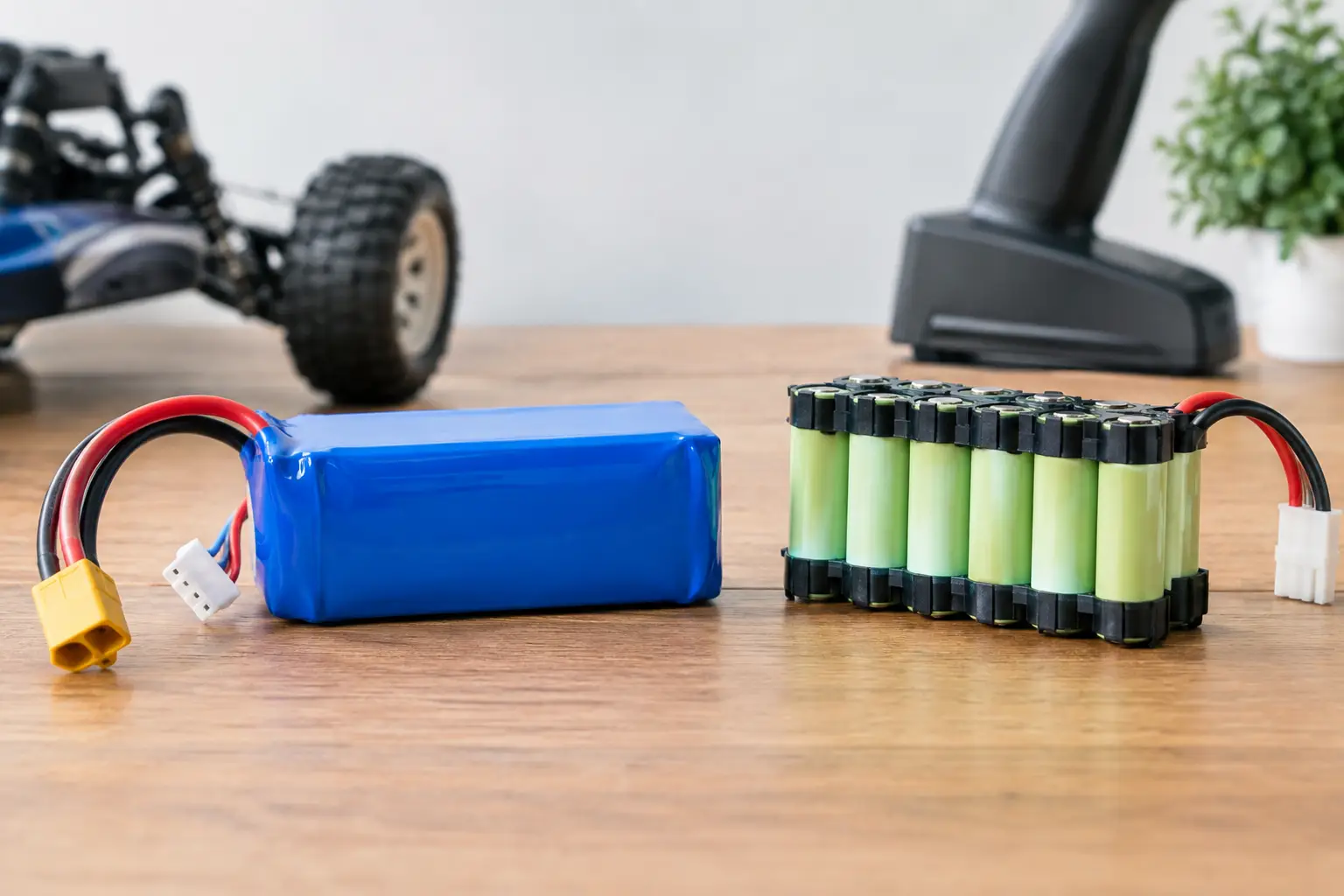
A 5000mAh pack does not automatically give every RC model the same session length. That is the catch behind LiPo versus NiMH runtime. Capacity matters, but so do voltage, vehicle weight, motor type, gearing, terrain and how hard you use the throttle. A battery that keeps a fast basher moving for 20 minutes may run a crawler for well over an hour.
For most electric RC cars, LiPo is the clear choice when you want stronger performance and a lighter model. NiMH remains a sensible, straightforward option for many beginner-ready models and casual users. The right answer depends less on the label and more on what you drive and what you expect from each run.
LiPo versus NiMH runtime: start with watt-hours
The mAh figure tells you how much charge a battery stores, but it does not tell the whole runtime story. To compare packs with different voltages properly, look at watt-hours (Wh):
Watt-hours = volts x amp-hours
A typical 6-cell NiMH pack is 7.2V. At 5000mAh, or 5Ah, it stores roughly 36Wh. A 2S LiPo is 7.4V nominal, so a 5000mAh pack stores about 37Wh. On paper, those packs hold almost the same energy.
That does not mean they deliver the same real-world runtime. A LiPo holds its voltage better while discharging, which lets the motor work efficiently for more of the pack. A NiMH pack’s voltage drops progressively under load. As the vehicle slows, many drivers use more throttle to maintain pace, increasing current draw and shortening the remaining run.
The difference is more pronounced with powerful brushless systems, heavy monster lorries and high-grip surfaces. With a low-demand brushed motor and gentle driving, the gap can be much smaller.
Why LiPo often feels like it runs longer
LiPo packs are lighter for the energy they carry and can supply current more easily. Less battery weight reduces the work required to accelerate the vehicle, particularly on 1/10 scale buggies, stadium lorries and racers. The model feels sharper, and its speed remains more consistent until the low-voltage cut-off activates.
That consistency can create the impression of a much longer run, even if the measured time is only moderately better than an equivalent NiMH pack. A NiMH-equipped car may feel noticeably tired in its final third of use, whereas a LiPo-powered car generally stays lively before stopping more abruptly at cut-off.
A LiPo also gives you more useful performance from a high-current setup. If a brushless motor demands a hard burst of power, a suitable LiPo can provide it with less voltage sag. The vehicle spends less time straining, and the electronics are less likely to feel underpowered simply because the battery is nearing the end of its charge.
There is a trade-off. Better acceleration and higher top speed can encourage harder driving. If you fit a LiPo, increase the pinion size and hold full throttle everywhere, your runtime may fall rather than rise. The battery has not failed - the model is simply using more energy per minute.
When NiMH can still be the better runtime choice
NiMH is not obsolete, and it is often a practical fit for ready-to-run RC models supplied with a basic charger. It is more forgiving for newcomers because it does not need balance charging, storage charging or a low-voltage cut-off setting. For a child’s first RC car, that simplicity has genuine value.
A high-capacity NiMH pack can also provide a decent length of use in a brushed 1/10 scale vehicle. For relaxed garden running, a 5000mAh or 6000mAh NiMH battery may be all that is needed, particularly if outright speed is not the priority.
NiMH can be useful where the radio box, battery tray or electronic speed control was designed around a 6-cell stick pack. Before changing chemistry, check that the LiPo physically fits, that its connector matches or can be changed safely, and that the ESC supports LiPo low-voltage protection. Never rely on guesswork with battery settings.
The main downside is that NiMH packs are comparatively heavy, charge more slowly and lose punch as their voltage falls. They can also be damaged by being run too flat. If the car has slowed dramatically, stop and recharge rather than trying to squeeze out a final few minutes.
Capacity is only half the calculation
Choosing the biggest mAh rating is an easy route to longer runs, but only if the pack fits and the extra weight suits the model. Moving from a 5000mAh to a 7000mAh battery increases stored energy by 40 per cent at the same voltage. In a similar setup, that can deliver a meaningful runtime gain.
However, the 7000mAh pack may be heavier and physically larger. In a lightweight buggy, that extra mass can affect balance, jumping and braking. In a crawler, the position of the battery may matter more than its total capacity because weight high in the chassis can make the model less stable on side slopes.
Voltage is equally significant. A 3S LiPo has more energy than a same-capacity 2S LiPo because it has a higher nominal voltage: 11.1V versus 7.4V. Yet 3S does not guarantee longer runtime. It makes the motor spin faster and can make the vehicle much quicker, so current draw often rises substantially. A 3S setup driven hard can finish sooner than a 2S setup that is driven with restraint.
For long sessions, it is usually better to choose the voltage your model and motor are geared for, then select a quality pack with sufficient capacity. Chasing speed first and runtime second rarely produces the most satisfying result.
The biggest factors that change RC battery runtime
Your driving environment can make a larger difference than the battery chemistry. Smooth tarmac needs less energy than long grass, loose gravel or deep mud. A monster lorry with oversized tyres working through wet grass will drain any battery quickly. A touring car rolling on a clean, level surface uses far less power.
Gearing deserves attention too. An over-geared motor runs hotter and draws more current, reducing runtime and risking motor or ESC damage. If the motor is too hot to touch for more than a couple of seconds after a run, review the pinion gear, spur gear and cooling before buying bigger batteries.
Drivetrain condition matters. Binding wheel bearings, a slipping clutch, damaged diffs or a mesh set too tight all turn battery energy into heat. Lift the model and spin the wheels by hand. They should rotate smoothly, without obvious roughness or resistance. Regular cleaning and maintenance are often the cheapest runtime upgrade available.
Driving style is the final variable. Repeated full-throttle launches, heavy braking and constant wheelspin use far more energy than smooth throttle inputs. This is especially noticeable with brushless bashers. A second battery is often more useful than hoping one pack will cover a whole afternoon of hard running.
Getting the best runtime from a LiPo safely
Use a proper LiPo balance charger and select the correct cell count, charge rate and battery type. Unless the manufacturer states otherwise, charging at 1C is a sensible default: a 5000mAh LiPo charges at 5A. Charge packs on a non-flammable surface, do not leave them unattended, and inspect them for swelling, damaged leads or split shrink wrap before use.
Set your ESC to LiPo mode before running. The low-voltage cut-off protects the pack from over-discharge, usually by reducing power or stopping the vehicle. Do not switch to NiMH mode to gain a few extra minutes. Running a LiPo too low can permanently reduce its performance and create a safety risk.
After the run, let the pack cool before recharging. If you will not use it for more than a few days, use your charger’s storage mode rather than leaving it fully charged. This helps preserve pack life and keeps the battery ready for its next outing.
Choosing the sensible option for your model
For a beginner’s brushed ready-to-run model, NiMH can be the simplest starting point. Buy a decent capacity pack, use the supplied-compatible charger or an appropriate upgrade charger, and enjoy uncomplicated running. When you want stronger acceleration, more consistent speed and potentially better usable runtime, move to LiPo only once the model’s ESC and battery compartment are confirmed compatible.
For brushless cars, lorries and racers, LiPo is usually the practical standard. A 2S pack is a balanced choice for control, manageable speed and good sessions. A 3S pack suits models rated for it when you want extra pace, but monitor temperatures and expect runtime to depend heavily on throttle use. For crawlers, a high-capacity 2S LiPo is commonly a strong choice, provided the pack’s shape and placement work with the chassis.
Rather than choosing solely by the largest number on the label, match battery voltage, capacity, connector and physical dimensions to the model. If you are unsure, RC Model Shop can help identify a suitable pack and charger combination before you order.
The most enjoyable setup is rarely the one with the highest stated runtime. It is the one that gives your RC model the right balance of pace, handling and dependable running - with a spare charged pack ready when the first one is done.
