Can LiPo Batteries Swell? Causes and Safe Steps
02/09/2026
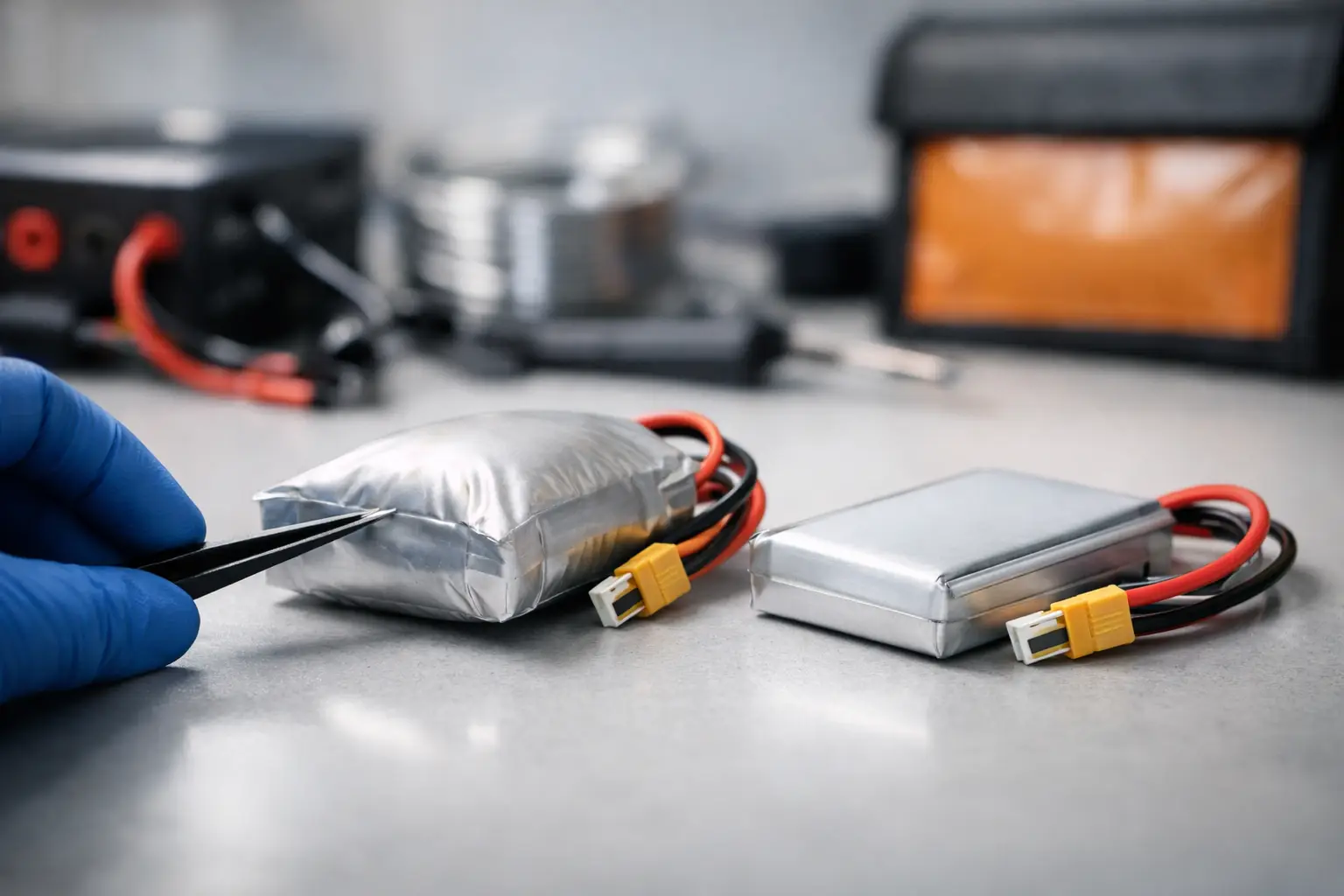
A LiPo battery that no longer sits flat, will not fit properly in its battery tray or has developed a visibly rounded or swollen shape needs attention.
Can LiPo batteries swell? Yes. Often called LiPo puffing, swelling happens when gases form inside the battery cells as the internal chemistry deteriorates or becomes damaged.
A swollen LiPo should not be treated as a simple fitment problem. It is a sign that the battery is no longer in its original healthy condition and should be removed from normal RC use.
For an RC car, boat or aircraft, a healthy LiPo battery should be physically undamaged and maintain its normal shape.
If you need to replace a damaged or ageing pack, browse our range of RC batteries, but always check the voltage, connector, dimensions and manufacturer recommendations for your model before ordering.
Why do LiPo batteries swell?
LiPo cells use a chemical electrolyte.
As the battery ages or is subjected to unsuitable operating conditions, chemical reactions inside the pouch cell can generate gases.
Because LiPo pouch cells do not use a rigid metal case, this internal gas causes the cell to expand or puff.
Several factors can contribute.
LiPo battery age and wear
LiPo batteries are consumable components.
Repeated charging and discharging gradually changes the chemistry inside the cells.
Over time you may notice:
-
Reduced run time
-
Greater voltage drop under load
-
Increased heat
-
Cells becoming less balanced
-
Reduced usable capacity
-
Physical swelling
There is no universal number of charge cycles at which a LiPo must be replaced because battery life depends heavily on how it has been charged, stored and used.
Over-discharging a LiPo battery
Running a LiPo battery below a suitable voltage can permanently damage its chemistry.
Modern RC ESCs commonly include a low-voltage cut-off designed to help protect LiPo batteries.
Make sure the ESC is configured for the battery chemistry being used.
When low-voltage protection activates, stop driving rather than repeatedly restarting the model to squeeze more run time from the pack.
A battery that has been deeply discharged may no longer charge or perform normally.
Excessive heat
Heat accelerates battery degradation.
A battery can be subjected to excessive load when an RC model is:
-
Aggressively geared
-
Driven through long grass
-
Fitted with oversized tyres
-
Carrying additional weight
-
Driven continuously at high throttle
-
Running with a binding drivetrain
-
Using a power system that demands more current than the battery is suited to supply
If a battery repeatedly becomes unusually hot, stop and investigate the vehicle setup.
Do not rely purely on touching the battery to decide whether the temperature is acceptable.
Where the manufacturer provides maximum operating or charging temperatures, follow those limits.
A suitable temperature gauge can also provide a much more useful measurement than guessing by touch.
Charging a LiPo incorrectly
Charging mistakes can seriously damage a LiPo battery.
Potential problems include:
-
Selecting the wrong battery chemistry
-
Selecting the wrong cell count
-
Using an unsuitable charging current
-
Charging a physically damaged battery
-
Incorrect balance connections
-
Continuing to use a pack showing abnormal behaviour
Use a charger designed for the battery type and follow both the battery and charger manufacturer's instructions.
You can browse our range of RC battery chargers or read our guide to choosing a LiPo battery charger.
Physical damage can cause LiPo problems
Crashes can damage a LiPo battery even when the outer covering initially looks acceptable.
Inspect batteries after significant impacts, especially if:
-
The battery tray has been damaged
-
The pack has moved inside the vehicle
-
The body or chassis has struck the battery
-
Wiring has been pulled or crushed
-
The pack has been punctured
-
The hard case is cracked
Do not continue charging or using a battery with obvious physical damage.
Is a slightly swollen LiPo safe to use?
A visibly swollen LiPo has undergone an internal physical change.
For normal RC use, the safest approach is to stop using and charging a swollen battery and arrange appropriate disposal.
Do not keep using a puffed battery simply because:
-
It still holds voltage
-
The model still runs
-
The swelling is only slight
-
It can still be forced into the battery tray
A swollen battery can deteriorate further during charging or under the high-current load produced by an RC model.
Replacing the pack is considerably cheaper than risking damage to the RC model, charger or surrounding property.
Signs a LiPo battery should not be used
Stop using or charging a battery if you notice:
-
Visible swelling or puffing
-
Split or damaged outer wrapping
-
Cracked hard case
-
Puncture damage
-
Damaged battery wiring
-
Exposed conductors
-
Unusual smell
-
Leakage
-
Abnormal discolouration
-
Unusual heat when not being used
-
Significant cell imbalance
-
Crash or crush damage
Do not puncture, crush, bend or attempt to physically flatten a swollen battery.
Never attempt to force a puffed battery back into its original shape.
What should you do with a swollen LiPo?
If you discover a swollen battery, disconnect it from the model or charger if it is safe to do so.
Keep it away from combustible materials while you arrange safe disposal.
If the battery is already:
-
Smoking
-
Hissing
-
Venting
-
Leaking
-
Becoming rapidly hotter
-
On fire
prioritise personal safety.
Move away from the hazard, keep other people away and contact the emergency services where necessary.
Do not put yourself at risk trying to move a battery that is already actively failing.
How should a swollen LiPo be stored before disposal?
A damaged battery should only be temporarily stored in a manner appropriate for damaged lithium batteries while disposal is arranged.
Keep it:
-
Away from combustible materials
-
Away from children and pets
-
Away from heat sources
-
Away from direct sunlight
-
In a location where a battery failure would present the lowest practical risk
A LiPo safety bag can provide additional protection during normal handling and storage, but it does not make a damaged battery safe.
Likewise, a battery container should be suitable for lithium battery storage and used according to its manufacturer's instructions.
Do not assume that simply placing a swollen battery inside a bag means it can continue to be charged or used.
How to dispose of a swollen LiPo battery in the UK
Do not put a LiPo battery in your household rubbish.
Lithium batteries can cause serious fires if they are crushed or damaged during waste collection and processing.
For a swollen or damaged LiPo, contact:
-
Your local household waste recycling centre
-
Your local authority
-
An appropriate battery recycling service
before travelling.
Tell them that the battery is a damaged or swollen lithium rechargeable battery, because damaged batteries may require different handling from ordinary household batteries.
Do not assume a supermarket battery collection container is suitable for a swollen or damaged RC LiPo.
Check with the collection point first.
Do not use salt water to dispose of LiPo batteries
Older RC advice sometimes recommends placing unwanted LiPo batteries in salt water.
Do not rely on this as a disposal method.
It is not a controlled professional recycling process and can leave you with a damaged battery and contaminated liquid that still requires appropriate disposal.
Using an approved battery recycling route is the better option.
How to reduce the risk of LiPo swelling
No rechargeable battery lasts forever, but good charging, storage and vehicle setup can significantly reduce unnecessary stress.
Use the correct LiPo charger
Use an RC battery charger designed for the chemistry and cell count of your battery.
Before charging, check:
-
Battery chemistry
-
Cell count
-
Charge current
-
Main connector
-
Balance connector
-
Battery condition
Do not start charging if the pack is swollen or physically damaged.
Balance charge LiPo batteries correctly
For conventional LiPo packs with a balance connection, balance charging helps the charger monitor and control individual cell voltages.
Follow the battery manufacturer's charging instructions.
Some smart battery systems use different charging arrangements and may manage balancing through their proprietary connectors, so the manufacturer's instructions should take priority over generic LiPo advice.
Do not charge a hot battery
Allow a battery to return to a normal temperature after driving before charging it.
Likewise, if a battery has been stored in very cold conditions, allow it to reach a suitable temperature naturally before charging or using it.
Do not deliberately heat a LiPo battery to speed up this process.
Store LiPo batteries correctly
Leaving conventional LiPo batteries fully charged for long periods can accelerate battery degradation.
Many suitable chargers include a storage-charge mode, which brings the pack to an appropriate storage voltage.
For conventional LiPo chemistry this is commonly around the high-3V-per-cell region, but follow the battery or charger's specific instructions rather than relying on one exact figure for every pack.
If you are not planning to use the battery soon, storage mode is normally preferable to leaving it fully charged or nearly empty.
Store batteries somewhere suitable
Keep LiPo batteries somewhere:
-
Cool
-
Dry
-
Away from direct sunlight
-
Away from heaters
-
Away from flammable materials
-
Protected from physical damage
Check stored batteries periodically.
Do not put them away for months without inspecting their condition.
Your RC setup affects battery life
Battery care does not stop at the charger.
The model itself determines how much current the battery has to provide.
Changes including:
-
Larger tyres
-
Higher gearing
-
More powerful motors
-
Increased vehicle weight
-
Aggressive punch settings
can substantially increase the load placed on a battery.
If you have carried out a brushless motor upgrade, reassess the suitability of the battery as part of the complete power system.
A battery that was perfectly adequate for the original brushed setup may not necessarily be suitable for a substantially more powerful brushless system.
Check individual LiPo cell voltages
A suitable balance charger or battery checker can show the voltage of individual cells.
This is useful when a battery begins behaving differently.
Cells should normally remain reasonably close to one another during normal operation.
If one cell repeatedly sits significantly lower than the others, the battery may be deteriorating.
Do not attempt to disguise a persistent cell problem by repeatedly forcing the pack through additional charge cycles.
Reduced run time can indicate an ageing battery
If a battery that previously gave good run time begins reaching low-voltage cut-off much sooner, investigate the battery.
Possible causes include:
-
Reduced usable capacity
-
Increasing internal resistance
-
Cell deterioration
-
Cell imbalance
It is also worth checking the vehicle for additional mechanical load such as damaged bearings, tight gear mesh or drivetrain binding.
Not every reduction in run time is caused by the battery, but a deteriorating pack should be considered.
Label your RC batteries
If you own several RC batteries, labelling them can make battery management easier.
Useful information can include:
-
Purchase date
-
Model normally used in
-
Battery number
-
Any unusual behaviour
This makes it easier to identify an ageing pack rather than confusing it with a newer battery of the same type.
Frequently Asked Questions
Why has my LiPo battery swollen?
LiPo swelling is caused by gas forming inside the pouch cells. Age, overheating, over-discharging, unsuitable charging, excessive load and physical damage can all contribute.
Can I keep using a slightly puffed LiPo?
The safest recommendation is no. Visible swelling indicates internal deterioration. Stop using and charging the battery and arrange appropriate disposal.
Can a swollen LiPo explode?
A damaged or failing lithium battery can experience thermal runaway, resulting in intense heat, venting or fire. Treat swelling as a warning sign rather than continuing normal use.
Can I flatten a swollen LiPo battery?
No. Never crush, puncture, squeeze or attempt to flatten a swollen LiPo battery.
Should I put a swollen LiPo in the bin?
No. Lithium batteries should not be put into normal household rubbish or ordinary household recycling. Check with your local authority or suitable battery recycling facility.
Should I charge a swollen LiPo to check whether it still works?
No. Do not charge a visibly swollen battery simply to test it.
Why is my RC LiPo getting hot?
Possible causes include excessive current demand, aggressive gearing, oversized tyres, drivetrain resistance, unsuitable battery specification or battery deterioration. Stop and investigate repeated abnormal heating.
Should I always balance charge an RC LiPo?
Conventional LiPo packs with balance connections should be charged according to the manufacturer's instructions using the correct charging and balancing procedure. Smart battery systems may manage balancing differently, so follow the battery manufacturer's specific requirements.
How should I store an RC LiPo?
If the battery will not be used for a period, use the appropriate storage-charge function where recommended and store the pack in a cool, dry and suitably protected location.
Where can I buy replacement RC LiPo batteries?
RC Model Shop UK stocks a wide range of RC batteries for different cars, crawlers, boats and aircraft.
Always match the new battery to the model's required voltage, connector, dimensions and manufacturer recommendations.
Shop RC batteries and chargers
LiPo batteries provide excellent power and energy density, but they need to be charged, stored and used correctly.
If a battery becomes swollen or physically damaged, do not try to extend its life by continuing to use it.
Replace questionable batteries, use the correct charging equipment and check the complete RC power system whenever a battery repeatedly runs unusually hot or reaches low-voltage protection earlier than expected.
RC Model Shop UK stocks a wide selection of RC batteries and RC battery chargers covering a variety of RC applications.
If you are unsure which battery is suitable, contact us with the exact RC model and details of the battery currently fitted and we can help identify compatible options.
Written by RC Model Shop UK