
Traxxas versus ARRMA Durability: Which Lasts?
29/08/2026
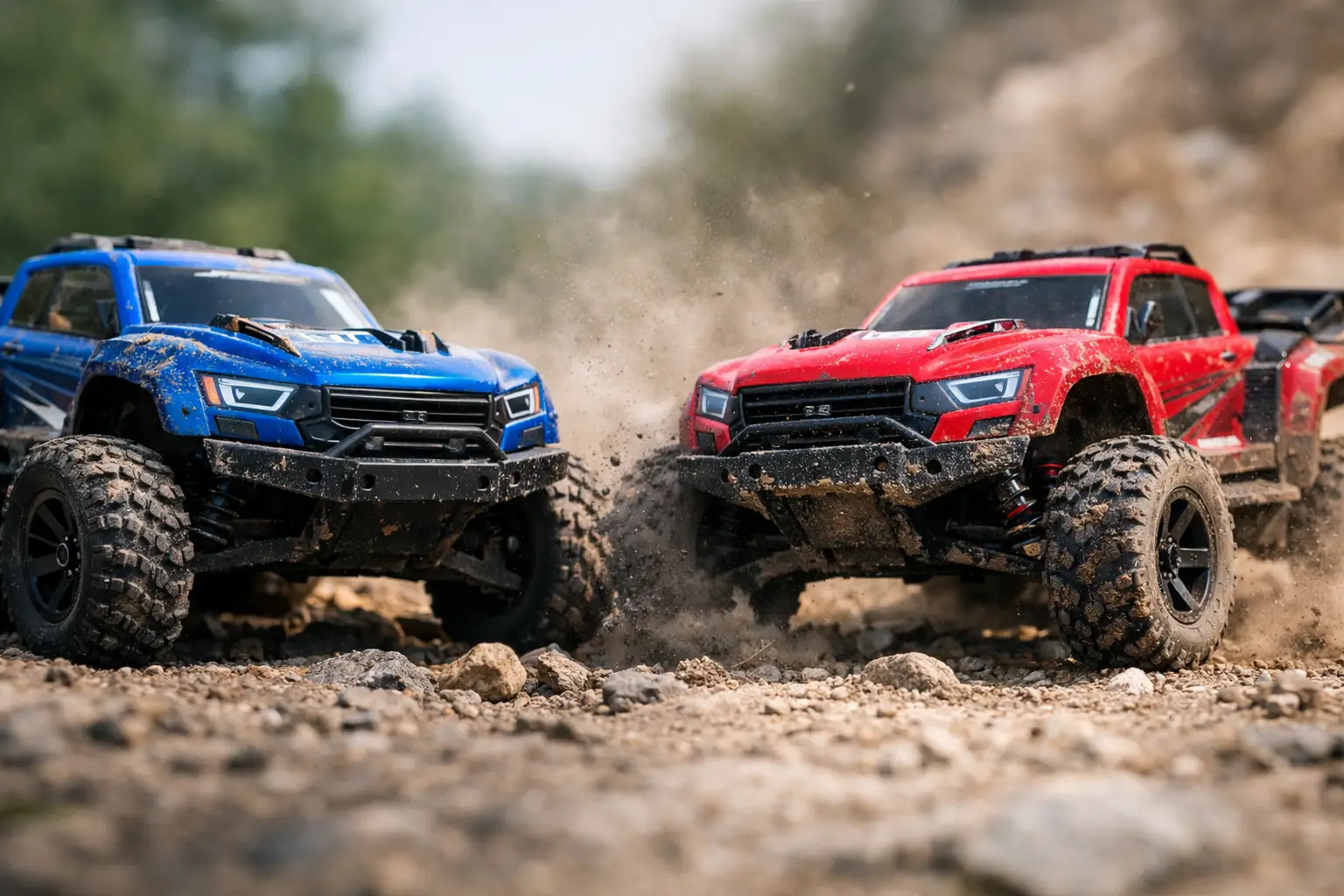
A snapped suspension arm at the skate park does not care which logo is on the body shell. Yet Traxxas vs ARRMA durability remains one of the most useful comparisons for anyone choosing a first serious basher or replacing an older RC car.
Both brands produce hobby-grade RC vehicles designed to be driven hard, repaired and driven again.
The real difference is not simply which badge is “stronger”. Durability depends on the individual model, scale, vehicle weight, battery voltage, terrain and how the car is driven.
A lightweight 1/10-scale 2WD model hitting a kerb experiences very different forces from a heavy 6S or 8S basher landing from a large jump.
If you are currently comparing the two brands, browse our ranges of ARRMA RC cars and Traxxas RC cars alongside this guide.
Traxxas vs ARRMA durability: the short answer
Neither brand is universally tougher.
Traxxas tends to put a strong emphasis on approachable ownership, flexible components, modular construction and extensive parts support.
ARRMA has built a strong reputation around powerful bashers, particularly within its 3S, 4S, 6S and larger platforms.
But comparing the brands properly means comparing equivalent vehicles.
A Traxxas Maxx should be compared with a similar high-performance basher rather than an entry-level ARRMA.
Likewise, an ARRMA Kraton 6S and a Traxxas Bandit are designed for completely different types of use.
What does RC durability actually mean?
Durability is about more than whether a car survives one spectacular crash.
A genuinely durable RC platform should also be practical to own.
That includes:
-
Suspension strength
-
Chassis strength
-
Drivetrain durability
-
Gear life
-
Bearing life
-
Electronics reliability
-
Parts availability
-
Ease of repair
-
Cost of common replacement parts
A model that occasionally breaks an inexpensive suspension arm but can be repaired quickly may be easier to live with than one that rarely breaks but requires a major strip-down when it does.
Traxxas durability
Traxxas has built much of its reputation around vehicles that are accessible to a wide range of drivers.
Popular platforms include:
-
Slash
-
Rustler
-
Stampede
-
Maxx
-
X-Maxx
-
XRT
Traxxas commonly uses engineering plastics extensively throughout its vehicles.
That is not automatically a weakness.
A well-designed plastic component can flex during an impact and absorb energy rather than immediately transferring the load into a more expensive component.
Suspension arms, bumpers and body mounts are obvious examples.
For normal bashing, a certain amount of flexibility can actually improve durability.
Traxxas modular construction
Another advantage on several Traxxas platforms is modular construction.
The front or rear assemblies on some models can be removed as larger sections, making drivetrain and suspension repairs easier to access.
For new RC owners, this can make maintenance less intimidating.
Ease of repair should be considered part of durability because every hobby-grade RC car will eventually need maintenance.
ARRMA durability
ARRMA is particularly well known for high-performance bashing.
Popular models include:
-
Granite
-
Vorteks
-
Big Rock
-
Typhon
-
Mojave
-
Kraton
-
Notorious
-
Outcast
ARRMA offers models covering everything from compact brushed vehicles through to extremely powerful large-scale brushless bashers.
Its 3S and 6S ranges in particular have become popular with drivers looking for high-performance off-road vehicles.
You can compare current ARRMA RC cars by scale, battery system and vehicle type before deciding which platform suits you.
ARRMA at higher power levels
As ARRMA models move into 4S, 6S and larger platforms, the complete vehicle becomes larger and heavier.
That allows the manufacturer to use larger drivetrain and suspension components, but it also creates much greater crash energy.
A 6S basher travelling quickly has considerably more mass and energy than a lightweight entry-level model.
That means a larger and apparently stronger vehicle can still suffer substantial damage during a poor landing.
No RC suspension arm, chassis brace or bulkhead is indestructible.
Traxxas vs ARRMA suspension durability
Both manufacturers design suspension systems around the intended use of each model.
Traxxas suspension
Traxxas suspension components often make good use of flexible engineering plastics.
That can help arms survive:
-
Cartwheels
-
Smaller jumps
-
Kerb impacts
-
General garden and park bashing
The ability for the component to flex slightly can prevent all of the impact energy being transferred directly into the chassis.
ARRMA suspension
ARRMA's larger bashers generally use substantial suspension components designed around heavier and faster vehicles.
Long suspension travel and wide tracks can make models such as the Kraton and Mojave extremely capable across rough terrain.
However, additional vehicle weight means poor landings generate more force.
Landing heavily on one wheel can still damage:
-
Suspension arms
-
Hubs
-
Turnbuckles
-
Driveshafts
-
Shock components
regardless of the brand.
Which is better for jumps?
The correct answer depends far more on the model than the manufacturer.
Both Traxxas and ARRMA produce vehicles capable of large jumps.
The biggest factors affecting survival are:
-
Vehicle weight
-
Landing angle
-
Jump height
-
Surface
-
Throttle position during landing
-
Suspension setup
-
Driver experience
A flat landing on all four wheels is very different from landing vertically on one front corner.
A stronger RC car does not remove the need to learn good jump control.
Drivetrain durability
Once power increases, drivetrain setup becomes increasingly important.
A brushed vehicle or modest 2S system generally places less load on gears, differentials and driveshafts than a powerful 3S, 4S or 6S system.
Our guide to brushed vs brushless RC motors explains why brushless systems can dramatically increase performance and drivetrain load.
With either brand, high-performance driving can place substantial stress on:
-
Pinion gears
-
Spur gears
-
Differentials
-
Driveshafts
-
Wheel hexes
-
Bearings
Durability therefore depends partly on maintenance.
ARRMA drivetrain strength
Higher-powered ARRMA models are designed with drivetrain components appropriate to their intended battery systems.
However, they still need sensible maintenance.
Useful checks include:
-
Gear mesh
-
Differential condition
-
Driveshaft wear
-
Wheel nut tightness
-
Bearings
-
Tyre condition
A worn bearing or loose wheel can create a failure that has little to do with the original strength of the vehicle.
Traxxas drivetrain strength
Traxxas also designs drivetrains around the intended power system of each vehicle.
Staying within the manufacturer's recommended battery, gearing and tyre specifications gives the drivetrain the best chance of remaining reliable.
Problems can arise when owners substantially increase:
-
Motor power
-
Battery voltage
-
Gearing
-
Tyre size
-
Tyre grip
without upgrading or monitoring the rest of the drivetrain.
That applies equally to ARRMA.
Power is one of the biggest causes of breakages
More power creates more stress.
This is particularly noticeable during:
-
Hard launches
-
Instant reverse inputs
-
Landing while applying throttle
-
Landing under braking
-
Wheelspin followed by sudden grip
A tyre spinning quickly in the air can suddenly transmit a large shock load through the drivetrain when it touches the ground.
Good throttle control can therefore improve drivetrain life regardless of whether the vehicle is Traxxas or ARRMA.
Tyres affect durability too
Tyres are often overlooked when discussing durability.
Larger or heavier tyres increase rotating mass.
High-grip tyres also transmit more torque into the drivetrain rather than allowing the tyre to slip.
Changing tyre size can affect:
-
Gearing
-
Motor temperature
-
ESC temperature
-
Driveshaft load
-
Differential load
Before fitting substantially larger wheels or tyres, consider their effect on the complete vehicle rather than treating them as a cosmetic upgrade.
Which brand has better parts availability?
Both Traxxas and ARRMA have excellent parts support for their major platforms.
This is one of the reasons both brands are popular with hobby-grade RC owners.
Traxxas has an enormous ecosystem of:
-
Genuine replacement parts
-
Upgrade parts
-
Aftermarket components
-
Accessories
and many of its major platforms have been supported for years.
ARRMA also has strong replacement-parts support across popular ranges, including its 3S and 6S platforms.
Our guide to buying RC car spare parts explains why checking exact model and part numbers matters.
Why parts availability matters
The toughest RC car in the world is not much fun if a small broken component leaves it parked for several weeks.
Before buying a vehicle, consider the availability of common parts such as:
-
Suspension arms
-
Hubs
-
Steering components
-
Driveshafts
-
Spur gears
-
Differential parts
-
Wheel hexes
-
Body shells
Being able to repair the vehicle quickly is an important part of hobby-grade ownership.
Is Traxxas better for beginners?
Traxxas can be an excellent choice for beginners.
Reasons include:
-
Straightforward RTR packages
-
Strong parts support
-
Familiar platforms
-
Modular construction on many models
-
Large aftermarket
-
Wide range of vehicle sizes
The integrated nature of many Traxxas packages can also make choosing compatible batteries and accessories relatively straightforward.
However, that does not mean ARRMA is unsuitable for beginners.
Is ARRMA good for beginners?
Yes, but choose the appropriate model.
A brushed ARRMA or lower-powered platform can be perfectly suitable for someone entering hobby-grade RC.
The mistake is assuming that a complete beginner needs to start with a powerful 6S basher simply because it is more expensive or impressive.
ARRMA's 3S range provides serious brushless performance and is better suited to drivers who have suitable space and some understanding of throttle control.
Traxxas vs ARRMA for skate parks
Skate parks are extremely demanding on RC cars.
Concrete provides almost no forgiveness during a poor landing.
Both Traxxas and ARRMA vehicles can be used in skate-park environments, but repeated large jumps onto concrete can damage any hobby-grade vehicle.
Smaller and lighter models generate less impact energy than heavy 6S or 8S vehicles.
If durability is the priority, focus on controlled jumps and good landings rather than simply choosing the heaviest or most powerful model.
Traxxas vs ARRMA for grass
Both brands offer excellent vehicles for grass.
For rougher surfaces, tyre diameter and ground clearance are important.
Monster trucks and larger bashers generally cope better with longer grass than low-slung buggies.
ARRMA models such as the Granite, Big Rock and Kraton and Traxxas platforms such as the Maxx and X-Maxx are examples of vehicles designed with substantial off-road capability.
The exact terrain should determine the model rather than the brand alone.
Traxxas vs ARRMA for high-speed bashing
ARRMA has a particularly strong reputation for powerful open-space bashing.
Its 3S, 4S and 6S ranges give drivers clear steps into increasingly serious performance.
Traxxas also offers extremely capable high-performance bashers, including the Maxx, X-Maxx and XRT families.
At this level, the question becomes less about brand and more about:
-
Vehicle scale
-
Price
-
Battery requirements
-
Running space
-
Replacement-part cost
-
Transport and storage
Large RC cars are impressive but require considerably more room to use properly.
Traxxas vs ARRMA repairability
Both manufacturers provide exploded diagrams and replacement components for their hobby-grade models.
Repair difficulty depends on the exact platform.
Before buying, it is worth looking at the parts diagram for the vehicle you are considering.
This gives you an idea of:
-
How assemblies are constructed
-
How many components are involved
-
What common crash parts cost
-
How easily parts can be accessed
Learning to repair the model yourself is a normal part of hobby-grade RC ownership.
How to make a Traxxas or ARRMA last longer
A surprising number of failures can be prevented through basic maintenance.
Before and after hard running, check:
-
Wheel nuts
-
Suspension arms
-
Steering links
-
Driveshafts
-
Bearings
-
Spur and pinion gears
-
Motor temperature
-
ESC temperature
-
Tyres
Remove grass, stones and other debris from the chassis.
A stone lodged around a driveshaft or drivetrain component can create significant resistance or physical damage.
Check bearings regularly
A rough bearing increases drag and can eventually damage surrounding parts.
Spin the wheels occasionally and listen or feel for roughness.
If the model has been used in wet or dusty conditions, inspect bearings more frequently.
A seized wheel bearing can quickly damage a hub or axle.
Watch motor and ESC temperatures
If you change:
-
Gearing
-
Battery voltage
-
Motor
-
Tyres
-
Vehicle weight
monitor the power system afterwards.
Higher load can increase motor and ESC temperature dramatically.
Cooling accessories may help a correctly geared vehicle, but they should not be used to hide a badly overloaded setup.
Upgrade known weak points, not everything
Our guide to the best RC upgrades for bashers covers the types of modifications that can genuinely improve a hard-used RC car.
The important point is to upgrade strategically.
Aluminium is not automatically better.
A plastic suspension arm may flex or break during a severe impact, but in doing so it may protect:
-
Bulkhead
-
Chassis
-
Differential housing
-
Other expensive parts
Replacing every flexible component with aluminium can simply move the failure somewhere else.
So which is tougher: Traxxas or ARRMA?
There is no honest universal winner.
If you compare the brands as a whole, you are comparing vehicles ranging from smaller entry-level models to extremely powerful large-scale bashers.
Traxxas is particularly strong when you value:
-
Ease of ownership
-
Parts availability
-
Straightforward maintenance
-
Wide platform choice
-
Extensive aftermarket support
ARRMA is particularly strong when you value:
-
High-performance bashing
-
Powerful brushless platforms
-
Stable handling at speed
-
Larger off-road vehicles
-
Clear progression through different power levels
The correct choice comes down to the individual model and how you intend to use it.
Frequently Asked Questions
Is ARRMA tougher than Traxxas?
Not across every model. ARRMA has a strong reputation for high-performance bashers, while Traxxas has several extremely durable platforms of its own. Compare equivalent models rather than brands as a whole.
Is Traxxas good for bashing?
Yes. Traxxas produces numerous vehicles designed for off-road and general bashing, ranging from smaller models through to the Maxx and X-Maxx families.
Are ARRMA cars durable?
Yes. ARRMA is well known for off-road bashers, particularly within its higher-performance ranges. Durability still depends on driving style, maintenance and the exact model.
Which is easier to repair, Traxxas or ARRMA?
Both have strong parts support and detailed exploded diagrams. Repair difficulty depends on the individual platform, although Traxxas uses modular construction on several popular models.
Which is better for a beginner?
Either brand can work well. A lower-powered model is usually a more sensible first choice than immediately buying a heavy 6S or 8S vehicle.
Which is better for big jumps?
Both brands produce vehicles capable of large jumps. Scale, vehicle weight, suspension design and the quality of the landing matter more than the badge on the body.
Which has better spare-parts support in the UK?
Both ARRMA and Traxxas have extensive replacement-parts support. Before buying, check availability for the exact model you are considering rather than assuming every part for every vehicle is permanently stocked.
Should I upgrade plastic suspension arms to aluminium?
Not automatically. Plastic components can flex and absorb impact energy. Aluminium may transfer that energy into a more expensive component. Upgrade only where there is a genuine weakness you want to address.
Shop Traxxas and ARRMA RC cars in the UK
Both brands produce excellent hobby-grade RC cars, but the right choice depends on where and how you intend to drive.
Choose according to:
-
Terrain
-
Vehicle scale
-
Battery system
-
Available space
-
Driver experience
-
Repair budget
-
Desired performance
Browse our current Traxxas RC cars and ARRMA RC cars to compare the available platforms.
If you are deciding between two specific Traxxas and ARRMA models, contact us with the exact models and where you intend to drive them and we can help compare the two properly.
Written by RC Model Shop
This article was written by the team at RC Model Shop, one of the UK’s leading specialists in hobby-grade radio-controlled vehicles.
With years of hands-on experience selling, repairing and maintaining RC cars, crawlers, boats and aircraft, we regularly help customers choose models that suit their experience, available driving space and the type of terrain they actually use.
Our experience with Traxxas and ARRMA goes beyond comparing specifications. We deal with replacement parts, drivetrain components, suspension repairs, batteries, chargers and upgrades, giving us a practical understanding of how different RC platforms stand up to real-world use and what is involved when something eventually needs repairing.
Whether you are buying your first hobby-grade RC car, moving up to a more powerful brushless basher or deciding between two competing models, our aim is to help you choose a vehicle that you can enjoy, maintain and repair for years to come.
For expert advice, contact the team at RC Model Shop or browse our ranges of Traxxas RC cars and ARRMA RC cars.