
Short Course Versus Monster Truck: Which RC Fits?
20/09/2026
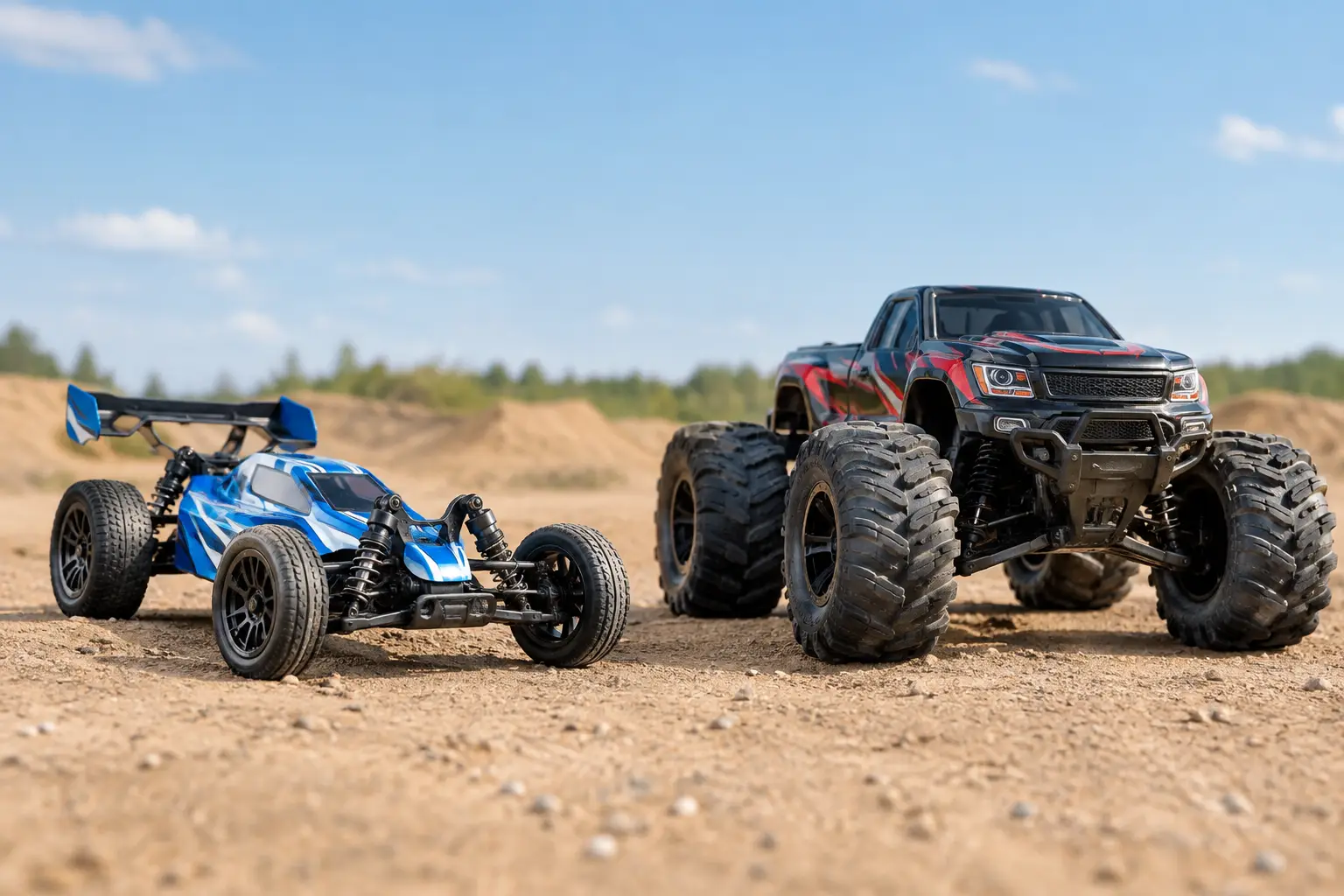
A loose gravel car park, a muddy field or the back garden can make almost any RC look tempting. The real question in the short course versus monster lorry choice is not which one is more exciting - both are - but which one will suit where and how you actually want to drive. Pick the right format and you will spend more time running packs, less time fighting the terrain, and have a model that still feels right after the first few weekends.
Short Course Versus Monster Lorry: The Core Difference
Short course lorries are modelled on full-size off-road racing lorries. They use enclosed, pickup-style bodies over a relatively low and wide chassis, with wheels tucked beneath the arches. The result is a purposeful, planted RC that tends to look at home carving across loose dirt, grass tracks and hard-packed surfaces.
Monster lorries take a different route. Oversized tyres, generous ground clearance and a higher ride height are the defining features. They are built to drive over the things that stop smaller models: ruts, stones, tufts of grass, kerbs and the uneven edges of a bashing spot. Their stance is less about neat racing lines and more about getting through whatever is in front of them.
Neither layout is automatically better. A short course lorry rewards a smoother trigger finger and thoughtful corner entry. A monster lorry makes rough ground accessible and encourages the sort of driving where a mound of soil looks like a launch ramp.
How They Feel Behind the Transmitter
The difference becomes clear within the first few turns. A short course lorry usually feels lower, more settled and more predictable when pushed through a corner. Its wider body can catch the eye, but the chassis is generally designed to keep mass low. On compact dirt, gravel and short grass, that helps it change direction with confidence rather than leaning heavily onto the outside wheels.
Short course bodies also have a practical benefit for casual bashing. They cover much of the chassis and help keep some dirt, small stones and spray away from the electronics. They will not make a model waterproof or maintenance-free, but there is often less exposed hardware to clean after a wet, gritty run.
A monster lorry feels more physical. Large tyres absorb bumps that would unsettle a lower lorry, and the extra clearance means you can keep driving when the ground becomes uneven. It is a very forgiving character for newer drivers, particularly on rough grass. The trade-off is that a taller model has more body roll and is easier to traction-roll in a fast turn. On high-grip ground, a sharp steering input can put it on its roof surprisingly quickly.
That is not necessarily a drawback. Many drivers enjoy the challenge and the spectacle. It simply means monster lorries are generally happier being driven in wider arcs than being treated like a race lorry.
Match the Model to Your Usual Running Spot
Your local terrain should carry more weight than top-speed figures or body style. If you mainly run at a BMX-style dirt area, a firm field, a gravel track or a large open car park, a short course lorry makes a strong case. It is easier to place accurately, holds a line well and feels composed when you build speed.
For long grass, woodland paths, uneven gardens and ground littered with roots or loose stones, a monster lorry is normally the safer choice. Short course lorries can run on grass, but they need the surface to be short and fairly even. Once the grass reaches chassis height, it creates drag, strains the drivetrain and can make the motor work harder than it should.
Think about space, too. A monster lorry can make a modest patch of rough ground entertaining because every bump and rise becomes part of the run. A short course lorry benefits from more room to stretch its legs. It is often more satisfying when there is enough open space to set up corners and carry momentum.
Wet UK conditions also deserve a realistic mention. Water-resistant electronics are useful, but mud, standing water and damp grass still increase wear. Large monster tyres can fling more debris into every corner of the chassis. An enclosed short course body offers a little more shielding, although it can hold mud underneath if it is not removed and cleaned afterwards. In either case, dry the model after use and check the bearings, gears and connectors before the next pack.
Jumps, Bashing and Breakages
For big, casual jumps, monster lorries have the obvious advantage. Their tyres provide extra cushioning on landing, while the chassis clearance reduces the chance of grounding out. They also tend to clear rough run-ups more easily, so you are less likely to lose speed before the ramp.
However, bigger tyres create more rotating mass. That adds stress to axles, wheel hexes, driveshafts and steering components, especially when landing under power or clipping an obstacle at speed. A powerful monster lorry is tough, not indestructible. Repeated flat landings will find the limits of any model.
Short course lorries are excellent for smaller jumps and smoother jump faces. Their lower stance can make them easier to control in the air, particularly when the take-off is predictable. They are less forgiving of deep ruts on the landing side, though, and the body shell can take cosmetic damage from rollovers, scuffs and hard impacts.
If bashing is your priority, do not judge durability by tyre size alone. Check whether replacement arms, suspension parts, body shells, wheel sets and drivetrain components are readily available. A model with strong parts support is usually a better long-term buy than a cheap option that becomes difficult to repair after one awkward impact.
Batteries, Speed and Ongoing Costs
Vehicle size and power system affect the practical side of ownership. Both short course and monster lorries are available in a range of scales, from compact models suited to gardens through to larger, high-power machines that need a proper open area. A larger vehicle often means larger batteries, a more capable charger and higher costs when tyres or bodywork eventually need replacing.
Do not assume a monster lorry is slower. Many are extremely quick, particularly on higher-voltage LiPo batteries. The difference is how that speed is used. A short course lorry tends to feel more controlled at pace on a flatter surface, while a monster lorry uses its power to carry through rough sections and accelerate out of loose terrain.
For a first RC, a brushed model or a sensibly powered brushless package can be the better route than chasing maximum speed. Look for adjustable speed settings, sensible battery availability and a charger that matches the battery type. A good set-up gives you more useful running time and fewer preventable problems than simply fitting the biggest battery the battery tray will accept.
Tyres are another cost worth considering. Monster tyres are larger and can be more expensive to replace, while their extra grip and weight may wear drivetrain parts faster when a vehicle is driven hard. Short course tyres are generally better suited to mixed compact surfaces, but the body shell is a regular consumable for drivers who enjoy close racing or barrier-heavy bashing spots.
Which Is Better for Beginners?
A monster lorry is often the easiest recommendation for a beginner with a rough garden or an uneven local field. It gets over obstacles, does not demand a perfectly prepared surface and is entertaining at sensible speeds. If the model rolls over, the high stance can also make it easier to see and retrieve.
A short course lorry may be the better first choice for someone who wants to learn control rather than simply charge across rough ground. Its more planted handling helps new drivers understand braking points, steering inputs and throttle control. It can also be a good choice for a younger driver using a speed-limited transmitter, provided there is a reasonably flat place to run it.
Age is only part of the decision. A careful adult beginner with a compact garden may have more fun with a smaller short course model, while an experienced younger hobbyist with access to a field may be ready for a capable monster lorry. Choose for the driver, the available space and the willingness to clean and maintain the vehicle.
Make the Choice That Keeps You Running
Choose a short course lorry if you want sharper handling, a race-inspired look and a model that feels at its best on firm dirt, gravel, short grass and open spaces. Choose a monster lorry if your running ground is rough, grassy or unpredictable, and you want clearance, big-tyre traction and a more free-form bashing experience.
Before ordering, consider the batteries you will need, the space available for safe running and the replacement parts you may eventually want. RC Model Shop can help match a vehicle, battery and charger to the way you plan to drive. The best model is the one that makes you look forward to the next dry patch, the next charged pack and the next excuse to head outside.