
Best RC Cars for Bashing: 10 Tough Models Built for Speed, Jumps and Everyday Fun
12/06/2026
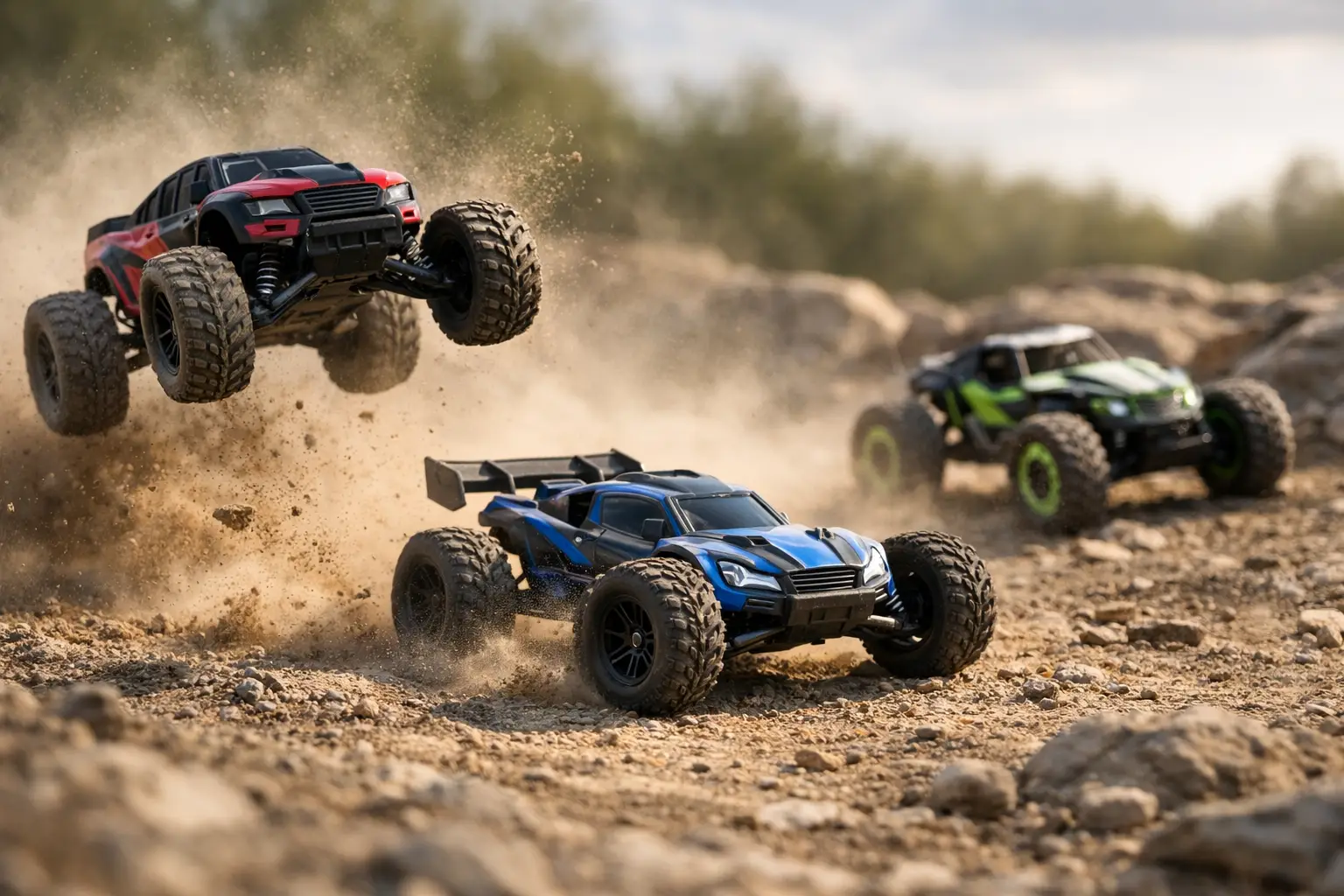
If you've ever launched an RC car off a dirt mound, clipped a kerb at full throttle or sent a monster truck flying across a rough field, you'll already know that not every RC model is built to handle serious punishment. Some cars look impressive on paper but spend more time on the workbench than on the ground. Others simply keep coming back for more.
That is why choosing the best RC cars for bashing is about much more than top speed. Durability, spare parts support, handling and ease of maintenance all play a major role in determining whether a model remains fun long after the first battery pack.
Whether you are looking for your first brushless basher or upgrading to a larger 6S or 8S machine, this guide covers some of the best RC cars currently available for rough terrain, jumps, grass, gravel and everyday off-road abuse.
Shop Popular RC Bashers
-
ARRMA RC Cars: https://www.rcmodelshop.co.uk/brands/725/arrma
-
Traxxas RC Cars: https://www.rcmodelshop.co.uk/brands/691/traxxas
-
Corally RC Cars: https://www.rcmodelshop.co.uk/brands/801/corally
-
Monster Trucks: https://www.rcmodelshop.co.uk/products/510/cars?searchField=monster+truck
What Makes a Good RC Basher?
The best bashers all share a few important characteristics.
Strong Drivetrain Components
Power is great fun, but only if the drivetrain can survive repeated use. Strong differentials, driveshafts and gearboxes help ensure the vehicle spends more time driving and less time being repaired.
Good Ground Clearance
Most UK bashers spend time on grass, gravel, dirt and uneven surfaces. Larger tyres and increased ground clearance allow a vehicle to handle rough terrain more effectively.
Readily Available Spare Parts
Even the toughest RC car will eventually need replacement parts. Choosing a popular platform means suspension arms, hubs, body mounts and drivetrain components are easy to source when needed.
Suitable Power System
For many drivers, a 3S brushless system offers the ideal balance of performance and affordability. Larger 6S and 8S vehicles provide incredible speed but generally require larger budgets for batteries, chargers and maintenance.
10 Best RC Cars for Bashing
1. ARRMA Kraton 6S EXB
The ARRMA Kraton 6S EXB has earned a reputation as one of the toughest bashers available. Built around ARRMA's Extreme Bash platform, it features upgraded components designed specifically for aggressive driving.
Large suspension travel, excellent stability and huge power potential make it ideal for rough terrain, high-speed runs and large jumps.
Why it stands out:
-
Extreme Bash upgraded chassis
-
Excellent high-speed stability
-
Huge aftermarket support
-
Suitable for serious bashing enthusiasts
2. Traxxas X-Maxx 8S
Few RC vehicles create as much excitement as the X-Maxx. Massive tyres, enormous ground clearance and incredible durability have helped make it one of the most popular large-scale bashers ever produced.
The X-Maxx thrives in open spaces where its size and power can truly be appreciated.
Why it stands out:
-
Huge 8S power system
-
Outstanding durability
-
Massive jumping capability
-
Excellent parts availability
3. Corally Kagama XP 6S
The Kagama XP offers a superb blend of monster truck durability and truggy-like handling. Its powerful 6S system provides serious performance while maintaining impressive control over rough surfaces.
For drivers wanting something slightly different from the mainstream options, the Kagama deserves serious consideration.
Why it stands out:
-
Powerful 6S brushless setup
-
Stable handling characteristics
-
Strong suspension design
-
Excellent value for performance
4. ARRMA Notorious 6S
If your idea of bashing includes wheelies, backflips and outrageous stunts, the Notorious delivers exactly that.
Its shorter wheelbase and stunt truck layout make it one of the most entertaining vehicles in ARRMA's lineup.
Why it stands out:
-
Wheelie-friendly design
-
Strong 6S platform
-
Great stunt performance
-
Extremely entertaining to drive
5. Traxxas Maxx
Many hobbyists consider the Maxx to be the perfect compromise between size, durability and practicality.
It provides much of the toughness associated with the larger X-Maxx while remaining easier to transport and more affordable to run.
Why it stands out:
-
Excellent durability
-
Powerful brushless system
-
Easier to transport than larger models
-
Fantastic all-round basher
6. ARRMA Outcast 4S
The Outcast 4S sits perfectly between beginner-friendly platforms and full-size 6S monsters.
It delivers excellent performance while keeping running costs more manageable than larger vehicles.
Why it stands out:
-
Great value performance
-
Strong 4S platform
-
Excellent stunt capability
-
Easier to control than larger 6S models
7. Traxxas Hoss 4X4 VXL
The Hoss combines monster truck capability with a responsive and agile driving experience.
Its large Sledgehammer tyres provide excellent grip across grass, dirt and gravel while maintaining impressive handling.
Why it stands out:
-
Excellent ground clearance
-
Strong brushless performance
-
Good balance of speed and control
-
Great all-terrain capability
8. Traxxas Rustler 4X4 VXL
The Rustler 4X4 remains one of the most versatile RC vehicles on the market.
It offers excellent handling, strong acceleration and broad upgrade potential, making it suitable for both new and experienced drivers.
Why it stands out:
-
Excellent handling
-
Huge upgrade ecosystem
-
Reliable 4WD platform
-
Great long-term ownership experience
9. Traxxas Mini Maxx
Not everyone needs a giant monster truck. The Mini Maxx offers impressive durability and performance in a compact package.
It is easy to transport, easy to store and can be run in areas that would be unsuitable for larger vehicles.
Why it stands out:
-
Compact size
-
Excellent portability
-
Durable construction
-
Beginner-friendly operation
10. ARRMA Quake Grom
The Quake Grom proves that small-scale RC cars can still deliver big fun.
Affordable, tough and highly portable, it is an excellent choice for newcomers and experienced hobbyists alike.
Why it stands out:
-
Compact and portable
-
Durable Grom platform
-
Great value for money
-
Ideal for smaller driving areas
How to Choose the Right RC Basher
Before buying, think about where you will actually drive most often.
Smaller Parks and Gardens
Compact models such as the Mini Maxx and Quake Grom are often more enjoyable because they can be driven safely in smaller spaces.
Large Open Fields
Vehicles such as the X-Maxx, Kraton 6S EXB and Kagama XP really come alive when they have room to stretch their legs.
First-Time Buyers
For beginners, models like the Rustler 4X4, Hoss and Outcast 4S often provide the best balance between performance, durability and running costs.
Experienced Drivers
If you're already comfortable with high-powered brushless vehicles, stepping up to a Kraton 6S, Notorious 6S or X-Maxx can unlock a completely different level of performance.
Built for Fun, Built to Take a Beating
The best RC basher is not necessarily the fastest or most expensive model. The right choice is the one that matches your budget, driving area and expectations while remaining durable enough to survive regular use.
Whether you want a compact monster truck for local parks or an 8S giant capable of huge jumps and incredible speed, there has never been a better selection of bash-ready RC vehicles available.
Invest in a platform with good parts support, suitable batteries and proven durability, and you'll spend far more time driving than repairing.
Frequently Asked Questions
What is the best RC car for bashing?
Many enthusiasts consider the ARRMA Kraton 6S EXB, Traxxas Maxx and Traxxas X-Maxx to be among the best bashers currently available due to their durability, performance and spare parts support.
Is 3S or 6S better for bashing?
For most hobbyists, 3S and 4S systems offer the best balance of speed, durability and affordability. 6S systems provide significantly more power but usually require larger driving areas and higher running costs.
Are monster trucks better than truggies for bashing?
Monster trucks generally offer better ground clearance and rough-terrain capability, while truggies often provide greater stability and control at higher speeds.
What breaks most often on RC bashers?
Suspension arms, body mounts, steering components and drivetrain parts typically experience the most wear during heavy bashing. Fortunately, these parts are usually inexpensive and easy to replace on popular platforms.
What batteries do I need for a basher?
The correct battery depends on the vehicle. Always follow the manufacturer's recommendations regarding cell count, connector type and battery dimensions to ensure safe operation and maximum performance.
Written by the RC team at RC Model Shop / Appliance Electronics UK Ltd. For advice on RC cars, batteries, chargers, upgrades and spare parts, visit rcmodelshop.co.uk or call 01922 494608.