
RC Motor Temperature: Safe Limits and Fixes
21/11/2026
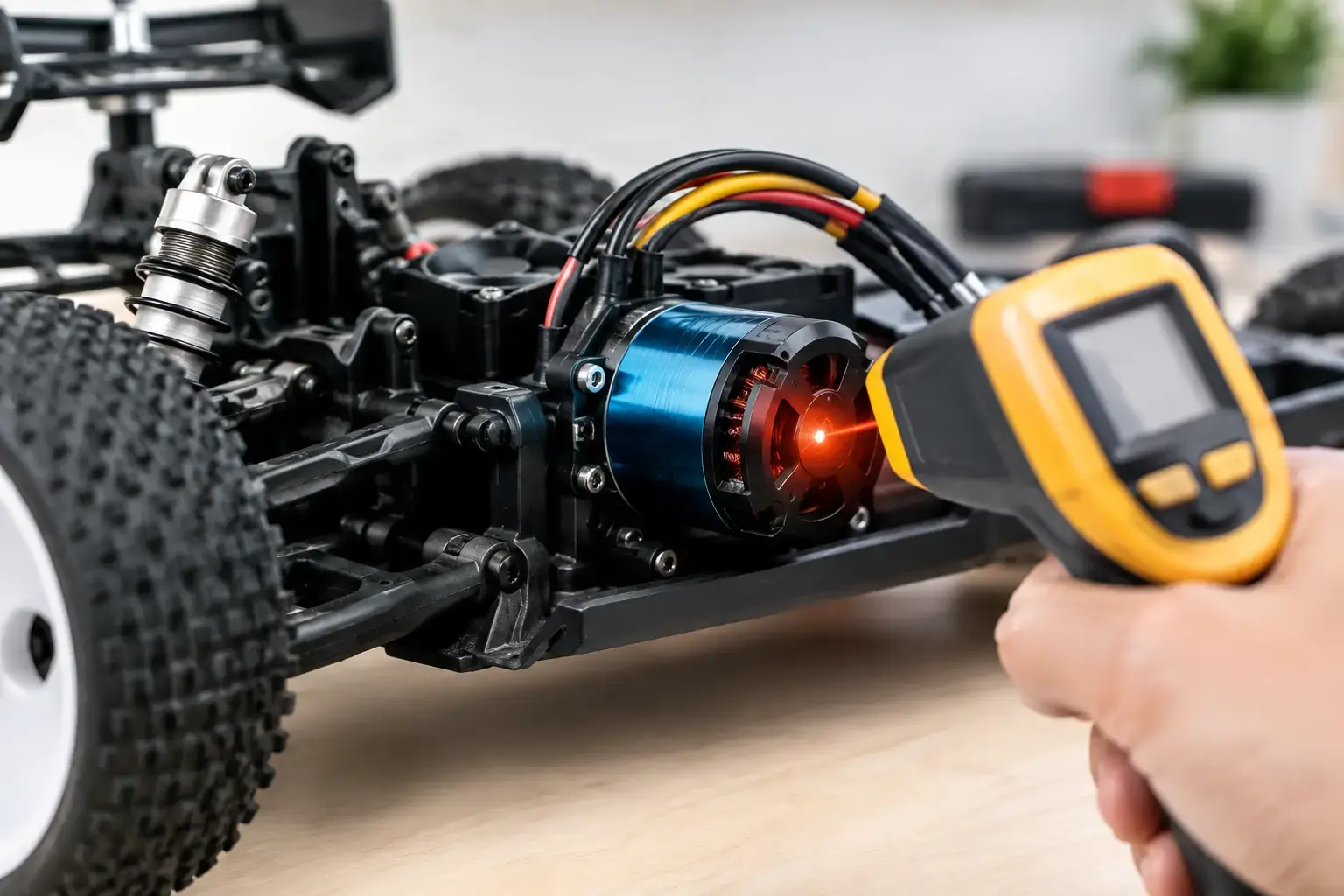
A fast RC car that comes back after five minutes with a motor too hot to touch is not simply performing well. High RC motor temperature is usually your model telling you that the motor, gearing, battery or driving conditions are asking too much of the system. Ignore it for long enough and you can shorten motor life, damage the ESC or turn a straightforward setup issue into an expensive repair.
The good news is that overheating is normally traceable. A few temperature checks and sensible changes can make a model quicker to run, more reliable and far more enjoyable between battery packs.
What RC motor temperature is safe?
For most electric RC cars, it is sensible to aim for a motor case temperature of around 60-70°C after a normal run. A brief reading in the 70-80°C range may be acceptable for some quality brushless systems, especially in warm weather or competitive use, but it should prompt a closer look at the setup. Once the motor case is regularly above 80°C, stop and investigate before the next pack.
There is no single number that applies to every model. Motor size, whether it is brushed or brushless, the ESC rating, vehicle weight, gearing, battery voltage and airflow all matter. Always treat the motor and ESC manufacturer guidance as the final word where it is available.
Also remember that the outside of the can is cooler than the windings inside it. A motor that reads 80°C on its case may be much hotter internally. That is why repeatedly running at the upper limit is a poor strategy, even if the model has not yet shut down.
The ESC deserves the same attention. If the motor is cool but the ESC is hot, the issue may be an ESC working beyond its comfortable current range, poor airflow, an aggressive punch setting or a drivetrain that is binding. Check both components rather than assuming the motor is always at fault.
Measure temperature properly
A small infrared temperature gun is one of the most useful tools in an RC pit bag. Take a reading as soon as the model stops, aiming at the centre of the motor can rather than the end bell. Check the ESC heat sink too. Waiting even a minute can make the figures look safer than they really were.
The finger test is useful only as a rough warning. If you cannot keep a finger on the motor for more than a second or two, it is too hot to continue running. It cannot tell you whether the case is 70°C or 95°C, however, and that difference matters.
For meaningful results, test in the conditions you actually drive in. A quick blast across short grass tells you little about a full pack on a bumpy field, a loose BMX-style track or a high-grip car park. Write down the pinion, spur gear, battery, outside temperature and readings after each change. It takes little effort and prevents random setup changes.
Why does RC motor temperature rise?
Gearing is the first place to look. A larger pinion gear makes the vehicle faster in theory, but it also loads the motor harder. An excessively small spur gear can have the same effect. Tall gearing is tempting when chasing top speed, yet it can turn a manageable setup into an overheated one within a single battery pack.
Vehicle load is just as important. Long grass, deep gravel, soft sand, mud and repeated full-throttle acceleration all demand more torque than smooth tarmac. Large tyres, heavy beadlock wheels and added scale accessories can also increase the load substantially. A crawler that creeps around obstacles may appear gentle, but a stalled or near-stalled motor can pull serious current.
Drivetrain resistance is another common cause. Check that the wheels spin freely, bearings are smooth, the gear mesh is not too tight and no stone is trapped around the spur gear or driveshafts. On a new model, inspect the mesh before the first hard run. After a muddy session, clean and dry the drivetrain before assuming an electronic upgrade is needed.
Battery choice can expose an existing problem. Moving from 2S to 3S, or fitting a higher-discharge battery, gives the system more potential power. If the gearing and cooling were already marginal, temperatures can rise sharply. More voltage is not automatically a problem, but it often requires a more conservative pinion choice and closer monitoring.
Fix an overheating RC motor in the right order
Start by reducing the pinion gear by one or two teeth, then run the same test route and recheck the motor and ESC. This is usually the most effective change because it reduces the load throughout the run. Do not make several changes at once or you will not know what solved the issue.
Next, inspect the drivetrain with the motor disconnected or the pinion removed. The transmission should turn smoothly without tight spots. Replace rough bearings, correct overtightened wheel nuts, clear debris and set a sensible gear mesh. The gears need a small amount of free movement; forcing them tightly together creates heat and unnecessary wear.
Then consider how the model is being used. A 1/10 scale basher geared for tarmac speed may need a smaller pinion for grass. A monster truck with oversized tyres may need lower gearing than the standard wheels allowed. If you regularly run in hot summer weather, leave more temperature margin rather than tuning right up to the limit on a cool day.
Cooling upgrades can help, but they should support a sound setup rather than hide a problem. A motor heat sink and fan can be worthwhile where space permits, while an ESC fan helps when the ESC is the hotter component. Keep fan blades and heat sink fins clean, and make sure body shells have enough airflow. Cutting vents can reduce heat, but position them carefully to avoid letting excessive dirt and water directly into the electronics.
For racing or high-powered bashers, ESC settings are worth checking. Excessive punch, aggressive timing and high turbo settings can raise current draw and heat. Reducing timing or punch may slightly soften the initial response, but it can make the car more consistent over a whole run. The best setting depends on the surface, motor and driving style, so test rather than guessing.
Brushed, brushless and crawler considerations
Brushed motors naturally wear and can run hot when brushes, commutator or bearings are tired. If a brushed motor has suddenly become hotter and slower, inspect it for contamination and wear. In many ready-to-run models, replacing a worn brushed motor is more practical than trying to restore it.
Brushless systems are efficient, but they are not immune to heat. Sensorless brushless motors can run particularly hot when repeatedly driven at very low speed under heavy load. If the model judders or coggs before moving, do not hold full throttle until it clears. Use smoother throttle inputs, revise the gearing or consider a sensored system where precise low-speed control is the priority.
Crawlers need a different mindset from speed-run cars. Wheel weights, portals, sticky tyres and steep climbs can place heavy demand on the motor even at walking pace. A motor may be working hardest when the vehicle is wedged against a rock with the throttle held open. Back off, choose another line and let the drivetrain recover rather than forcing the model through.
When a hotter motor points to a bigger mismatch
If lower gearing, a free-running drivetrain and adequate cooling still leave temperatures high, the system may simply be underspecified for the model. This can happen after fitting heavier wheels, increasing voltage, converting to a more powerful motor or running a vehicle in conditions far tougher than its original design brief.
A larger motor, a more capable ESC or a better-matched motor and gearing combination may be the sensible answer. It is worth choosing parts as a system rather than selecting the highest kv motor or biggest battery on the shelf. Higher kv generally means higher motor speed per volt, but it does not automatically mean a better result in a heavy vehicle.
At RC Model Shop, practical setup advice starts with the model, battery voltage, current gearing and where you drive it. Those details make it much easier to identify whether you need a pinion change, cooling hardware, replacement bearings or a properly matched power upgrade.
Check temperatures after each meaningful change, especially on the first full pack. A motor that finishes a hard run comfortably warm rather than painfully hot gives you more than reliability - it gives you a model you can run again without wondering what will fail next.