
Best Brushless Motor Combo for RC Cars
15/05/2026
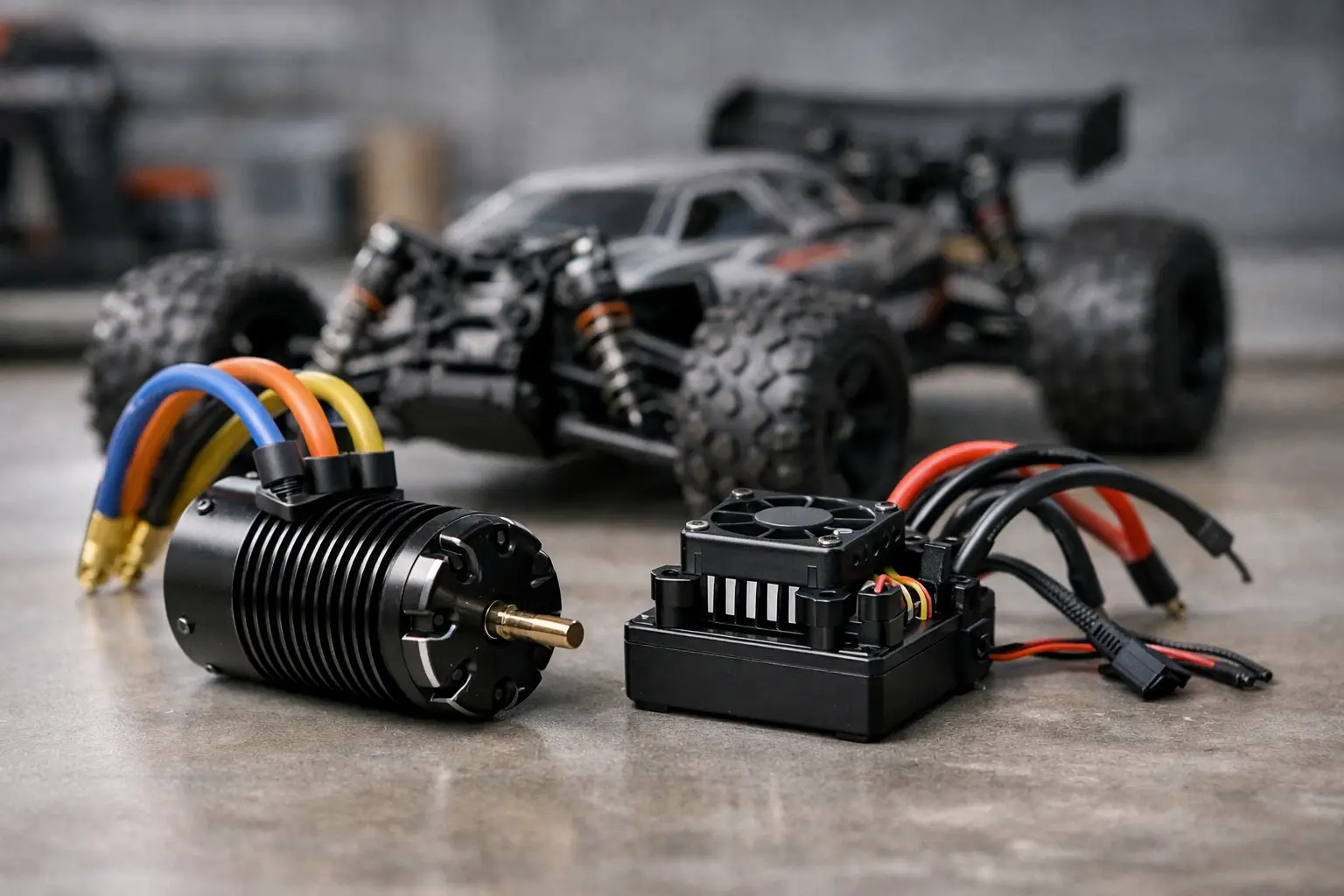
Best Brushless Motor Combo for RC Cars - What Actually Matters?
A brushless setup can transform an RC car from decent to genuinely quick, but the best brushless motor combo is not always the one with the biggest numbers on the box.
If the kV is too high, the ESC is undersized or the gearing is wrong, you can end up with:
-
excessive heat
-
shorter runtime
-
poor drivability
-
unnecessary drivetrain wear
For most buyers, the right combo is the one that suits the vehicle, battery and driving style without creating avoidable problems.
Whether you run a 1/10 basher, a heavy 1/8 truggy or a technical crawler setup, choosing the right electronics matters far more than simply chasing maximum speed.
What makes a good brushless motor combo?
A motor and ESC combo works properly when the components are correctly matched and realistically suited to the chassis.
That sounds obvious, but it is where most buying mistakes happen.
Many people focus on top speed first, then realise:
-
the motor can is too large
-
the ESC overheats
-
the gearing is too aggressive
-
the connectors do not match the batteries
-
the drivetrain cannot handle the load
The motor creates the power characteristics, while the ESC controls how that power is delivered.
A good combo provides:
-
smooth throttle response
-
dependable temperatures
-
sensible runtime
-
enough overhead for your intended battery setup
That means checking:
-
motor size
-
kV rating
-
ESC amp rating
-
battery voltage
-
connector type
-
sensor compatibility
before buying.
RC Model Shop stocks a wide range of RC electronics including brushless motors, ESCs and servos suitable for bashers, crawlers and racing setups.
Start with the vehicle class first
The best brushless motor combo for a 1/10 touring car is rarely the best choice for a heavy crawler or 1/8 monster truck.
Vehicle weight, terrain, tyre size and drivetrain load all affect what works best.
1/10 scale on-road and light off-road setups
For many 1/10 scale RC cars, a 3650-sized motor paired with a suitable ESC is the most common starting point.
This works well for:
-
touring cars
-
stadium trucks
-
2WD bashers
-
lightweight 4WD platforms
A moderate kV setup on 2S LiPo is often the best all-round combination for UK conditions. It provides:
-
strong acceleration
-
manageable temperatures
-
better runtime
-
improved control
without making the car difficult to drive.
For drivers who prioritise smoothness and throttle precision over outright speed, sensored systems are often worth considering.
You can browse a large selection of 1/10 RC cars and compatible upgrade platforms suitable for brushless upgrades.
1/8 buggy, truggy and monster truck setups
Heavier 1/8 vehicles place much greater load on electronics.
This usually means:
-
larger motors
-
higher-capacity ESCs
-
more conservative gearing
-
stronger cooling requirements
A 4068-sized motor or similar is commonly used in:
-
truggies
-
monster trucks
-
heavy bashers
This is also where underspecifying the ESC becomes expensive very quickly.
A setup that seems fine on paper can overheat rapidly when running:
-
grass
-
gravel
-
loose dirt
-
repeated full-throttle acceleration
For bashing, it is usually smarter to choose an ESC with additional current headroom rather than constantly running near its limit.
Crawlers and scale trail trucks
Crawlers are completely different from speed-focused RC builds.
For crawlers, low-speed control matters far more than top-end pace.
The best brushless motor combo for crawling is usually:
-
sensored
-
lower kV
-
smooth at startup
-
strong on drag brake control
Throttle precision matters much more than outright speed.
Platforms such as the Traxxas TRX-4 and Axial SCX10 often benefit greatly from smoother sensored systems with predictable throttle modulation.
Understanding kV and battery voltage properly
kV tells you how many RPM the motor attempts to produce per volt without load.
Higher kV generally means:
-
more potential speed
-
less efficient torque delivery
-
increased heat risk
Lower kV generally means:
-
smoother power delivery
-
better torque
-
cooler operation
-
improved drivability
That does not automatically mean lower kV is slower in real-world driving.
A lower-kV setup running correctly geared on higher voltage can often outperform an overly aggressive high-kV setup struggling with heat.
Battery choice matters just as much as the motor itself.
For many UK RC owners, 2S LiPo remains the most practical option for 1/10 vehicles because it:
-
keeps temperatures manageable
-
reduces drivetrain stress
-
improves control
-
still provides excellent speed
Moving to 3S can make sense, but only if:
-
the drivetrain supports it
-
gearing is adjusted correctly
-
temperatures remain safe
RC Model Shop stocks a large range of LiPo batteries and RC battery upgrades suitable for both 2S and 3S brushless systems.
Sensorless vs sensored brushless systems
This is one of the most important decisions for many buyers.
Sensorless systems
Sensorless systems are:
-
more affordable
-
simpler
-
common in bash-ready setups
-
excellent value for casual use
For many hobbyists, sensorless remains the best value option.
Sensored systems
Sensored setups use a sensor wire between the ESC and motor to improve timing accuracy at low speed.
This gives:
-
smoother startup
-
cleaner throttle response
-
better technical control
-
improved low-speed precision
For:
-
racing
-
crawling
-
technical driving
the extra cost is often worthwhile.
Neither system is automatically better for everyone. The correct choice depends on how the vehicle is actually used.
The ESC matters just as much as the motor
One of the most common mistakes is overspending on the motor while compromising on the ESC.
If reliability matters, the ESC should never be treated as an afterthought.
You should check:
-
continuous amp rating
-
supported battery voltage
-
BEC specification
-
programmability
-
waterproofing
A stronger BEC becomes especially useful with:
-
larger servos
-
crawlers
-
heavy bashers
-
high-load steering systems
Programming options also matter more than many beginners realise. Adjustable:
-
punch
-
timing
-
drag brake
-
low-voltage cutoff
can dramatically improve drivability and temperature management.
Gearing can make or break a brushless setup
Even the best brushless motor combo can perform badly with incorrect gearing.
Overgearing is one of the fastest ways to create:
-
overheating
-
ESC thermal shutdown
-
drivetrain wear
-
reduced reliability
If upgrading from brushed, start conservatively.
A slightly smaller pinion gear usually:
-
runs cooler
-
reduces stress
-
makes testing safer
-
improves consistency
You can then increase gearing gradually once temperatures are confirmed safe after full runs.
RC Model Shop stocks a range of RC pinion gears and gearing upgrades suitable for many popular RC platforms.
Common brushless upgrade mistakes to avoid
The biggest mistake is buying purely based on kV numbers.
High numbers look impressive in product titles, but they are not automatically better.
Other common mistakes include:
-
ignoring physical fitment
-
using incorrect gearing
-
upgrading battery voltage without adjusting setup
-
underspecifying the ESC
-
poor cooling setup
-
weak drivetrain components
It is also important to think about:
-
spare availability
-
replacement fans
-
sensor wires
-
programming support
Good long-term support can make ownership far easier.
So what is the best brushless motor combo overall?
For most 1/10 RC cars, the best all-round setup is usually:
-
moderate kV
-
correctly geared
-
quality ESC
-
enough thermal headroom
-
matched properly to 2S or 3S LiPo
For casual bashing, sensorless systems often provide the best value.
For:
-
racing
-
crawling
-
technical driving
sensored systems are usually the better long-term option.
For heavier 1/8 platforms, stepping up to a larger motor and more capable ESC is nearly always smarter than trying to save money on borderline electronics.
In real-world RC driving, cooler and more controllable usually beats theoretically faster.
That is why sensible setup advice matters as much as the specification sheet itself.
At RC Model Shop, the goal is to match the electronics to:
-
the chassis
-
the battery
-
the terrain
-
the driving style
rather than simply recommending the most aggressive setup available.
Get those basics right and you spend far less time chasing heat problems and far more time enjoying the car.
Frequently Asked Questions
What is the best brushless motor combo for a 1/10 RC car?
For most 1/10 bashers and touring cars, a moderate-kV 3650 motor paired with a quality ESC on 2S LiPo offers the best balance of speed, reliability and runtime.
Is sensored or sensorless better?
Sensorless systems are usually better value for general bashing, while sensored systems provide smoother throttle control for crawling and racing.
Can I run 3S on any brushless setup?
No. The ESC, motor, gearing and drivetrain all need to support the additional load and voltage safely.
Why does my brushless motor overheat?
Common causes include:
-
overgearing
-
excessive kV
-
poor cooling
-
oversized tyres
-
aggressive terrain
-
incorrect ESC setup
Do I need to change gearing when upgrading to brushless?
Usually yes. Brushless systems often require different pinion and spur gearing to maintain safe temperatures and reliable performance.
Written by the RC team at RCModelShop.co.uk / Appliance Electronics UK Ltd, UK supplier of RC electronics, LiPo batteries, gearing upgrades and brushless systems.