
RC Drift Setup Example for a Reliable First Car
20/10/2026
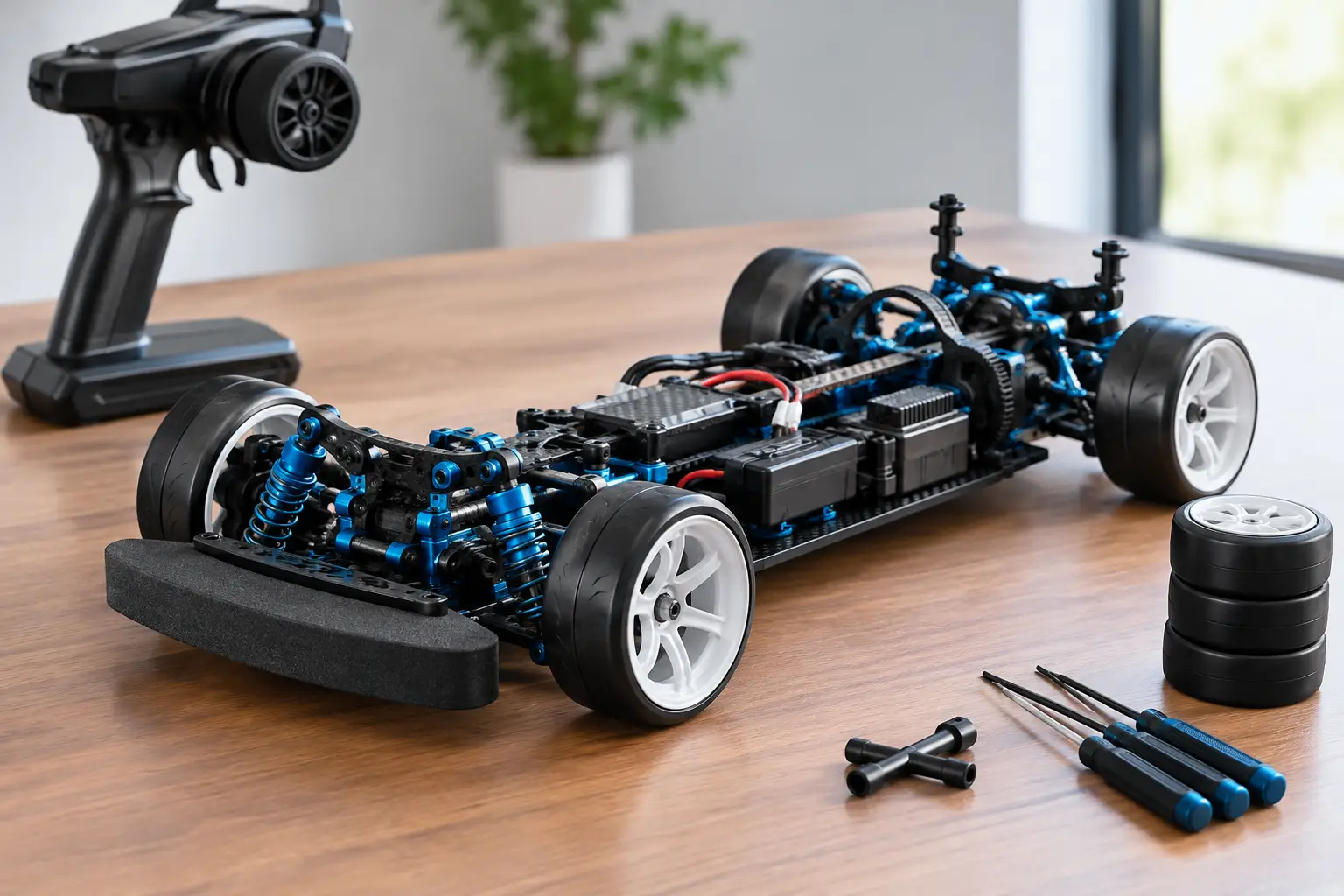
RC Drift Setup Guide: Best Settings for a 1/10 RWD Drift Car
Getting your RC drift car set up correctly makes a huge difference to how it handles. Whether you're new to drifting or looking to improve your control, the right combination of steering geometry, suspension, tyres and gyro settings will help you achieve smoother, more consistent slides.
In this guide, we'll walk through a practical RC drift setup example for a 1/10 scale rear-wheel-drive (RWD) drift car, including recommended starting settings and adjustments for different driving surfaces.
These settings are designed to give you a reliable starting point rather than a one-size-fits-all solution. Every chassis behaves differently, so small adjustments and regular testing are the key to getting the best performance.
What Makes a Good RC Drift Setup?
A properly set-up RC drift car should be easy to control at full steering lock, maintain a consistent drift angle and transition smoothly between corners.
The goal isn't simply to produce as much wheelspin as possible. It's about balancing throttle control, steering response and rear-wheel traction to achieve realistic, controlled drifting.
For beginners, a predictable car is far more useful than an extremely powerful one.
This guide focuses on a typical 257 mm wheelbase RWD drift chassis using a sensored brushless motor, 2S LiPo battery and dedicated hard-compound drift tyres.
Recommended RC Drift Setup Settings
The following settings provide a useful baseline for many 1/10 scale RWD drift cars.
| Component | Recommended Starting Setting |
|---|---|
| Motor | Sensored 10.5T brushless |
| Battery | 2S LiPo |
| ESC | Zero boost and turbo initially |
| Front camber | -7° |
| Rear camber | -2.5° to -3° |
| Front toe | 1° total toe-out |
| Rear toe | 2.5° to 3° total toe-in |
| Caster | 8° to 10° |
| Front ride height | 7 mm |
| Rear ride height | 8 mm |
| Front damper oil | Approximately 300 cSt |
| Rear damper oil | Approximately 250 cSt |
| Gyro gain | 35–45% initially |
These figures are starting points only. Always check your chassis manufacturer's recommendations, particularly for steering geometry, suspension and differential settings.
1. Choose the Right RC Drift Tyres
Tyres are one of the most important parts of any RC drift setup.
Unlike conventional RC racing cars, drift cars use specialised hard-compound tyres designed to slide consistently rather than produce maximum grip.
The correct tyre depends heavily on the surface you're driving on.
Polished concrete: Hard drift tyres designed for smooth, low-grip surfaces generally work well.
Carpet: Use tyres recommended by your local drift club or track. Carpet can produce very different grip characteristics depending on its construction.
RC drift tiles: Dedicated drift tyres suitable for the particular tile surface will help maintain predictable handling.
Always use a matching set of tyres where possible. Mixing different compounds or significantly worn tyres can make the car difficult to balance.
Before adjusting your suspension, check that all four tyres are correctly fitted and that the wheels rotate freely.
2. Set Your RC Drift Car Ride Height
Ride height affects stability, weight transfer and suspension movement.
For a typical 1/10 RWD drift car, a useful starting point is:
-
Front ride height: 7 mm
-
Rear ride height: 8 mm
This gives the chassis a slight rearward rake while maintaining enough clearance for the suspension to operate.
Measure ride height with the battery installed and the car ready to run.
Avoid lowering the chassis excessively. If the underside catches the track during transitions, the car may become unpredictable.
For uneven concrete surfaces, slightly increasing ride height can improve consistency.
3. Adjust Front Camber, Rear Camber and Toe
Steering geometry plays a major role in how an RC drift car initiates and maintains a slide.
Front Camber
Start with approximately -7 degrees of front camber.
Negative camber can help maintain a useful tyre contact patch when the steering reaches a high angle.
However, excessive negative camber can reduce steering grip and make the car harder to control.
Rear Camber
A rear camber setting of approximately -2.5 to -3 degrees provides a reasonable baseline for many chassis.
The ideal setting depends on tyre design, suspension geometry and track grip.
Front Toe
Start with approximately 1 degree of total front toe-out.
This can improve initial steering response and help the car enter a drift.
Too much toe-out may make the car nervous during straight-line driving and transitions.
Rear Toe
Try approximately 2.5 to 3 degrees of total rear toe-in.
Rear toe-in generally improves stability and can help prevent the rear of the car from rotating too aggressively.
Remember that some drift chassis have fixed rear toe geometry, so adjustments may require different suspension components.
4. Set Steering Lock and Caster Correctly
RWD drift cars require significantly more steering angle than conventional RC touring cars.
However, maximum steering lock isn't always the best setting.
The important thing is ensuring that the steering operates smoothly throughout its entire range without binding.
Check the following before driving:
-
Steering links move freely.
-
Wheels don't contact the body or suspension.
-
Front driveshafts or steering components don't bind.
-
Servo endpoints are correctly adjusted.
-
Both front wheels move smoothly at full lock.
For caster, approximately 8 to 10 degrees can be a useful starting range on compatible chassis.
Caster influences steering self-alignment and how the front wheels behave during countersteering.
Different chassis use different steering geometry, so always prioritise smooth operation over copying an exact angle.
5. Find the Best RC Drift Gyro Settings
A gyro is one of the most useful electronic components in an RWD drift car.
It automatically assists with countersteering when the rear of the vehicle begins to slide.
For beginners, we recommend starting with approximately 35–45% gyro gain, depending on the gyro and transmitter.
Increase the gain gradually until the car feels stable and predictable.
If the steering begins to oscillate, feels delayed or appears to fight your inputs, the gain may be too high.
Before your first run, confirm that the gyro is correcting in the correct direction.
With the car safely lifted, move the rear of the chassis sideways and check that the front wheels countersteer in the direction needed to catch the slide.
If the gyro operates in reverse, correct its direction before driving.
A quality, responsive steering servo also makes a noticeable difference to drift control.
6. RC Drift Suspension Setup
Suspension tuning helps control weight transfer and maintain consistent tyre contact during a drift.
For a basic setup, start with medium front springs and slightly softer rear springs, provided these suit your chassis.
Suggested damper oil starting points are:
| Suspension | Oil Viscosity |
|---|---|
| Front dampers | 300 cSt |
| Rear dampers | 250 cSt |
Always compare oils using the same viscosity measurement. Manufacturer weight ratings can vary.
On higher-grip surfaces, firmer damping or different spring rates may help control excessive chassis movement.
On slippery concrete, softer damping may help the suspension react more smoothly.
Before changing springs or oil, make sure the suspension arms, pivots and dampers move freely.
A sticking suspension component can cause inconsistent handling regardless of the settings used.
7. Choose the Right Motor, ESC and Battery
A powerful motor isn't necessarily better for RC drifting.
Smooth throttle delivery is usually more important than outright speed.
For many 1/10 RWD drift cars, a sensored 10.5T brushless motor with a 2S LiPo battery provides a practical starting point.
Sensored brushless systems offer smooth low-speed response, making it easier to control wheelspin through corners.
Initially, keep ESC boost and turbo disabled.
Once you're comfortable with the chassis, you can experiment with throttle response and electronic timing if the motor and ESC support these adjustments.
If you're choosing a suitable battery, read our RC LiPo battery buyer's guide.
For motor recommendations, see our best brushless motor combinations for RC cars.
RC Drift Gearing
Start with conservative gearing based on your chassis and motor manufacturer's recommendations.
A larger pinion gear generally increases potential wheel speed but also places greater load on the motor.
A smaller pinion can improve acceleration characteristics and reduce motor load.
Monitor motor temperatures after running and adjust gearing if necessary.
For more information, read our RC brushless motor upgrade guide.
8. How to Test Your RC Drift Setup
Once you've completed the initial setup, avoid changing multiple settings at the same time.
Start with slow figure-eight exercises and gradually work towards linking corners.
Pay attention to how the car behaves.
Car spins too easily: Check throttle input, steering rate, rear tyre condition and gyro settings. Additional rear toe-in may help on adjustable chassis.
Car pushes wide: Inspect front tyre condition, steering geometry and available steering lock before adjusting camber or rear grip.
Steering feels nervous: Reduce steering sensitivity and check for excessive toe-out or gyro gain.
Car suddenly grips during a slide: Check tyre condition, suspension movement and changes in track surface.
Transitions feel too slow: Experiment with small adjustments to steering response, gyro gain and throttle control.
Make one change at a time and test again.
Keeping a simple record of your setup makes it much easier to understand which adjustments improve the car.
9. Common RC Drift Setup Mistakes
Many beginners make drifting harder than necessary by changing too many components before learning the basics.
Common mistakes include using excessive motor power, setting the gyro too high, running unsuitable tyres and increasing steering lock without checking for binding.
Another common issue is copying settings from a completely different chassis.
A setup that works brilliantly on one drift car may behave very differently on another because of motor position, weight distribution and suspension design.
Start with the manufacturer's recommended settings and make gradual adjustments for your particular driving surface.
Final Thoughts: Getting the Best RC Drift Setup
The best RC drift setup isn't necessarily the most expensive or complicated.
A well-balanced chassis with suitable tyres, smooth throttle response, correctly adjusted steering and sensible gyro settings can deliver excellent results.
For beginners, focus on consistency before chasing more speed or extreme steering angles.
Once you're comfortable linking corners and controlling the car throughout a drift, you can begin fine-tuning suspension, gearing and weight distribution to suit your driving style.
At RC Model Shop UK, we stock a wide range of RC cars, batteries, chargers, motors, electronic components and replacement parts to help you get the most from your hobby.
Whether you're starting out or upgrading your existing RC model, explore our range at RC Model Shop UK.
Frequently Asked Questions
What is the best gyro setting for an RC drift car?
A starting range of 35–45% gain can work well for many systems, but the correct setting depends on your gyro, servo, chassis and driving surface. Adjust gradually until the car feels stable without steering oscillation.
What motor is best for a 1/10 RC drift car?
A sensored 10.5T brushless motor running on 2S LiPo is a useful all-round starting point for many RWD drift cars. Always check track rules and chassis compatibility.
How much camber should an RC drift car have?
Approximately -7 degrees at the front and -2.5 to -3 degrees at the rear can provide a starting baseline, but the best settings depend on steering geometry, tyres and track conditions.
Do RC drift cars need special tyres?
Yes. Dedicated hard-compound drift tyres provide the controlled sliding characteristics required for realistic RC drifting. Choose tyres suitable for your driving surface.
Is RWD or AWD better for RC drifting?
RWD is generally preferred for realistic, scale-style RC drifting and is commonly used at dedicated drift tracks. AWD models can be easier for casual sliding on some surfaces, but they behave differently.
Written by RC Model Shop UK
RC Model Shop UK – RC Cars, Parts & Accessories Specialists
Our team has experience supplying RC cars, replacement parts, batteries, chargers and upgrades for hobby enthusiasts across the UK. We create practical guides to help beginners and experienced hobbyists choose the right equipment, maintain their models and get more enjoyment from RC.
Website: www.applianceelectronics.co.uk