
How to Choose RC Receiver for Your Model
06/09/2026
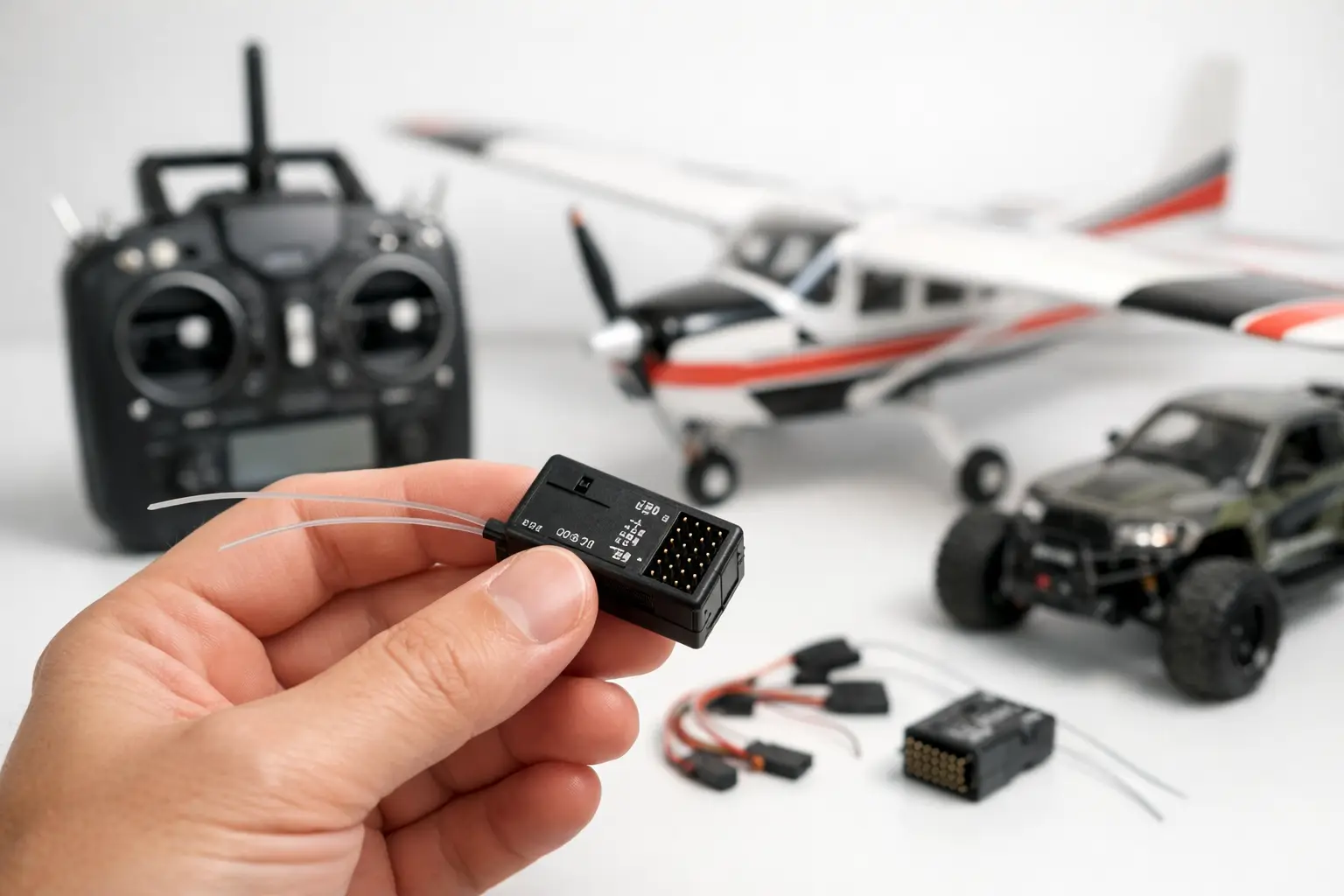
A new receiver can solve a damaged-electronics problem, add telemetry or allow one transmitter to control several models. But an RC receiver is not a universal plug-in part.
When learning how to choose an RC receiver, start with the transmitter already in your hand. The radio protocol it uses determines which receivers can bind and communicate correctly.
A receiver can look perfect on paper and still be the wrong choice if it will not bind to your transmitter, has too few channels, will not fit the model or is not suitable for the voltage being supplied.
You can browse our range of RC receivers, but compatibility should always be checked against the exact transmitter and model before ordering.
Start with transmitter and receiver compatibility
Modern 2.4GHz radio systems are reliable and convenient, but the fact that two systems both operate on 2.4GHz does not make them compatible.
Different manufacturers use different radio protocols.
Brands such as Spektrum, Futaba, FlySky, Sanwa and others use their own systems, and compatibility can also vary between generations within the same brand.
That means the first things to identify are:
-
Transmitter brand
-
Exact transmitter model
-
Supported radio protocol
-
Receiver protocol
-
Model type
Do not assume that two receivers with the same channel count will work with the same radio simply because both are marked 2.4GHz.
Some transmitters support multiple protocols or additional receiver types, but this should be confirmed from the transmitter and receiver specifications before purchase.
Check how the receiver binds
Different radio systems use different binding procedures.
Depending on the receiver and transmitter, binding may require:
-
A bind button
-
A bind plug
-
A transmitter menu option
-
A specific power-up sequence
-
A dedicated receiver mode
Keep the manufacturer's instructions available during the first installation rather than trying different procedures at random.
If you are replacing an existing receiver, the model number printed on the old receiver can be very useful when identifying a compatible replacement.
Choose enough channels for your RC model
The number of channels determines how many separate functions the receiver can control.
RC cars and trucks
A basic electric RC car or truck normally needs two channels:
-
Channel 1 – steering
-
Channel 2 – throttle through the ESC
Additional channels may be needed for:
-
Lights
-
Winch
-
Cooling fan control
-
Two-speed gearbox
-
Dig function
-
Rear steering
-
Sound system
-
Other accessories
A crawler fitted with several accessories can quickly require four, five or more channels.
Our guide to RC crawler accessories gives examples of the additional equipment owners may want to control.
RC boats
Many electric RC boats also use two channels for steering and throttle.
Scale boats can require additional channels for functions such as lighting, sound or auxiliary equipment.
RC aircraft
Aircraft generally need more channels.
A straightforward trainer may use four channels for:
-
Throttle
-
Aileron
-
Elevator
-
Rudder
Additional functions such as flaps, retractable landing gear, lighting, gyro controls or separate control surfaces increase the channel requirement.
Count the functions you intend to use now and consider allowing at least one spare channel if your transmitter supports it.
More receiver channels are not always better
Buying the highest-channel receiver available is not automatically useful.
The transmitter also needs enough switches, knobs, sliders or programmable controls to operate those channels properly.
A six-channel receiver offers little benefit if the transmitter only provides practical control over three or four functions.
Choose the channel count around the way the model will actually be used.
Check receiver voltage compatibility
The receiver needs a suitable power supply.
Depending on the model, power may come from:
-
The ESC's built-in BEC
-
A separate BEC
-
A dedicated receiver battery
-
A regulated power system
Always check the receiver's permitted input-voltage range.
Do not supply more voltage than the receiver is designed to handle.
This becomes especially important with high-voltage servos.
A steering servo may be capable of operating at 7.4V or 8.4V while another component in the radio system has a lower voltage limit.
The complete system needs to be compatible with the selected BEC output.
Remember that the servo load affects the BEC
The receiver itself does not usually create the largest electrical load in a surface RC model.
A powerful steering servo can draw substantially more current, particularly when:
-
Steering against resistance
-
Turning large crawler tyres
-
Operating heavy steering components
-
Working at high servo voltage
If a crawler, large basher or boat suffers intermittent control or receiver resets under steering load, the problem may be an inadequate BEC or another power-supply issue rather than a faulty receiver.
Our guide to RC cars for bashing covers the types of high-load vehicles where robust electronics become particularly important.
Replacing the receiver will not fix an underspecified or failing power system.
Nitro and petrol RC receiver power
Nitro and petrol models use a different electrical arrangement from most electric RC vehicles because there is no drive ESC providing receiver power.
The receiver and servos may instead be powered by a separate receiver battery and switch harness.
Check the condition and specification of:
-
Receiver battery
-
Switch harness
-
Connectors
-
Charging system
-
Servo leads
A weak battery, corroded connector or faulty switch can cause intermittent control problems that may initially appear to be a receiver fault.
Check the physical size of the receiver
Measure the installation space before ordering.
Receiver dimensions can matter in:
-
Compact RC chassis
-
Receiver boxes
-
Boats
-
Micro vehicles
-
Aircraft
-
Scale builds with limited internal space
A larger receiver may provide additional channels or telemetry functions, but that is of little use if it will not physically fit the model.
Also consider cable access. Servo and ESC plugs need enough room to be inserted without being sharply bent or crushed by a receiver-box lid.
Receiver antenna placement matters
Receiver antennas should be installed according to the manufacturer's instructions.
Avoid crushing, cutting, extending or sharply bending antenna wires.
Where an antenna has an exposed active section, keep that section intact.
In surface models, the antenna should generally be positioned as clearly as practical away from components that may interfere with reception.
Avoid trapping it directly against:
-
Motor wiring
-
ESC power cables
-
Large battery packs
-
Metal components
-
Carbon-fibre structures
The manufacturer's installation instructions should always take priority.
Do you need a waterproof RC receiver?
That depends on the model and where it will be used.
For surface vehicles driven through:
-
Wet grass
-
Mud
-
Puddles
-
Damp trails
a waterproof or appropriately protected radio installation can be useful.
However, do not assume the receiver is waterproof simply because the vehicle itself is advertised for wet-weather use.
Some receivers rely on being installed inside a sealed receiver box.
RC boats need particular attention because moisture can build up inside the hull even when the model has not capsized.
If the receiver is not rated for water exposure, install it according to the vehicle and receiver manufacturer's protection requirements.
Surface receiver vs aircraft receiver
Receivers are often designed around a particular type of model.
Surface receivers
Surface receivers for cars, trucks, crawlers and boats are generally designed around steering and throttle functions and often use compact layouts suited to vehicle chassis.
Aircraft receivers
Aircraft receivers may include features such as:
-
More channels
-
Stabilisation
-
Telemetry
-
Satellite receiver support
-
Flight-controller compatibility
-
Additional antenna arrangements
A receiver may physically fit another type of model, but that does not automatically make it the best or correct choice.
Choose a receiver intended for the radio system and model type wherever possible.
Receiver response speed and latency
For most recreational RC driving, a modern 2.4GHz receiver provides more than enough response speed.
Lower-latency or high-speed receiver modes become more relevant in applications such as:
-
RC racing
-
High-speed on-road driving
-
Competition boats
-
Performance aircraft
The receiver, transmitter and servo all need to support the selected operating mode.
Do not select a higher-speed servo frame rate unless the connected servos are designed to support it.
Some analogue servos can behave poorly or become damaged if operated outside their supported signal specification.
Do you need telemetry?
Telemetry allows information to travel back from the model to the transmitter.
Depending on the radio system and additional sensors fitted, telemetry may provide information such as:
-
Receiver voltage
-
Signal quality
-
Battery voltage
-
Temperature
-
RPM
-
Other vehicle data
Telemetry is useful when it provides information you will actually monitor and use.
For some drivers, seeing battery or receiver voltage can be valuable. For a straightforward recreational model that is driven close by for short runs, the extra cost may offer little practical benefit.
Stabilised RC receivers
Some receivers include electronic stability assistance.
In surface models this can help reduce unwanted steering movement or make a powerful vehicle easier to keep straight on loose surfaces.
Aircraft receivers may use stabilisation to assist with flight control.
However, electronic stability should not be used to hide a poorly set-up model.
Correct:
-
Steering trim
-
Servo endpoints
-
Suspension
-
Alignment
-
Control throws
first.
In technical crawling, too much stability assistance can interfere with precise steering inputs.
Our Axial crawler setup guide covers other adjustments that can improve crawler control without relying heavily on electronic assistance.
Failsafe settings are essential
A correctly configured failsafe is an important safety feature.
If the receiver loses the transmitter signal, the model should respond in a predictable and safe way.
For most surface models, that normally means the throttle returning to neutral or another safe position.
Aircraft failsafe settings depend on the radio system, aircraft and manufacturer recommendations.
After binding a receiver, configure and test the failsafe according to the manufacturer's instructions before using the model normally.
When testing a powered model, keep wheels, propellers and other moving parts safely clear.
Do a range test after fitting a new receiver
After installing a new receiver, carry out the manufacturer's recommended range test.
This is particularly important for:
-
Aircraft
-
Boats
-
Long-range surface models
-
Models where the receiver or antenna position has changed
A successful bind on the workbench does not automatically prove the installation will maintain reliable control at normal operating distance.
Check antenna routing and installation before blaming the receiver if the range test is poor.
Replacing a receiver after a fault
If a receiver is being replaced because of:
-
Crash damage
-
Water exposure
-
Intermittent signal
-
Brown-outs
-
Unexplained loss of control
inspect the rest of the electrical system at the same time.
Check:
-
Servo leads
-
ESC receiver plug
-
BEC operation
-
Battery connectors
-
Switch harness
-
Antenna
-
Wiring damage
A new receiver cannot compensate for faulty wiring or an unstable power supply.
RC receiver buying checklist
Before ordering an RC receiver, confirm:
-
Transmitter brand
-
Exact transmitter model
-
Radio protocol
-
Receiver compatibility
-
Required number of channels
-
Receiver voltage range
-
BEC or receiver-battery voltage
-
Physical receiver dimensions
-
Antenna requirements
-
Model type
-
Waterproofing requirements
-
Telemetry requirements
-
Stabilisation requirements
Taking a few minutes to check these details can prevent most receiver-ordering mistakes.
Frequently Asked Questions
Will any 2.4GHz receiver work with my RC transmitter?
No. 2.4GHz describes the frequency band, not the communication protocol. The receiver must support the protocol used by the transmitter.
Can I use a different brand receiver with my transmitter?
Sometimes, depending on the radio system and receiver, but it should never be assumed. Check the transmitter manufacturer's compatibility information and the receiver specification before buying.
How many channels do I need for an RC car?
A basic electric RC car normally uses two channels: one for steering and one for throttle. Additional accessories such as lights, winches, rear steering or a two-speed gearbox require extra channels.
What receiver do I need for an RC crawler?
That depends on the crawler and accessories fitted. A basic crawler may only require two channels, while a crawler with a winch, dig function, lighting or two-speed transmission may require four or more.
Can a receiver handle an 8.4V servo?
Only if the complete radio system is rated appropriately. Check the receiver's maximum input voltage as well as the servo and BEC specifications before using higher-voltage settings.
Why does my receiver reset when I steer?
A receiver reset or brown-out under heavy steering load can be caused by a voltage drop or inadequate BEC current. Check the servo, BEC and electrical connections rather than automatically assuming the receiver is faulty.
Do RC receivers have to be waterproof?
No, but the receiver must be adequately protected for the conditions in which the model is used. Some receivers are waterproof, while others need to be installed inside a suitable sealed receiver box.
Do I need to set the failsafe after fitting a receiver?
Yes. Bind the system and configure the failsafe according to the radio manufacturer's instructions, then test it safely before normal use.
Shop RC receivers in the UK
Choosing the correct receiver starts with the transmitter.
Protocol compatibility comes first, followed by the number of channels, voltage range, physical size and the additional features your model actually needs.
RC Model Shop UK stocks a range of RC receivers for different RC applications.
If you are unsure which receiver is compatible, contact us with the exact transmitter model and details of the RC model. A clear photo of the existing receiver label can also help us identify the right replacement.
Written by RC Model Shop UK