
How to Choose Brushless Motors for Your RC Car
08/09/2026
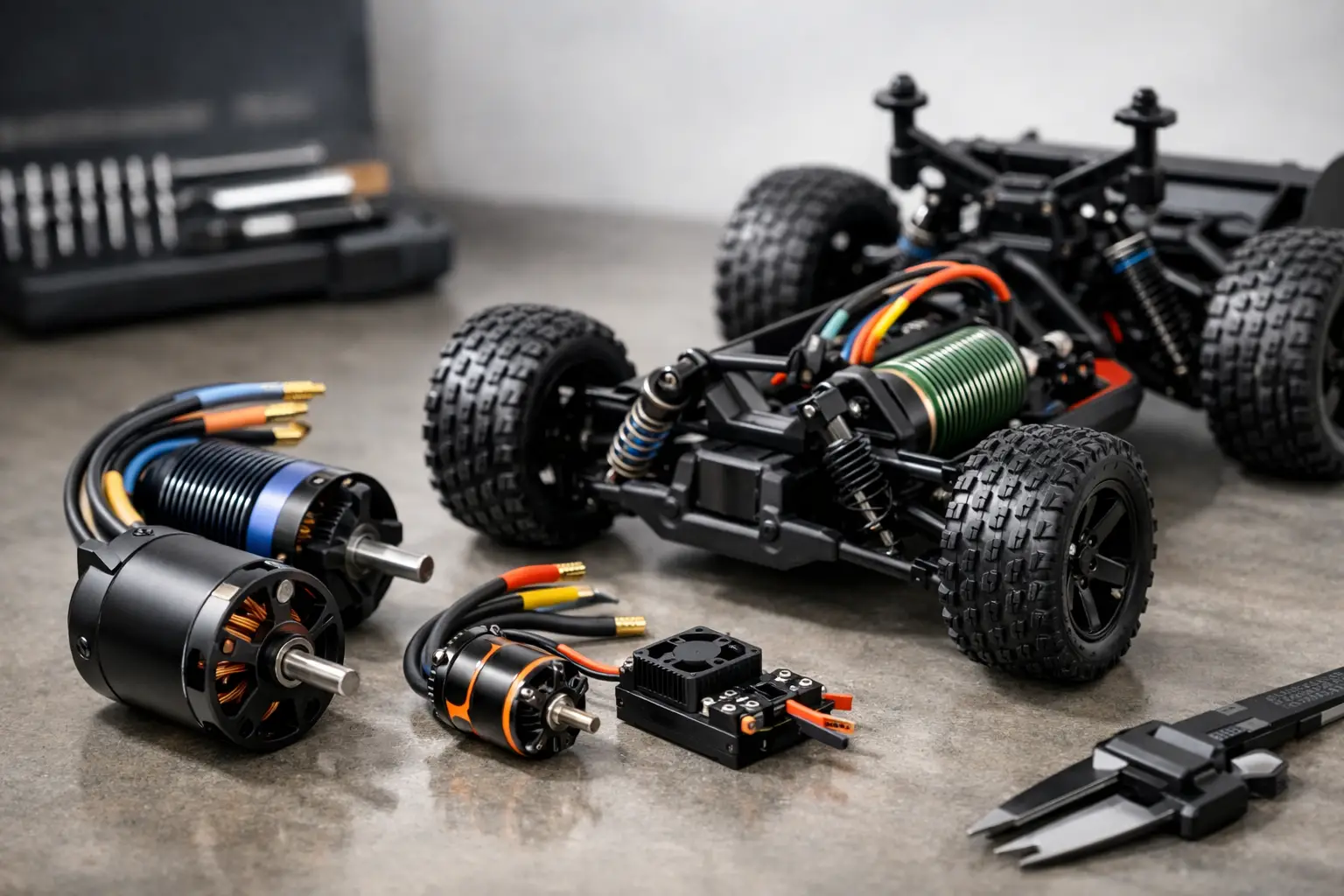
A brushless upgrade can turn a capable RC car into a seriously quick one, but fitting the highest-KV motor you can find is rarely the right answer.
Motor choice affects acceleration, top speed, run time, temperatures, drivetrain load and how easy the model is to control. Get the combination right and the car feels sharper, faster and more predictable. Get it wrong and you may end up with overheated electronics, stripped gears or a model that is simply too aggressive for the surface.
For most RC drivers, the best brushless setup is the one that matches the vehicle, battery voltage, terrain and driving style.
A crawler needs smooth low-speed control. A basher needs strong acceleration and manageable temperatures. A race car may benefit from a carefully matched sensored system and gearing suitable for its class.
You can browse our range of brushless RC motors and brushless ESC and motor combos if you already know the type of setup your model requires.
What makes brushless RC motors different?
Brushed motors use physical brushes and a commutator to switch electrical current through the motor.
Those components wear over time and create friction.
Brushless RC motors use electronic switching controlled by the ESC, removing the physical brushes from the motor.
The practical advantages can include:
-
Greater power for the motor size
-
Better efficiency
-
Less routine motor maintenance
-
Stronger acceleration
-
Higher potential performance
That is why brushless systems are one of the most popular performance upgrades for electric RC cars.
There is a trade-off.
Brushless power systems depend more heavily on choosing compatible components and setting the gearing correctly. The extra torque and wheel speed can also expose weaknesses in a drivetrain that previously worked perfectly well with a brushed motor.
Before upgrading, inspect the condition of the:
-
Spur gear
-
Pinion gear
-
Slipper clutch or centre differential
-
Driveshafts
-
Differential gears
-
Bearings
-
Wheel hexes
Adding considerably more power to worn drivetrain components is rarely a good combination.
What does KV mean on an RC brushless motor?
KV is one of the first specifications you will see when comparing brushless motors.
It represents the approximate unloaded RPM produced per volt.
For example, a 3000KV motor has a theoretical unloaded speed of around 3,000 RPM for every volt supplied.
That does not mean a higher-KV motor will automatically make every RC car faster.
Real-world speed depends on several factors, including:
-
Battery voltage
-
Pinion and spur gearing
-
Tyre diameter
-
Vehicle weight
-
Motor size
-
Surface
-
Aerodynamic drag
-
Drivetrain efficiency
A high-KV motor paired with tall gearing and a heavy vehicle may simply generate excessive heat.
In contrast, a lower-KV motor running on a suitable higher-voltage battery can sometimes deliver stronger, more usable performance with better temperature control.
Higher KV vs lower KV
As a general guide, lower-KV motors are commonly used in heavier models, higher-voltage systems and applications where torque and temperature control are important.
Higher-KV motors are more commonly associated with lower-voltage systems and lighter vehicles where additional motor RPM is useful.
However, KV should never be chosen in isolation.
Always check the motor manufacturer's recommended:
-
Battery cell count
-
Vehicle scale
-
Vehicle weight
-
ESC specification
-
Gearing range
before deciding whether a motor is suitable.
Motor size matters too
Two motors with the same KV rating can behave very differently if they are physically different sizes.
A larger motor generally has greater thermal mass and may be capable of handling more sustained load than a smaller motor of similar design.
Common sizes you may see include motors such as 3652, 3660 and 4074.
This becomes particularly important on heavier 1/8-scale buggies, truggies and monster trucks.
A motor suitable for a lightweight 1/10-scale buggy may not be appropriate for a much heavier truck running larger tyres, even if the KV figure appears similar.
A simple brushless motor example
Imagine a 4000KV motor running on a 2S LiPo battery in a suitable 1/10-scale vehicle.
That may provide a lively but manageable setup.
Run the same motor on 3S with larger tyres and aggressive gearing, however, and the additional RPM and load may cause temperatures to rise rapidly.
In some cases, switching to a lower-KV motor or reducing pinion size can produce better real-world performance because the electronics remain within a sensible operating temperature.
A setup that can complete a full battery pack reliably is far more useful than one that reaches thermal protection after a few minutes.
Sensored vs sensorless brushless motors
Brushless systems broadly fall into two groups: sensored and sensorless.
Sensorless brushless systems
Sensorless systems are widely used in bashers, monster trucks, general-purpose RC cars and many other high-performance models.
They can provide excellent power and value for money.
At higher motor speeds they work extremely well, although some setups may feel less smooth when initially pulling away at very low speed.
For general bashing and high-speed driving, that is often perfectly acceptable.
Sensored brushless systems
Sensored systems use a sensor cable between the motor and ESC.
This allows the ESC to detect rotor position more accurately, particularly at low speed.
The result can be:
-
Smoother starting
-
Better low-speed control
-
More predictable throttle response
-
Improved crawling control
Sensored systems are widely used in crawling and racing applications where throttle precision matters.
For technical crawling, the extra control available from a properly set up sensored system can be particularly useful.
Our Axial crawler setup guide covers other areas that affect low-speed crawler performance.
Some ESCs can operate with both sensored and sensorless motors, but compatibility should always be checked before buying.
Choosing a brushless ESC and motor combo
Buying a matched brushless ESC and motor combo can simplify the upgrade process because the motor and ESC have been selected to work together.
However, you still need to make sure the complete package suits your vehicle.
Check:
-
Vehicle scale
-
Motor dimensions
-
Motor shaft size
-
ESC battery voltage limit
-
Motor KV
-
Battery cell count
-
Connector type
-
Available chassis space
-
Cooling requirements
A combo intended for a lightweight 1/10-scale buggy is not automatically suitable for a heavy monster truck.
Likewise, a motor physically fitting the chassis does not guarantee the ESC or drivetrain can support it.
Match the ESC to the battery
The ESC must be rated for the battery voltage you intend to use.
If an ESC is specified for 2S to 3S LiPo use, it should not be treated as a 4S ESC simply because the motor itself may be capable of handling additional voltage.
Exceeding the manufacturer's voltage rating can damage the ESC.
The battery must also be suitable for the load.
A powerful brushless setup can demand significant current under hard acceleration, especially when driving through grass, climbing loose terrain or repeatedly launching from a standstill.
A suitable LiPo battery for an RC car needs the correct voltage, dimensions, connector and electrical capability for the application.
Check your RC connectors
High-current brushless systems depend on good electrical connections.
Loose, worn or damaged battery connectors can introduce electrical resistance and generate heat.
Check:
-
Battery connector condition
-
ESC connector condition
-
Adapter condition
-
Polarity
-
Wire damage
If a connector becomes excessively hot, fits loosely or shows visible damage, stop using it until the cause has been identified.
Reversing battery polarity can damage an ESC extremely quickly, so always confirm connector orientation before powering up a modified installation.
Gearing is one of the biggest factors in brushless reliability
Pinion and spur gearing have a major effect on how hard the motor and ESC have to work.
Larger pinion
A larger pinion generally increases potential vehicle speed but also increases load on the motor and ESC.
Smaller pinion
A smaller pinion generally reduces motor load and can help lower temperatures.
It may also provide stronger usable acceleration in situations where the previous gearing was too tall.
After fitting a new brushless system, begin conservatively.
Use gearing recommended by the motor, ESC or vehicle manufacturer where available.
Then test the vehicle under the conditions in which you actually drive it.
A short run on smooth tarmac places a very different load on the electronics compared with:
-
Long grass
-
Deep gravel
-
Large tyres
-
Repeated jumping
-
Hot weather
-
Continuous full-throttle use
Check motor and ESC temperatures
Temperature is one of the best indicators of whether a brushless setup is working comfortably.
Motor and ESC temperatures vary between systems, so follow the manufacturer's specified limits wherever available.
If a motor or ESC becomes excessively hot, stop the model and investigate the cause rather than repeatedly allowing thermal protection to activate.
Possible causes include:
-
Gearing that is too tall
-
Oversized tyres
-
Binding bearings
-
Incorrect gear mesh
-
Drivetrain resistance
-
Excessive vehicle weight
-
Unsuitable motor choice
-
Battery or ESC limitations
Reducing pinion size is often one of the first sensible changes when a brushless system is running too hot.
Cooling fans and heatsinks can help manage normal heat, but they should not be used to hide a fundamentally overloaded setup.
Best brushless setup for RC bashers
Bashers generally benefit from a setup that balances torque, acceleration and durability.
A moderate-KV sensorless brushless system is often a better choice than an extreme high-KV setup.
The objective is usable performance across:
-
Grass
-
Dirt
-
Gravel
-
Jumps
-
Mixed surfaces
rather than maximum theoretical speed.
An excessively aggressive setup can make the vehicle difficult to control while dramatically increasing stress on tyres and drivetrain components.
Best brushless setup for RC racers
Sensored brushless systems are common in racing because predictable throttle response can help with corner exit and traction.
However, racing regulations can specify:
-
Motor turns
-
Approved ESC modes
-
Timing rules
-
Battery requirements
so always check the rules for the class before buying equipment.
A motor that is technically faster may not be legal for the class you intend to race.
Best brushless setup for RC crawlers
Crawlers require a very different approach.
Low-speed throttle control, torque and predictable braking are more useful than outright RPM.
A quality sensored brushless crawler setup can provide excellent low-speed control.
Some crawler builds also use brushless outrunner motors, but physical fitment, ESC compatibility and drivetrain setup all need to be considered carefully.
For trail and technical crawling, smooth power delivery usually matters more than headline top speed.
Brushless systems for speed-run RC cars
Speed-run vehicles are a specialist application.
They may combine:
-
Higher voltage
-
High motor RPM
-
Tall gearing
-
Aerodynamic modifications
-
Specialised tyres
-
Extensive cooling
but these combinations put enormous loads on the complete vehicle.
Tyres, gearing, drivetrain strength and aerodynamic stability become just as important as the motor itself.
A speed-run power system should not automatically be copied onto a general-purpose basher.
What to check before fitting a brushless motor
Before ordering or installing a new brushless RC motor, confirm the physical installation requirements.
Check:
-
Motor diameter
-
Motor length
-
Mounting hole pattern
-
Motor shaft diameter
-
Chassis clearance
-
Pinion type
-
Spur and pinion pitch
-
Battery voltage compatibility
-
ESC compatibility
Common gear pitches include Mod and DP systems, and parts from different systems are not interchangeable simply because they look similar.
Use the correct pinion type for the spur gear fitted to the model.
Set the gear mesh correctly
Incorrect gear mesh can quickly damage gears.
There should be a small amount of backlash between the pinion and spur gears.
The gears should not be clamped tightly together, but there should also not be excessive movement between the teeth.
Rotate the drivetrain manually after setting the mesh and check that it remains consistent through a full revolution.
Programme the ESC correctly
Once installed, configure the ESC according to the manufacturer's instructions.
Depending on the ESC, adjustable settings may include:
-
Battery type
-
Low-voltage cut-off
-
Brake strength
-
Drag brake
-
Punch
-
Motor timing
-
Reverse behaviour
For a newly upgraded basher, starting with a more moderate punch setting can make the vehicle easier to control and reduce shock loading through the drivetrain.
Change one setting at a time and test the result before making further adjustments.
Frequently Asked Questions
What KV brushless motor should I use?
There is no universal KV that suits every RC model. The correct choice depends on vehicle weight, scale, battery voltage, gearing and driving style. Always check the motor and vehicle manufacturer's recommendations before buying.
Is a higher-KV RC motor faster?
Potentially, but not always in real-world use. Higher KV means greater unloaded RPM per volt, but vehicle speed also depends on gearing, tyre size, battery voltage and load. An excessively high-KV setup may simply run hot or become difficult to control.
Can I put a brushless motor in any RC car?
Not necessarily. The chassis needs to accept the motor dimensions and mounting pattern, and the drivetrain must be capable of handling the additional performance. You also need a compatible brushless ESC and suitable battery.
Do I need a new ESC when fitting a brushless motor?
If the vehicle currently has a brushed ESC, yes. Brushed and brushless motors are controlled differently. A brushless motor requires a compatible brushless ESC.
Is sensored brushless better than sensorless?
Neither is universally better. Sensored systems provide smoother low-speed control and are useful for crawling and racing. Sensorless systems are widely used for bashing and high-speed applications where simple, powerful performance is the priority.
Why is my brushless motor getting hot?
Possible causes include over-gearing, oversized tyres, drivetrain binding, excessive vehicle weight or a motor that is not appropriate for the application. Check the drivetrain and gearing before relying on additional cooling.
Should I buy a motor and ESC separately or as a combo?
A matched ESC and motor combo can make choosing compatible components easier. Buying separately gives you more flexibility, but you need to check the motor, ESC, battery and vehicle specifications carefully.
Shop brushless RC motors and ESC combos
A successful brushless upgrade is about matching the complete power system rather than chasing the largest KV number.
Motor size, KV, battery voltage, ESC specification, gearing and vehicle weight all work together.
Choose a setup suited to how you actually drive, start with conservative gearing and monitor temperatures during the first few runs.
RC Model Shop UK stocks a range of brushless RC motors as well as brushless ESC and motor combos for different RC applications.
If you are unsure what will fit your model, contact us with the exact vehicle model, current battery and existing motor or ESC details and we can help identify suitable options.
Written by RC Model Shop UK