
Hardcase Versus Softcase LiPo Batteries
03/11/2026
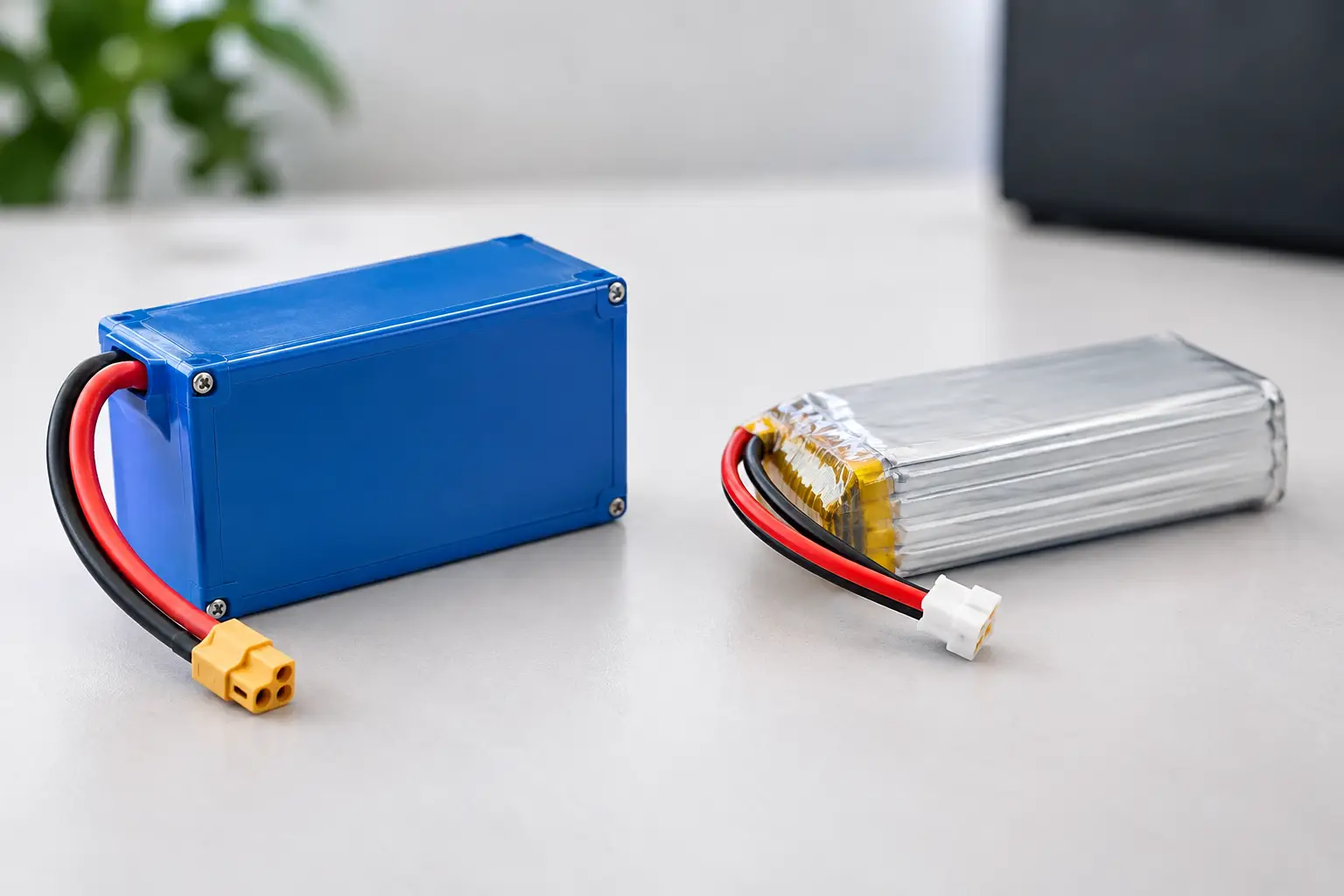
Hardcase vs Softcase LiPo Batteries: Which Is Best for Your RC Model?
Choosing the right LiPo battery can make a noticeable difference to how your RC model performs. The wrong battery could leave your car feeling underpowered, add unnecessary weight or simply fail to fit inside the battery compartment.
When comparing hardcase vs softcase LiPo batteries, neither is automatically better. Both have their advantages, and the right choice depends on your RC model, how you use it and how well the battery is protected.
For most RC cars, buggies and monster trucks, hardcase LiPo batteries are a popular choice because of their added physical protection. Softcase LiPo batteries are particularly useful for RC aircraft, helicopters, drones and certain boats where weight and available space are important.
In this guide, we'll explain the differences, advantages, disadvantages and safety considerations to help you choose the right battery.
What Is the Difference Between Hardcase and Softcase LiPo Batteries?
Both hardcase and softcase LiPo batteries use lithium polymer cells to supply power to your RC model. The main difference is how those cells are packaged and protected.
A hardcase LiPo battery has a rigid plastic outer casing designed to provide additional protection against knocks, abrasion and impacts.
A softcase LiPo battery typically has a lightweight shrink-wrapped exterior without a rigid protective shell. This reduces unnecessary weight and can make the battery easier to accommodate in smaller compartments.
Although the internal battery technology is similar, the casing can influence durability, weight, dimensions and suitability for different RC applications.
Hardcase vs Softcase LiPo Batteries: Quick Comparison
| Feature | Hardcase LiPo | Softcase LiPo |
|---|---|---|
| Outer protection | Rigid plastic casing | Shrink-wrapped cells |
| Impact resistance | Better external protection | Requires greater protection |
| Weight | Generally heavier | Generally lighter |
| Dimensions | Can be bulkier | Often more compact |
| RC cars and trucks | Usually preferred | Suitable in protected installations |
| RC aircraft | Less common | Widely used |
| RC boats | Depends on battery compartment | Common in many models |
| Maintenance | Inspect casing and connections | Inspect wrapping and cell surfaces |
| Safety | Requires proper LiPo care | Requires proper LiPo care |
The most important point is that neither battery style is inherently safer in every situation. Correct installation, charging, storage and handling remain essential.
What Are the Advantages of Hardcase LiPo Batteries?
Hardcase LiPo batteries are particularly popular with RC car enthusiasts because they provide an additional layer of protection around the battery cells.
When driving an RC buggy, monster truck or short-course truck, the vehicle may experience heavy landings, rollovers, vibration and impacts from loose stones.
A hardcase battery helps protect the cells from some of these everyday hazards.
1. Better Physical Protection
The rigid casing provides a barrier between the internal cells and external objects.
This is particularly useful when driving on gravel, dirt tracks, rough terrain and other surfaces where debris may enter the chassis.
However, the casing does not make the battery impact-proof. A sufficiently severe crash can still damage the cells inside.
2. Ideal for Many RC Cars and Trucks
Many hobby-grade RC cars and trucks are designed to accommodate hardcase LiPo batteries.
These include numerous 1/10 and 1/8 scale models used for bashing, racing and general recreational driving.
A correctly sized hardcase pack can sit securely inside the battery tray without placing unnecessary pressure on the cells.
3. Convenient for Regular Use
Hardcase batteries are generally easy to install, remove and handle.
Their rigid construction can also help protect the battery from minor abrasion during normal transportation and maintenance.
4. Popular for RC Racing
Hardcase LiPo batteries are widely used in various RC racing classes.
Depending on the competition, organisers may specify battery dimensions, approved battery lists or particular casing requirements.
Always check your racing club's regulations before purchasing a competition battery.
Are There Any Disadvantages to Hardcase LiPo Batteries?
The main disadvantages are additional weight and potentially larger dimensions.
The protective casing adds material around the battery, which can make it unsuitable for models with very limited battery space.
Hardcase batteries may also conceal internal damage following a heavy impact. A casing that looks relatively normal does not guarantee that the cells inside are undamaged.
What Are the Advantages of Softcase LiPo Batteries?
Softcase LiPo batteries are widely used in applications where reducing weight and maximising available space are priorities.
They are particularly common in RC aeroplanes, helicopters, drones and certain RC boats.
1. Lighter Construction
Without a rigid plastic outer casing, a softcase LiPo can weigh less than a comparable hardcase battery.
This can be especially beneficial for RC aircraft, where battery weight contributes directly to the model's overall flying weight.
A lighter battery may help improve the power-to-weight ratio, depending on the model and battery specifications.
2. More Compact Battery Options
Softcase batteries are available in a wide range of shapes and dimensions.
This makes them useful for models with narrow fuselages, restricted battery compartments or unusual mounting arrangements.
However, softcase batteries are not designed to be bent or compressed to fit into a compartment.
3. Suitable for RC Aircraft and Drones
Aircraft performance can be sensitive to weight distribution.
Choosing a suitable softcase battery can help achieve the correct centre of gravity while providing the required voltage and capacity.
Always follow the aircraft manufacturer's battery recommendations.
4. Useful for Certain RC Boats
Many RC boats use softcase LiPo batteries because their battery compartments are designed around this format.
Where a battery is mounted securely inside a protected hull, a softcase pack can be a practical solution.
However, it must be protected from movement, sharp edges, excessive heat and moisture.
What Are the Disadvantages of Softcase LiPo Batteries?
The biggest disadvantage is reduced physical protection.
Without a rigid casing, the cells are more vulnerable to punctures, crushing and abrasion.
Softcase batteries must be mounted carefully and should never be allowed to move freely inside the model.
Any swelling, puncture, damaged cell pouch or other suspected cell damage means the battery should not be used or charged.
For more information, read our guide on why LiPo batteries swell and what to do about them.
Which LiPo Battery Is Best for RC Cars and Monster Trucks?
For most RC cars, buggies and monster trucks, a hardcase LiPo battery is generally the preferred option, provided it is compatible with the vehicle.
Surface RC models are frequently exposed to vibration, rough terrain and impacts.
A hardcase pack provides useful additional protection in these environments.
This is especially relevant for RC enthusiasts who regularly drive their vehicles over jumps, gravel, dirt tracks or uneven surfaces.
However, some RC cars are designed to use softcase batteries. If the manufacturer specifies a particular battery type, follow that recommendation.
Before purchasing, always confirm the battery dimensions, voltage, connector and recommended capacity.
Which LiPo Battery Is Best for RC Aeroplanes?
For most RC aeroplanes, a softcase LiPo battery is the more common choice.
Aircraft manufacturers aim to keep unnecessary weight to a minimum while maintaining the correct centre of gravity.
Softcase batteries offer a useful combination of relatively low weight and compact dimensions.
However, selecting the lightest battery is not always the best approach.
A battery that is too light may make it difficult to achieve the correct balance, while one that is too heavy could negatively affect flight performance.
Always check the recommended battery specification in your aircraft manual.
Which LiPo Battery Is Best for RC Boats?
Both hardcase and softcase LiPo batteries can be suitable for RC boats.
The correct choice depends on the boat's battery compartment, mounting arrangement and manufacturer recommendations.
Many RC boats use softcase packs because they are compact and can be secured inside the hull.
Other boats have compartments that accommodate hardcase batteries.
Whichever style you choose, ensure the battery is firmly secured and protected from water exposure.
Remember that a hardcase LiPo battery is not automatically waterproof.
Does a Hardcase LiPo Battery Last Longer Than a Softcase?
Not necessarily.
The lifespan of a LiPo battery depends more on its cell quality, operating conditions, charging practices and storage than the style of its outer casing.
Both types can provide a good service life when used correctly.
Factors that affect LiPo battery lifespan include:
-
Repeatedly discharging the battery too deeply.
-
Using an unsuitable charger or incorrect charging settings.
-
Excessive operating temperatures.
-
Storing the battery fully charged for extended periods.
-
Physical damage from crashes or incorrect installation.
-
Drawing more current than the battery can safely supply.
A hardcase battery may be better protected from certain external impacts, but this does not mean its cells will automatically last longer.
Does Hardcase or Softcase Affect RC Performance?
The casing itself does not directly determine how much power a battery delivers.
Performance is influenced primarily by the battery's voltage, capacity, discharge capability, internal resistance and overall condition.
However, casing weight and dimensions can affect the model.
For example, additional battery weight may influence acceleration, handling or flight performance.
In a large monster truck, the weight difference may be relatively insignificant. In a lightweight RC aircraft, even a small difference can be more noticeable.
The goal is to choose a battery that delivers suitable performance without adding unnecessary weight or compromising fitment.
Choosing the Correct LiPo Voltage
Before buying either type of battery, check the voltage supported by your RC model.
LiPo batteries are commonly described by their cell count.
| Battery | Nominal Voltage |
|---|---|
| 2S LiPo | 7.4V |
| 3S LiPo | 11.1V |
| 4S LiPo | 14.8V |
| 5S LiPo | 18.5V |
| 6S LiPo | 22.2V |
| 8S LiPo | 29.6V |
Increasing the voltage can significantly increase motor speed and power demand.
However, never fit a higher-voltage battery unless your motor, ESC and complete power system are compatible.
Using an unsupported battery can damage electrical components and potentially create a safety hazard.
Understanding LiPo Capacity and C Rating
When comparing LiPo batteries, you'll also notice specifications such as 3000mAh, 5000mAh, 50C and 100C.
These figures are important regardless of whether the battery is hardcase or softcase.
Battery Capacity (mAh)
Capacity indicates how much electrical charge the battery can store.
A higher-capacity battery can generally provide longer running times under comparable conditions.
For example, a 5000mAh battery will typically provide longer run time than a 3000mAh battery when used in the same model under similar conditions.
However, larger-capacity batteries can also be heavier and physically bigger.
Battery Discharge Rating (C)
The C rating describes the manufacturer's claimed discharge capability relative to the battery's capacity.
A higher C rating may be useful in demanding applications, but printed ratings are not always directly comparable between manufacturers.
Battery quality, internal resistance and operating temperature also influence performance.
Rather than choosing the highest advertised C rating, focus on selecting a reliable battery that meets your model's electrical requirements.
For additional guidance, read our RC LiPo battery buyer's guide.
Check Battery Dimensions and Connectors Before Buying
One of the most common mistakes when purchasing a replacement LiPo battery is assuming that batteries with the same voltage and capacity will have identical dimensions.
They often don't.
Before ordering, measure the available battery compartment and check the maximum permitted battery dimensions.
Pay particular attention to the battery's height, especially if your RC model uses a rigid battery cover.
You should also check the connector type.
Common RC battery connectors include XT30, XT60, EC3, IC3, EC5, IC5, Deans/T-plug and various manufacturer-specific connections.
A battery with the wrong connector may not connect directly to your model.
Avoid relying on multiple adaptors, particularly in high-current applications, as unsuitable connections can generate excess heat.
Always ensure your battery can be secured properly without compressing the cells or trapping the wires.
Essential LiPo Battery Safety Advice
Whether you choose a hardcase or softcase battery, safe handling is essential.
LiPo batteries contain significant stored energy and can become hazardous if damaged, incorrectly charged or improperly stored.
Safe Charging
Always use a charger specifically suitable for LiPo batteries.
Select the correct battery chemistry, cell count and charging current, and use the balance-charging function where applicable.
Charge on a non-flammable surface, ideally using an appropriate LiPo charging safety container or bag as an additional precaution.
Never leave batteries unattended while charging.
If a battery becomes unusually hot, swells or shows signs of damage, stop using it.
Read our guide to choosing the best RC LiPo battery charger for more information.
Safe Storage
When a LiPo battery will not be used for an extended period, use a suitable charger's storage mode.
For conventional LiPo cells, storage voltage is typically around 3.8V per cell, although you should follow the battery manufacturer's guidance.
Avoid leaving batteries fully charged for weeks or storing them in a deeply discharged condition.
Keep batteries in a cool, dry location away from direct sunlight, excessive heat and flammable materials.
Inspect Batteries After Crashes
Following a significant impact, remove the battery and inspect it carefully.
For hardcase batteries, check for cracks, deformation, split seams and damaged wiring.
For softcase batteries, check for punctures, dents, damaged wrapping and swelling.
If you suspect the cells have been damaged, do not recharge or reuse the battery.
A damaged LiPo should be handled and disposed of according to appropriate local battery recycling and safety guidance.
Shop RC LiPo Batteries at RC Model Shop UK
Whether you're replacing an existing battery, looking for longer run times or preparing a new RC model, choosing the correct battery specification is essential.
At RC Model Shop UK, we stock a range of RC batteries for different applications, including cars, trucks, aircraft and boats.
Browse our battery selection here:
Shop RC Batteries at RC Model Shop UK
If you're unsure which battery is suitable for your model, contact our team with your RC model number or a link to your existing battery.
We can help you check compatibility, including voltage, dimensions and connector type.
Frequently Asked Questions About Hardcase and Softcase LiPo Batteries
1. Are hardcase LiPo batteries safer than softcase batteries?
Hardcase batteries provide additional physical protection against certain impacts and abrasion. However, both battery types carry the same fundamental LiPo safety risks and require correct charging, handling and storage.
2. Can I use a softcase LiPo battery in an RC car?
Yes, provided the battery meets the manufacturer's specifications and is properly protected and secured. For models exposed to frequent impacts and rough terrain, a compatible hardcase battery is generally preferable.
3. Can I use a hardcase LiPo battery in an RC aeroplane?
Potentially, but only if its dimensions, weight, electrical specifications and mounting arrangement are suitable. Softcase batteries are generally more common in aircraft because of their lower packaging weight.
4. Do hardcase LiPo batteries provide more power?
No. Power delivery depends on the battery's electrical specifications and condition rather than its outer casing. Two batteries with similar specifications can perform differently because of cell quality and internal resistance.
5. Are softcase LiPo batteries lighter?
Generally, yes, when comparing otherwise similar batteries. Softcase packs do not require the additional rigid plastic shell found on hardcase batteries.
6. Do hardcase LiPo batteries last longer?
Not automatically. Battery lifespan is mainly influenced by cell quality, charging, discharging, temperature, storage and physical damage.
7. Can a hardcase LiPo battery swell?
Yes. The internal cells can swell even when enclosed inside a rigid casing. Bulging, split seams or deformation can indicate a problem, but swelling may not always be immediately visible.
8. Can I replace a 2S LiPo battery with a 3S battery?
Only if your RC model's motor, ESC and other relevant components are rated for 3S operation. Never assume a higher-voltage battery is compatible simply because it fits inside the battery compartment.
9. What should I do if my softcase LiPo battery gets punctured?
Stop using it immediately and do not attempt to charge it. Keep it away from flammable materials, avoid handling leaking contents and follow appropriate damaged-battery safety and disposal procedures. If it is smoking, heating rapidly or catching fire, move away and contact emergency services.
10. Where can I buy replacement LiPo batteries for my RC model?
You can browse the RC batteries available at RC Model Shop UK. Check your model's specifications before ordering, or contact our team for help identifying a compatible replacement.
Final Verdict: Hardcase or Softcase LiPo?
For most RC cars, buggies and monster trucks, a hardcase LiPo battery is the practical choice, offering useful additional protection against the knocks and impacts associated with surface RC driving.
For RC aeroplanes, drones and many specialist applications, softcase LiPo batteries offer advantages in weight and packaging, making them better suited to models where every gram and millimetre matters.
Neither option is universally better.
The right battery is one that fits securely, meets your model's electrical requirements and provides the performance you need without compromising safety.
If you need help choosing, our team at RC Model Shop UK is happy to assist.
Explore Our Complete Range of RC Batteries
Written by RC Model Shop UK
RC Model Shop UK specialises in radio-controlled cars, trucks, aircraft, boats, batteries, chargers, spare parts and accessories. Our team helps RC enthusiasts choose suitable equipment, maintain their models and get the most from their hobby.
Need battery advice? Contact RC Model Shop UK on 01922 494608 or WhatsApp 07424 365806.
RC Model Shop UK
52A Harrison Street, Walsall, West Midlands, WS3 3HW.