
FTX Buggy Review for UK Bashers and Beginners
31/08/2026
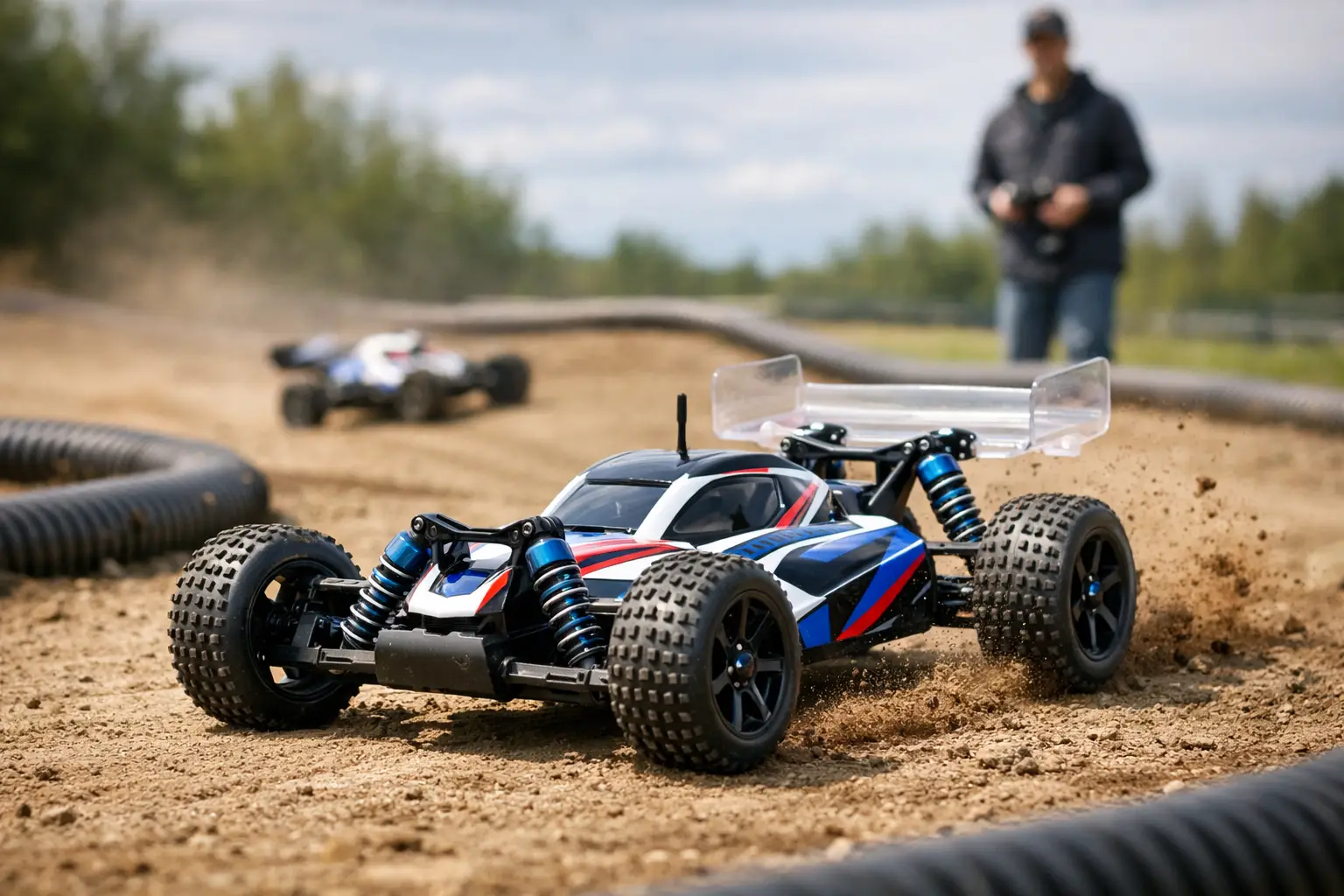
A good first RC buggy needs to survive the learning curve: clipped kerbs, uneven grass, accidental full-throttle inputs and the occasional meeting with a fence post.
This FTX buggy review looks at why FTX remains a popular choice for UK newcomers and casual bashers, where these models perform best and what you should check before buying one.
FTX offers hobby-grade RC vehicles at approachable prices. That distinction matters because a hobby-grade buggy is designed to be maintained, repaired and upgraded over time rather than discarded after one broken suspension arm or tired battery.
You can browse our current range of FTX RC buggies if you want to compare available models.
What does an FTX buggy do well?
The main appeal of an FTX buggy is straightforward: you get an electric RC car with independent suspension, replaceable parts and a layout that is relatively easy to understand.
For many buyers, an entry-level 1/10-scale buggy is an excellent step up from a toy-grade RC car.
A buggy is generally well suited to:
-
Tarmac
-
Short grass
-
Hard-packed dirt
-
Gravel
-
Prepared tracks
-
Dry parks
-
Mixed firm surfaces
The low body and wide stance help a buggy feel planted through faster corners.
Models such as the FTX Vantage have become familiar choices for UK hobbyists because the 4WD buggy format provides useful traction without becoming excessively complicated for a first-time owner.
Why 4WD works well for beginners
Four-wheel drive can make an RC buggy easier to control on loose or mixed surfaces.
Power is distributed to all four wheels rather than relying only on the rear tyres for drive.
This can help with:
-
Acceleration on loose ground
-
Stability
-
Wet or dusty surfaces
-
Recovering from small slides
-
Getting power down on grass
That does not make a 4WD buggy impossible to crash, but it can make the vehicle feel more predictable for a new driver.
FTX buggies are hobby-grade RC cars
One of the biggest advantages of choosing FTX over a basic toy-grade RC car is parts support.
Hobby-grade RC cars are designed so individual components can be replaced.
Depending on the model, replacement items may include:
-
Suspension arms
-
Steering components
-
Driveshafts
-
Differentials
-
Gears
-
Wheels and tyres
-
Body shells
-
Electronics
If something gets damaged, that does not necessarily mean the whole vehicle needs replacing.
For someone entering the hobby, that can make an FTX buggy considerably better value over time.
Check what is included with the buggy
FTX vehicles are commonly sold in ready-to-run form, but the exact contents vary between models.
Always check the individual product specification before ordering.
Depending on the version, the package may or may not include:
-
Drive battery
-
Battery charger
-
Transmitter batteries
-
Additional accessories
RTR – Ready to Run generally means the main vehicle is assembled and the radio system is installed.
It does not automatically guarantee that every battery or charging item needed to drive is included.
Where does an FTX buggy perform best?
Buggies work particularly well on relatively firm surfaces.
Their lower ride height and smaller tyre volume generally give them sharper handling than a monster truck, but that also means they have less ground clearance.
Good surfaces include:
-
Short grass
-
Dirt tracks
-
Tarmac
-
Gravel
-
Hard-packed ground
-
BMX-style areas used responsibly
Very long grass is much more demanding.
Long or wet grass can wrap around drivetrain components, increase rolling resistance and place considerably more load on the motor, ESC and battery.
If most of your driving will be across rough fields and long grass, read our guide to choosing the best RC car for grass.
A truggy or monster truck may be a better choice when extra ground clearance is more important than sharp buggy handling.
FTX buggy review: the compromises
FTX models are generally aimed at providing good hobby-grade value rather than competing directly with specialist race chassis.
That means expectations matter.
An entry-level FTX buggy should not automatically be treated like:
-
A dedicated racing buggy
-
A large 6S basher
-
A skate-park stunt vehicle
-
A speed-run car
The vehicle can still be quick and entertaining, but durability always depends on how it is driven.
Repeated high-speed impacts or landing jumps badly can damage any RC car.
Tyres make a big difference
Standard tyres are normally chosen to work reasonably well across several surfaces.
That inevitably involves compromise.
A tyre that works acceptably on:
-
Dirt
-
Grass
-
Tarmac
-
Gravel
will rarely be the absolute best option on every one of them.
Changing tyres later can be one of the most effective ways to adapt the buggy to where you actually drive.
Just make sure replacement tyres and wheels are compatible with the model.
Check:
-
Wheel diameter
-
Tyre size
-
Hex fitting
-
Offset
-
Clearance
before ordering.
2WD vs 4WD RC buggies
Both layouts have advantages.
4WD buggy
For most beginners, 4WD is usually the easier option.
Benefits can include:
-
More traction
-
Easier acceleration
-
Greater confidence on loose surfaces
-
More predictable handling in mixed conditions
A 4WD buggy is therefore a good choice for somebody who wants to start driving without spending as much time managing wheelspin.
2WD buggy
Two-wheel-drive buggies offer a different driving experience.
They are generally mechanically simpler and can reward more careful throttle control.
Because the driven wheels have to handle more of the acceleration load, the driver needs to learn how to manage grip.
For somebody interested in developing driving technique, that can be part of the appeal.
Brushed vs brushless FTX buggies
FTX produces models using both brushed and brushless power systems.
The right choice depends mainly on experience, available space and how much performance you want.
Brushed FTX buggy
A brushed model can be an excellent starting point for a beginner.
Advantages include:
-
More manageable speed
-
Lower initial cost
-
Less stress on drivetrain components
-
Easier learning curve
For somebody driving mainly around a garden, driveway or smaller park area, brushed power may be more than enough.
Brushless FTX buggy
Brushless RC motors can provide considerably stronger acceleration and higher performance.
That extra power also demands more from:
-
Batteries
-
Tyres
-
Drivetrain
-
Driver
-
Available space
A brushless buggy can be an excellent option for an experienced driver or someone who already understands hobby-grade RC cars.
It is not automatically the best first choice simply because it is faster.
Consider adjustable throttle for beginners
If the buggy is being bought for a younger or inexperienced driver, check whether the transmitter or ESC provides a way of reducing maximum throttle.
Being able to limit performance initially can help:
-
Build confidence
-
Reduce crashes
-
Protect drivetrain parts
-
Make smaller running areas more usable
Once the driver improves, more power can gradually be made available.
FTX buggy batteries
Battery type affects both performance and ease of ownership.
Depending on the model, FTX buggies may use NiMH or LiPo battery systems.
NiMH batteries
NiMH batteries are straightforward and can be a good introduction to hobby-grade RC.
They generally require less battery-management knowledge than LiPo packs.
LiPo batteries
LiPo batteries can offer:
-
Lower weight
-
Strong power delivery
-
High capacity for their size
-
Better performance in demanding setups
However, they require appropriate charging and storage.
If your FTX buggy uses LiPo power, use a suitable charger and follow the manufacturer's instructions.
Our guide to choosing the best RC charger for LiPo batteries explains the main charger features to consider.
Do not buy the biggest battery you can find
Battery capacity is only one specification.
The battery must also be compatible with:
-
Battery tray dimensions
-
Voltage
-
Connector
-
ESC
-
Motor
-
Vehicle specifications
A physically larger battery may not fit the tray even if its electrical specification looks suitable.
Likewise, increasing battery voltage beyond what the electronics are designed to support can damage the model.
Always check the exact vehicle specification first.
How long does an FTX buggy run for?
There is no single run-time figure that applies to every FTX buggy.
Run time varies according to:
-
Battery capacity
-
Motor type
-
Terrain
-
Temperature
-
Vehicle weight
-
Tyre choice
-
Driving style
Constant full-throttle running through grass places much more load on the battery than mixed-speed driving on smooth tarmac.
For regular users, having a second compatible battery is often more useful than trying to fit one extremely large pack.
LiPo battery safety
If your buggy uses a LiPo battery, follow the battery and charger manufacturer's instructions.
Important habits include:
-
Use the correct charging programme
-
Balance charge where required
-
Do not charge a damaged battery
-
Allow hot batteries to cool before charging
-
Use the ESC's correct LiPo low-voltage setting
-
Store batteries appropriately
-
Stop using swollen or damaged batteries
LiPo batteries provide excellent performance when used correctly, but they need more care than simply charging them whenever the car slows down.
FTX spare parts availability matters
One of the most important questions when buying any hobby-grade RC car is not simply:
How much does the car cost?
It is:
Can I get parts for it when I need them?
RC cars are mechanical vehicles.
Things wear out and crashes happen.
Useful spare parts for a buggy can include:
-
Suspension arms
-
Steering parts
-
Wheel hexes
-
Driveshafts
-
Spur gears
-
Pinion gears
-
Body clips
-
Wheels and tyres
The ability to repair the model is a major part of what separates a hobby-grade RC buggy from a disposable toy.
Basic FTX buggy maintenance
A little maintenance can prevent a surprising number of problems.
After driving:
-
Remove grass and stones
-
Brush away loose dirt
-
Check the wheels rotate freely
-
Inspect suspension components
-
Check wheel nuts
-
Look for loose fasteners
-
Check drivetrain noise
-
Inspect the battery
-
Allow electronics to cool
If the buggy has been used in damp conditions, make sure it is properly dried before storage.
Do not put a wet and muddy model straight into a cupboard or box.
Upgrade reliability before chasing more speed
It is very easy for a new RC owner to immediately start searching for faster motors and larger batteries.
That is not always the best use of money.
Useful improvements can include:
-
Better tyres for your surface
-
Fresh bearings
-
Stronger steering parts where genuinely needed
-
Better charging equipment
-
Additional batteries
A faster motor will not fix poor tyres, worn bearings or bad driving technique.
Be careful with aluminium upgrades
Metal upgrade parts look impressive, but aluminium is not automatically better in every position.
Plastic parts can flex during an impact and may act as relatively inexpensive sacrificial components.
Replacing everything with aluminium may:
-
Add weight
-
Transfer crash forces elsewhere
-
Increase repair costs
Upgrade parts to solve an actual weakness rather than simply replacing every plastic component.
Who should buy an FTX buggy?
An FTX RC buggy is particularly well suited to someone who wants a genuine hobby-grade RC car without immediately moving into premium racing equipment.
It can be a good choice for:
-
First-time hobby-grade RC owners
-
Teenagers
-
Casual bashers
-
Returning RC hobbyists
-
Drivers wanting a repairable model
-
Anyone wanting good performance without immediately buying a high-end platform
Who should choose something else?
An RC buggy is less suitable if the main goal is:
-
Rock crawling
-
Driving through deep mud
-
Long rough grass
-
Extreme skate-park jumping
-
Very rough terrain
Choose the vehicle around the surface.
A buggy may outperform a monster truck on a smoother track, but the monster truck's larger tyres and extra ground clearance can make it more practical on rough terrain.
Frequently Asked Questions
Are FTX RC cars good for beginners?
Yes. Many FTX models are designed as approachable hobby-grade vehicles with replaceable parts and ready-to-run configurations, making them suitable for drivers moving beyond toy-grade RC cars.
Is the FTX Vantage good for beginners?
The FTX Vantage 4WD buggy format can be a good beginner option because four-wheel drive provides useful traction and predictable handling. The exact version matters, particularly when choosing between brushed and brushless power.
Should I buy brushed or brushless FTX?
A brushed model is generally easier for a complete beginner to manage. Brushless models provide considerably more performance and may be more suitable once the driver has experience and suitable space.
Can an FTX buggy drive on grass?
Yes, particularly on short grass. Long or wet grass creates considerably more resistance and can cause the motor and electronics to work harder.
Are FTX RC cars hobby-grade?
Yes. FTX vehicles use replaceable mechanical and electrical components and can be maintained and repaired rather than treated as disposable toys.
Can I upgrade an FTX buggy?
Many FTX models have replacement and upgrade components available. Before changing motors, batteries or drivetrain parts, make sure the upgrade is compatible with the exact model and version.
Is 4WD better than 2WD for a beginner?
For most new drivers, 4WD is easier because it provides additional traction and stability. 2WD can be very rewarding but usually requires more throttle control when grip is limited.
Do FTX buggies include a battery and charger?
It depends on the exact model and version. Check the individual product listing before ordering because ready-to-run does not always mean every battery and charging accessory is included.
Shop FTX RC buggies in the UK
FTX buggies make a strong starting point for drivers who want a proper hobby-grade RC car with repairable components and sensible parts support.
The most important decision is not simply which version is fastest.
Choose according to:
-
Available driving space
-
Terrain
-
Driver experience
-
Brushed or brushless preference
-
Battery requirements
-
Budget
RC Model Shop UK stocks a range of FTX RC buggies, including brushed and brushless options for different levels of experience.
If you are unsure which FTX model is best for where you intend to drive, contact us and tell us the type of terrain, available space and who will be using it. We can help narrow down the most suitable options.
Written by RC Model Shop UK