
Why RC Tyres Balloon and What to Do About It
18/09/2026
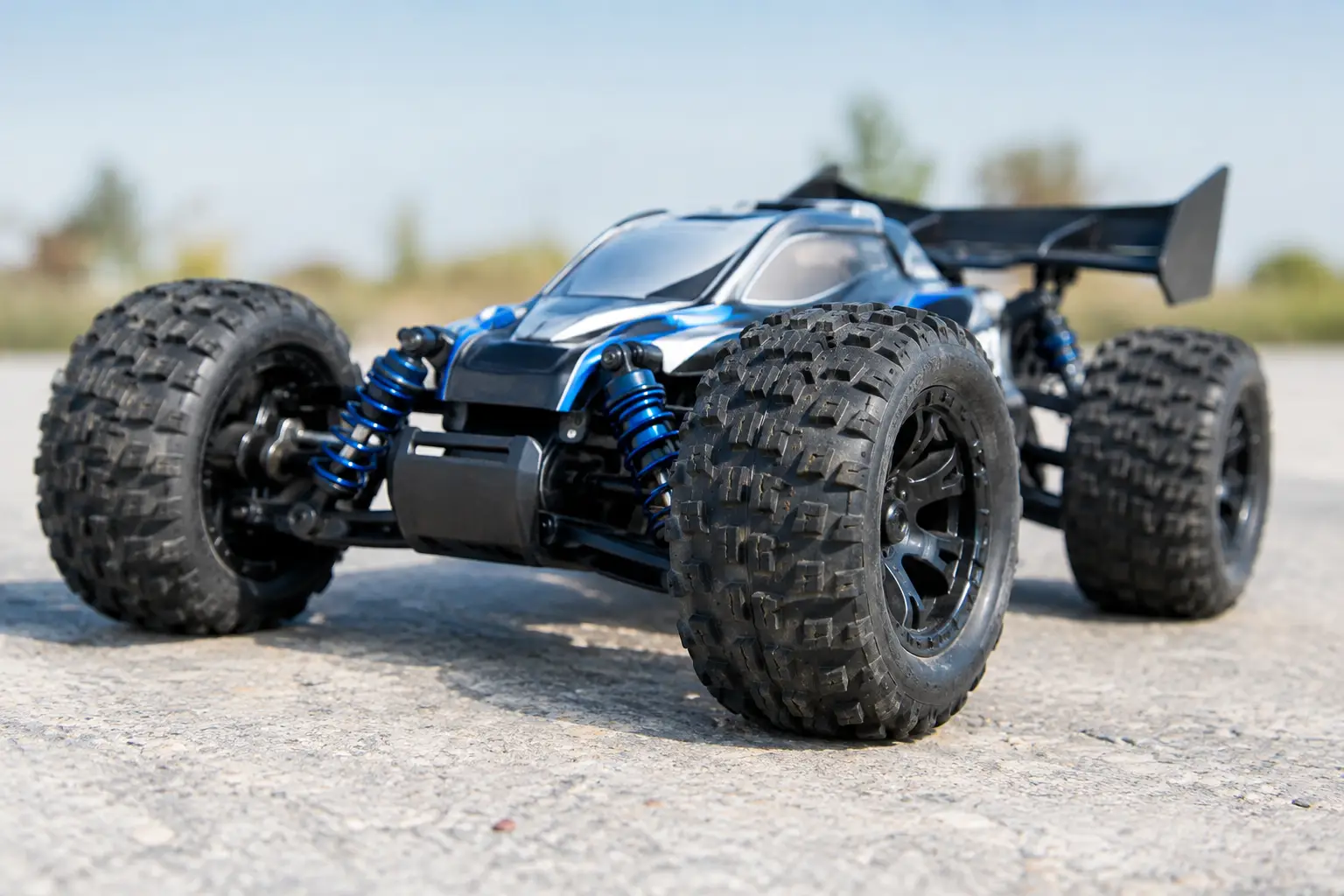
You line up a full-throttle pass, the motor comes on song, and suddenly the tyres look as though they have grown an inch. Understanding why RC tyres balloon helps you decide whether you are seeing normal high-speed behaviour or a setup issue that needs attention before it costs you a tyre, wheel hex or driveshaft.
Tyre ballooning is most common on fast electric bashers, stadium lorries and speed-run models, particularly when using powerful brushless systems on 3S, 4S, 6S or higher-voltage batteries. It is not always a fault. Every flexible rubber tyre expands to some degree as wheel speed rises. The question is whether that expansion is controlled, predictable and suited to how you use the model.
Why RC tyres balloon at speed
The main cause is centrifugal force. As the wheel spins, the mass of the tyre is pulled away from its centre. Rubber stretches, the sidewall flexes and the tyre diameter increases. More RPM means more force, and the effect rises very quickly rather than in a gentle straight line.
This is why a model can look perfectly settled at half throttle but develop dramatically swollen tyres during a flat-out run. A tyre that expands in diameter also covers more ground per revolution. In effect, the gearing becomes taller as the tyre grows, which can place extra load on the motor and ESC just when they are already working hardest.
Powerful brushless motors make ballooning far more visible because they can spin the wheels at enormous speed. A lightweight wheel and tyre assembly accelerates quickly, while a grippy surface can allow enough traction for the drivetrain to keep loading the tyres rather than simply spinning them loose. On-road speed models and high-powered 4WD bashers are frequent examples.
Why it can affect handling and reliability
A small, even amount of expansion is usually nothing to worry about. Many off-road tyres are designed with this in mind. Excessive ballooning, however, changes the tyre shape from its intended profile. The tread can crown in the middle, reducing the contact patch and making the model feel vague, twitchy or less stable under power.
On a buggy or truggy, that can mean reduced steering precision and inconsistent grip as you accelerate out of turns. On a monster lorry, a heavily ballooned tyre can make the model wander, lift unexpectedly or become harder to place before a jump. It can also make braking less predictable, as the tyres return towards their normal shape while the vehicle slows.
There is a mechanical cost too. A larger spinning tyre has more rotational inertia. The motor, pinion, spur gear, diffs, driveshafts and wheel hexes all have to deal with that load. If the tyres are badly unbalanced, vibration adds another problem. At high speed, that vibration can work wheel nuts loose, wear bearings and make an otherwise sound model feel unsettled.
In the worst cases, the tyre can tear at the bead, split through the carcass or pull away from the wheel. Once glue begins to fail, stop running it. A detached tyre can damage the body shell, suspension or nearby people, and it is unlikely to be repairable after a high-speed failure.
The setup factors that make ballooning worse
Tyre design is the biggest factor. Soft-compound tyres with thin, flexible carcasses generally expand more than firm, reinforced tyres. Large-diameter monster lorry tyres have a lot of rubber moving at the outside of the wheel, so they naturally generate substantial force at high RPM. Paddle tyres can also balloon noticeably when used with more power than their construction was intended for.
Foams matter just as much. The foam insert supports the tyre from within and helps it retain its shape. If the foam is too soft, worn, undersized or waterlogged, it cannot properly support the carcass. The result is often a tyre that grows in the centre and folds or squirmes at the edges during hard acceleration and cornering.
Water is particularly troublesome. If water has entered through the vent holes or an imperfect tyre bead, the foam can become heavy and uneven. The tyre may then wobble as well as balloon. After wet running, remove the wheels where practical and allow them to dry thoroughly. Leaving wet foam inside a tyre can create a handling issue on the next dry run and shorten the life of the insert.
Gearing and battery choice also play a part. Fitting a larger pinion, using a high-discharge battery or moving up a cell count may give the model enough wheel RPM to overwhelm its standard tyres. That does not automatically mean the upgrade is wrong, but it may mean the tyres are no longer the best match for the setup. Check motor and ESC temperatures after gearing changes, especially if tyre growth is obvious on long full-throttle passes.
Surface choice changes the picture. Loose dirt allows the tyres to spin, while high-grip tarmac can transmit power more effectively and stretch the tyre hard. The same vehicle may show mild ballooning on short grass and severe ballooning on a smooth car park.
How to reduce RC tyre ballooning
The most effective solution for a fast model is often a belted tyre. Belted RC tyres use an internal reinforcement layer to limit expansion at speed. They stay closer to their intended diameter, which improves high-speed stability, keeps the contact patch more consistent and reduces the strain caused by an expanding tyre.
There is a trade-off. Belted tyres can be heavier and less forgiving over rough ground than a conventional tyre. They may also transmit more impact into the wheel and suspension on big landings. For bashing in a field, a quality standard tyre with suitable foams can be the better choice. For repeated high-speed runs on tarmac, belted tyres are usually a worthwhile upgrade.
If belted tyres are not appropriate, start with the basics. Use tyres designed for your model's wheel size, vehicle weight and power level. Check that the foam insert fills the carcass properly without being crushed. A good foam should support the tyre but still allow it to conform to the surface. Tyres supplied as pre-mounted sets are convenient, but they are still worth inspecting before use.
Make sure each tyre is properly glued around both bead edges. Gently pull at small sections of the bead to check for lifting, without forcing the rubber. Re-glue any loose areas with suitable tyre adhesive before running. Also inspect the wheels for cracks around the hex and bead, as a damaged wheel can mimic an out-of-balance tyre problem.
Reducing punch settings, throttle EPA or aggressive launch modes can make a major difference without making the model dull to drive. It is often the sudden burst of torque that starts the tyre expanding and destabilises the car. Smoother power delivery is particularly useful for newer drivers and for models used in confined areas.
You can also gear down if the model is over-geared for its running surface. A smaller pinion lowers top wheel speed and can improve temperatures, acceleration control and drivetrain life. Do not use gearing alone to hide a tyre problem, though. If a tyre is distorted, damaged or unsuitable for the model, it still needs replacing.
Venting, balancing and common mistakes
RC tyres and wheels are usually vented to let air move in and out as the tyre compresses. This prevents the tyre acting like a sealed air spring and can improve landing behaviour. Vent holes may be in the tyre itself or in the wheel, depending on the design.
It is tempting to block vents in the hope of stopping ballooning. Usually, this does not solve the real issue and can create unpredictable handling. Tyre expansion is primarily caused by spinning mass and flexible construction, not simply trapped air. Blocked vents can also leave moisture with nowhere useful to escape.
Balancing is another overlooked job on models that regularly run at high speed. Even a well-made tyre can have a heavy spot from moulding, glue or moisture in the foam. A balanced wheel assembly reduces vibration and makes the model calmer at speed. It will not stop a soft tyre ballooning, but it can prevent the wobble that makes ballooning look and feel worse.
Avoid wrapping tape around the outside of a tyre as a permanent fix. It can peel, upset balance and fail without warning. Internal taping has been used by experienced hobbyists, but it is time-consuming, can trap moisture and is rarely as dependable as choosing a tyre built for the job. For most drivers, correctly matched belted tyres or firmer foams are the sensible route.
When ballooning means it is time to stop
Stop and inspect the wheels if one tyre balloons much more than the others, the vehicle suddenly shakes at speed, a tyre develops a visible bulge, or you can hear the bead lifting. Uneven ballooning often points to a damaged foam, water inside the tyre, a partially detached bead or an imbalance rather than normal tyre behaviour.
Also check after a major power upgrade. Standard tyres that are excellent on a 2S basher may not be safe or effective after moving to 4S power. Matching tyres to your actual setup, rather than the model's original specification, is the key decision.
A little tyre growth is part of fast RC driving. When it becomes excessive, treat it as useful feedback from the model: adjust the power delivery, inspect the tyre assembly or choose a construction that suits the speed you want to run. The right tyres let you use the performance you have paid for with more control and fewer surprise repairs.