RC Chargers: Choose the Right Power for Your Packs
17/11/2026
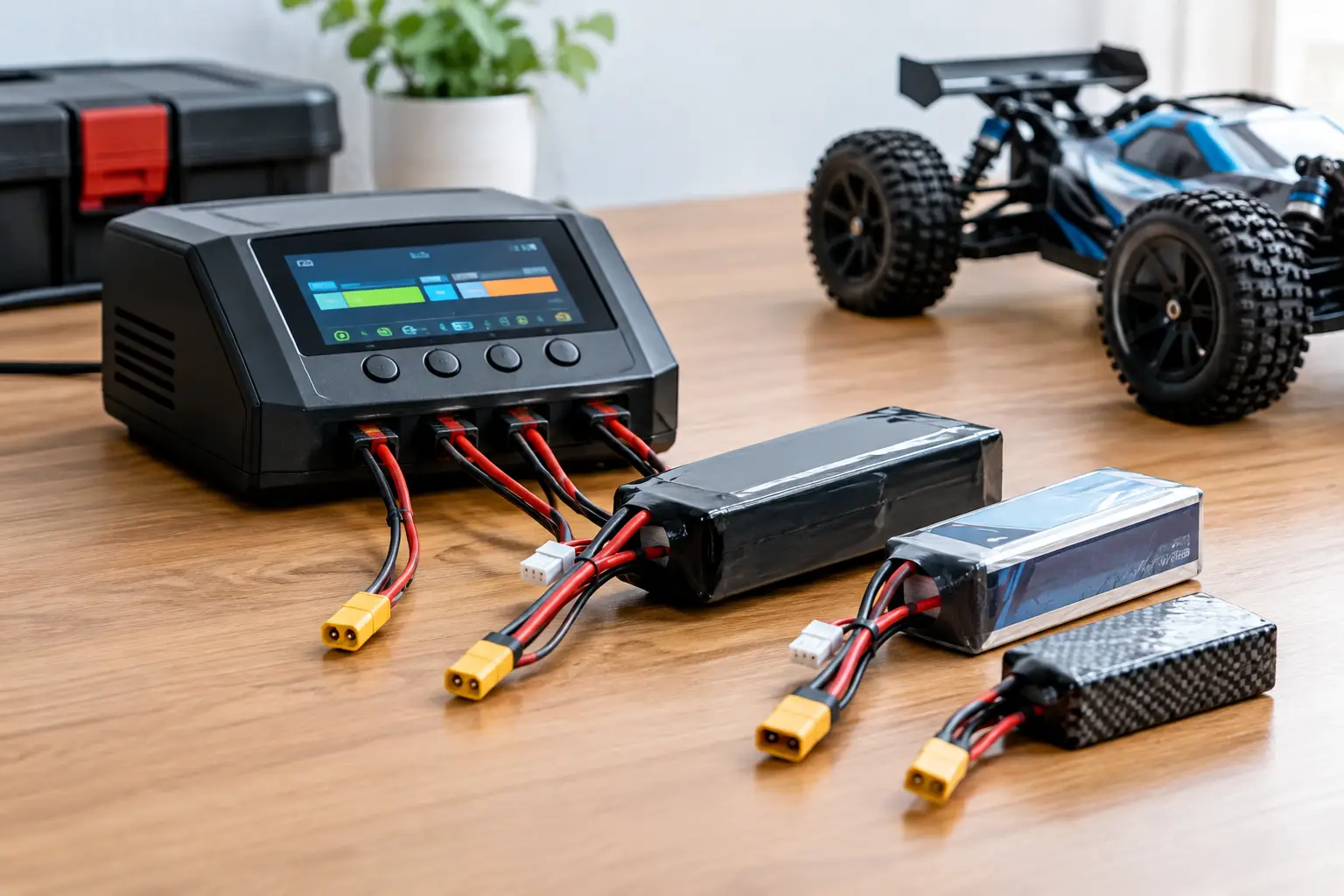
A new LiPo pack can feel like a disappointing purchase if it takes all evening to charge, while an overpowered unit with the wrong connections can be just as frustrating. RC chargers are a key part of the hobby: they affect how quickly you get back to driving, flying or boating, and how well your batteries perform over time. The right choice is not always the biggest or most expensive charger. It is the one that suits your battery chemistry, pack capacity, connector type and the way you run your models.
What RC chargers need to do
At a basic level, an RC charger puts energy back into a battery at a controlled rate. For modern hobby packs, however, it also needs to monitor voltage, stop at the correct point and identify faults before they become a problem. That is why a proper hobby-grade charger is very different from a basic mains lead supplied with some ready-to-run models.
Most RC enthusiasts will encounter LiPo, NiMH and sometimes LiFe batteries. Each chemistry needs its own charging programme. A quality charger lets you select that programme, set the correct current and confirm the number of cells in the pack. Using the wrong mode is not a minor setting error. It can permanently damage a battery and, in the case of lithium packs, create a serious safety risk.
For LiPo batteries, balance charging is the feature that matters most. A 2S, 3S or 4S LiPo is made from individual cells connected together. Over repeated use, those cells can drift slightly apart in voltage. The balance lead allows the charger to monitor and correct each cell, rather than treating the pack as one unit. For routine LiPo charging, use balance mode unless the battery manufacturer gives a specific reason not to.
Choose RC chargers by battery type and capacity
Start with the packs you own now, then think about the models you are likely to add next. A small 2S 2200mAh LiPo for an entry-level buggy does not require the same equipment as a pair of 6S 8000mAh packs used in a large-scale basher.
Battery capacity is stated in milliamp hours, or mAh. The standard, sensible charge rate for most packs is 1C. This means charging at a current equal to the capacity expressed in amps. A 5000mAh battery is 5.0Ah, so 1C is 5 amps. At that rate, a fully depleted pack generally takes around an hour to charge, although the final balancing stage can add time.
Some battery labels permit higher rates, such as 2C or 3C. That does not mean higher-rate charging is always the best option. It may be useful when time is limited, but it produces more heat and can place additional strain on the pack. Charging at 1C is the dependable default, particularly if you want good battery life.
NiMH packs are more forgiving than LiPos, but they still need the correct mode and current. Many starter models use 6-cell or 7-cell NiMH batteries with a Tamiya-style connector. A programmable charger will normally give a safer, more consistent result than a timed wall charger, and it can help reveal a pack that is no longer holding its capacity.
Understanding watts, amps and charge time
A charger's wattage determines how much charging power it can deliver. The required wattage rises as battery voltage and charging current increase. The simple calculation is volts multiplied by amps.
For example, a 2S LiPo reaches 8.4V when full. Charging a 5000mAh 2S pack at 5A requires roughly 42W. A 50W charger is therefore adequate for one pack at 1C, with some headroom. A 4S 5000mAh LiPo charged at 5A needs around 84W, so a 100W charger is the more practical minimum.
This becomes especially relevant with larger 6S packs, high-capacity batteries and twin charging. A charger may advertise a high maximum current, but it cannot supply that current at every voltage if its wattage is limited. Check the watt rating, not just the largest amp figure on the box.
One output or two?
A single-output charger suits many hobbyists perfectly. It is simpler, takes up less bench space and is ideal when you normally run one battery at a time. If your model uses a pair of packs, or you often charge batteries for several vehicles before a weekend session, a dual-output charger can save a great deal of waiting.
A true dual charger has two independently controlled channels. That means each battery can have its own chemistry, cell count and charge rate. You might charge a 2S LiPo on one side and a receiver pack on the other, provided both are set correctly.
Parallel charging is another option, but it needs more care. Packs connected in parallel should be the same chemistry, cell count and closely matched voltage. It is not the best starting point for a new LiPo user. Two independent outputs are slower only in the sense that each pack is treated separately, which is generally the safer and more flexible approach.
Mains, DC and power supply choices
An AC charger plugs directly into a UK mains socket and is the easiest option for home use. Many include DC input as well, allowing you to run them from a suitable external power source at the track or field. For most beginners and casual bashers, an AC/DC charger is the most convenient choice.
Some higher-power chargers are DC only. These can offer excellent performance, but they need a separate power supply or a suitable 12V source. That setup makes sense for experienced users charging multiple large packs, but it adds another specification to check. Your power supply must provide enough wattage and current for the charger. A powerful charger connected to an undersized supply will not deliver its claimed output.
Connectors and leads are part of the decision
Your charger may have 4mm or 5mm output sockets, while your batteries could use IC, XT60, XT90, EC or Tamiya connectors. This is normal. The answer is usually a suitable charge lead, not cutting and replacing connectors on every battery.
Choose charge leads with the correct battery connector and suitable wire gauge for the current you intend to use. Avoid stacking several adaptors together where possible. Each extra connection is another possible point of resistance, heat or accidental disconnection.
For LiPo packs, check the balance port as well as the main connector. Most standard LiPos use JST-XH balance leads, but there are exceptions. The balance plug must fit the charger's balance board or adaptor correctly. Never force a plug into a socket because it looks close enough.
Safe charging habits that protect your packs
The charger is only one part of safe battery care. Use it on a clear, non-flammable surface, keep lithium packs inside a suitable LiPo safety bag or fire-resistant charging enclosure, and stay nearby while charging. Do not charge a puffed, damaged, wet or unusually hot battery.
Before starting, confirm four things: the battery chemistry, cell count, charge current and selected programme. When a LiPo charger asks you to verify the cell count, take the prompt seriously. If the displayed count does not match the pack in front of you, stop and check the connections and settings.
After a run, let batteries cool before recharging. Charging a hot pack is hard on the cells. Likewise, do not leave a fully charged LiPo unused for weeks. If you will not use it within a few days, select the charger's storage mode. It brings the pack to a safer voltage for keeping between sessions and is one of the simplest ways to extend LiPo life.
Features worth paying for
A clear display, straightforward menu and reliable buttons make a bigger difference than they might seem. Charging should be a repeatable routine, not a sequence of confusing menu options. Memory slots are useful when you have several regular pack types, as they reduce the chance of entering the wrong settings each time.
Internal resistance readings, temperature monitoring and data functions can be valuable for racers and serious enthusiasts diagnosing battery performance. They are useful extras rather than essentials for a first charger. More important is accurate balancing, adequate wattage, the right leads and a brand with proper instructions and support.
At RC Model Shop, the practical starting point is to match the charger to your largest likely battery rather than only the smallest pack you currently own. A little headroom avoids an unnecessary replacement when you move from a 2S starter vehicle to a faster 3S or 4S model. Set it up carefully, charge at sensible rates, and your batteries will be ready when the next run is.