
How to Clean RC Car Bearings for Longer Life
04/09/2026
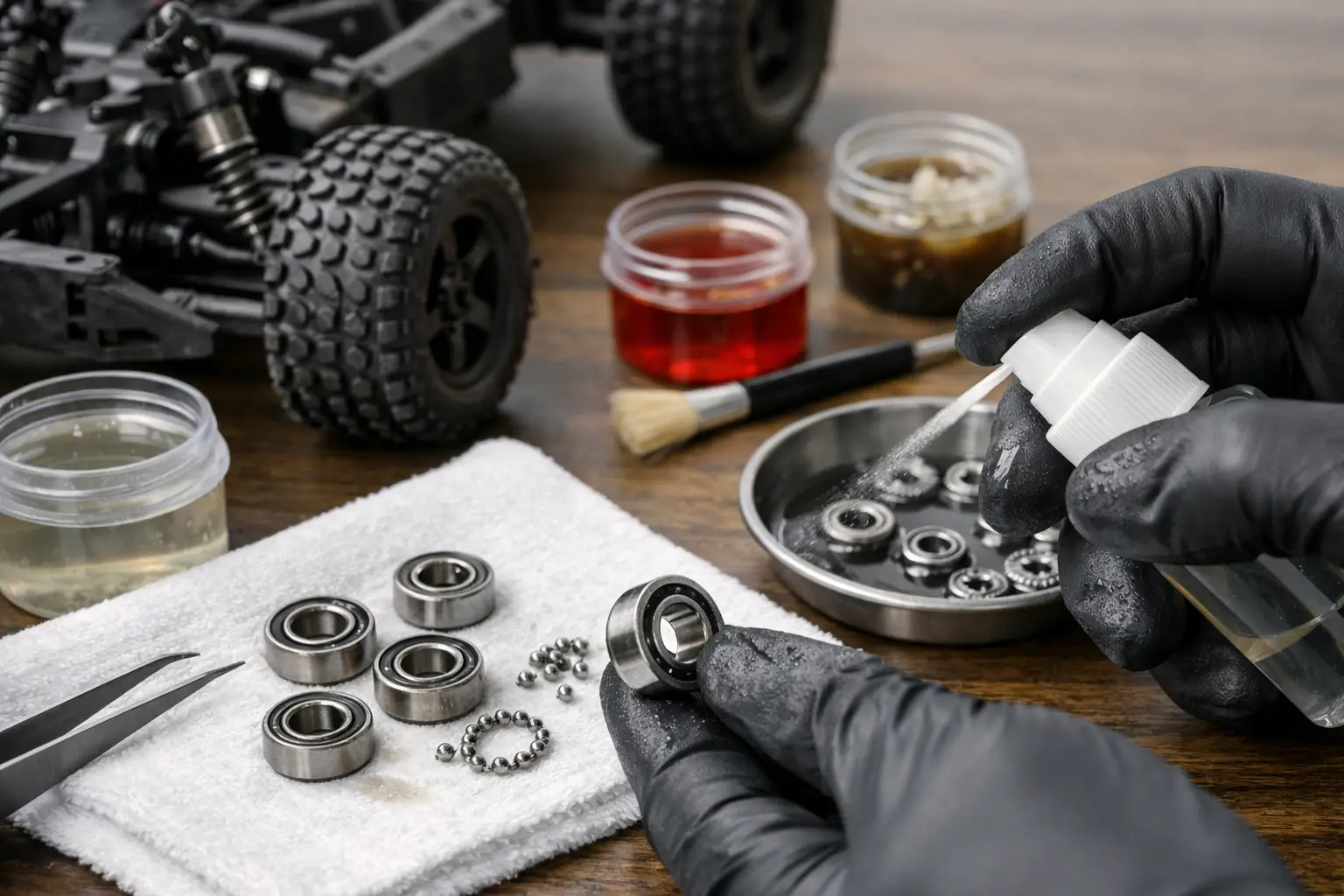
A gritty drivetrain, a wheel that does not spin freely or a motor working harder than usual can sometimes be traced back to one small component: a worn or contaminated bearing.
Learning how to clean RC car bearings properly can help keep a model running smoothly and reduce unnecessary drivetrain resistance. However, not every rough bearing is worth saving. Sometimes replacement is the better option, particularly when corrosion, excessive play or physical damage is already present.
RC bearings are used throughout many vehicles, including wheel hubs, gearboxes, differentials, steering assemblies and other rotating parts. Their job is simple: allow components to rotate smoothly with minimal friction.
Once dirt, water, dried lubricant or corrosion gets inside, that smooth operation can quickly disappear.
If your bearings are already worn beyond servicing, browse our range of RC bearings and bearing kits for replacement options covering many popular RC models.
When should you clean RC car bearings?
You do not need to remove and clean every bearing after every dry run.
Unnecessary dismantling can create more work without providing any real benefit.
Instead, pay attention to how the model sounds and feels.
A bearing may be worth inspecting if:
-
A wheel feels rough or notchy when rotated
-
You hear grinding or squealing
-
Part of the drivetrain feels unusually tight
-
A wheel has excessive play
-
The drivetrain no longer rotates smoothly
-
The vehicle has been used heavily in mud, sand or water
-
You can see contamination or corrosion around the bearing
Cleaning is particularly worth considering after demanding wet or dirty running.
Water left around bearings can contribute to corrosion, while fine sand and grit can work their way past seals and accelerate wear.
For race vehicles, bearing inspection may form part of regular preparation.
For bashers and crawlers, maintenance frequency will depend much more on where and how the model is driven.
An RC crawler regularly used through mud, streams and wet woodland may require more frequent bearing inspection than a car used mainly on clean, dry tarmac.
Check whether the bearing actually needs cleaning
Before reaching for cleaning fluid, remove the bearing and turn it slowly by hand.
A healthy bearing should generally feel smooth without obvious:
-
Grinding
-
Notches
-
Excessive side play
-
Rust
-
Physical damage
Do not judge a bearing purely by how long it free-spins.
Some bearings contain heavier lubrication or have seals that create slightly more drag, so a bearing that stops quickly is not automatically faulty.
The important question is whether it rotates smoothly.
When should an RC bearing be replaced?
Cleaning cannot repair physical wear.
Replace the bearing if you find:
-
Heavy rust
-
Pitted bearing surfaces
-
Excessive movement or play
-
Cracked or damaged seals
-
Heat damage or discolouration
-
Persistent roughness after cleaning
-
A damaged inner or outer race
Continuing to use a badly worn bearing can sometimes damage other components.
A failed wheel bearing, for example, can allow unwanted movement around the axle, wheel hub or driveshaft.
If a bearing is inexpensive and already badly contaminated, replacing it may be more sensible than repeatedly trying to recover it.
You can search our RC bearings and complete bearing kits using the model or bearing dimensions.
Understand the type of bearing fitted
RC models use several different bearing designs.
Common examples include:
Rubber-sealed bearings
These use rubber or rubber-like seals to help protect the internal bearing components from contamination.
You may see markings such as RS or 2RS, although exact manufacturer terminology varies.
These are commonly found on RC vehicles because the seals provide useful protection against dirt and moisture.
Metal-shielded bearings
These use thin metal shields rather than rubber seals.
They are often identified by markings such as ZZ, although again terminology can vary.
Open bearings
Some bearings have no protective shield or seal over the ball race.
These are easier to lubricate but provide less protection against contamination.
The correct cleaning method depends on how the bearing is constructed.
Do not assume every seal or shield is intended to be removed.
What you need to clean RC bearings
Keep your work area clean and well lit.
Useful equipment may include:
-
Suitable bearing cleaner
-
Lint-free cloth
-
Soft cleaning brush
-
Bearing lubricant
-
Small parts tray
-
RC hex drivers
-
Tweezers or appropriate small tools
-
Protective gloves where required
A magnetic parts tray or small containers are especially useful when dismantling hubs and gearboxes because RC assemblies often contain small washers, spacers and shims that are easy to lose.
Follow the safety instructions supplied with any cleaning product.
Use suitable ventilation and keep flammable cleaning products away from ignition sources.
Avoid unsuitable cleaning chemicals
Do not automatically reach for whatever strong solvent happens to be in the garage.
Some aggressive cleaners can damage:
-
Rubber seals
-
Plastic components
-
Paint
-
Adhesives
-
Lubricants
Products designed for unrelated automotive applications may also leave residues or be unsuitable for precision RC components.
Use a cleaner intended for bearings or suitable precision mechanical components and follow its manufacturer's directions.
If you are unsure whether a cleaner is compatible with a particular sealed bearing, replacement may be safer than experimenting with chemicals.
Remove the RC bearings carefully
Before dismantling unfamiliar hubs, gearboxes or drivetrain assemblies, take a few photographs.
This makes it much easier to remember the position of:
-
Bearings
-
Spacers
-
Shims
-
Washers
-
Driveshaft components
-
Left and right-hand parts
Remove bearings carefully without damaging the seal or surrounding housing.
Do not force a bearing out at an angle if it is tightly fitted.
If several different bearing sizes are being removed, keep them organised so they return to the correct positions.
How to clean RC car bearings
1. Remove loose dirt first
Wipe away loose dirt, mud and debris from the outside of the bearing.
There is little point putting a heavily mud-covered bearing straight into clean bearing fluid.
Removing the worst contamination first keeps the cleaner working on the material inside and around the bearing.
2. Inspect the seals
If the bearing has seals, inspect their condition.
Some bearing seals can be removed for servicing, while others are not intended to be repeatedly removed.
Do not force a seal out unless you know the bearing design allows it.
A bent or damaged seal may allow considerably more contamination into the bearing afterwards.
3. Clean the bearing
Use your chosen bearing-cleaning product according to its instructions.
Depending on the product and bearing type, this may involve flushing or soaking the bearing.
Gently rotating the inner race can help move cleaner through accessible internal surfaces.
Very dirty bearings may require more than one clean using fresh fluid.
Do not aggressively spin the bearing while it is dry or contaminated.
4. Allow the bearing to dry
Remove the bearing and allow the cleaning fluid to drain.
Wipe the outside using a lint-free cloth.
Allow the bearing to dry appropriately for the cleaner being used.
Compressed air can sometimes assist drying, but avoid using high-pressure air to spin a dry bearing at extremely high speed.
5. Inspect the bearing again
Once clean and dry, turn the bearing slowly.
It should feel smooth without obvious grinding, tight spots or excessive play.
If substantial roughness remains after cleaning, replace the bearing rather than repeatedly trying to recover it.
Lubricate the bearing after cleaning
Cleaning can remove some or all of the bearing's previous lubricant.
A serviceable bearing therefore needs appropriate lubrication before being returned to use.
Use a lubricant suitable for the bearing and application.
Do not automatically flood the bearing with oil.
Excess lubricant can attract dust and escape into surrounding components.
The appropriate lubricant can also depend on how the model is used.
A race vehicle where reducing drivetrain drag is important may have different maintenance priorities from a crawler regularly driven through wet and muddy conditions.
If the bearing manufacturer or model manufacturer specifies a particular lubricant or servicing method, follow that recommendation.
Refit bearing seals carefully
Where removable seals have been taken out for servicing, inspect them before refitting.
Do not reuse a badly:
-
Torn
-
Stretched
-
Bent
-
Split
-
Deformed
seal.
Make sure any reusable seal sits correctly in position without obvious gaps.
A damaged seal can allow dirt and water back into a freshly cleaned bearing very quickly.
How to install an RC bearing correctly
Refit the bearing squarely into its housing.
Avoid applying unnecessary force through the wrong bearing race.
As a general mechanical principle:
-
When pressing a bearing into a housing, apply force to the outer race
-
When pressing a bearing onto a shaft, apply force to the inner race
This helps avoid transferring installation force through the balls and internal race surfaces.
Do not hammer directly against a bearing unless the manufacturer specifically provides an appropriate installation method.
Check the drivetrain before driving
Before fully rebuilding the model, rotate the drivetrain manually.
Check that:
-
Wheels turn smoothly
-
Gears rotate correctly
-
Driveshafts are not binding
-
Bearings sit squarely
-
Shims and spacers have been refitted
-
Nothing has been overtightened
If the drivetrain was smooth before final tightening but becomes tight afterwards, investigate the assembly rather than assuming the new or cleaned bearing is faulty.
Test the RC car after bearing maintenance
Once the model has been rebuilt, test it carefully.
Start with a gentle run rather than immediately using full power.
Listen for:
-
Grinding
-
Clicking
-
Squealing
-
Unusual drivetrain noise
After running, check for abnormal heat around the hubs and drivetrain.
If one area becomes noticeably hotter than the equivalent component on the opposite side of the vehicle, investigate further.
How to keep RC bearings cleaner
Preventative maintenance can reduce how often bearings need to be removed.
After dirty running:
-
Brush loose mud and dirt from the vehicle
-
Do not store the RC car wet
-
Dry wet areas appropriately
-
Inspect wheel hubs for trapped dirt
-
Remove grass and debris wrapped around driveshafts
-
Check bearings after particularly wet or sandy use
Be careful when washing an RC model.
Forcing water directly into bearings, differential housings and electrical equipment can create problems that were not there before cleaning.
A vehicle can look spotless externally while water remains trapped inside bearings and drivetrain assemblies.
Should you pressure wash an RC car?
Generally, avoid directing high-pressure water at RC bearings, electronics and drivetrain seals.
Pressure can force water and contamination past seals.
If a vehicle needs cleaning after muddy use, follow the manufacturer's cleaning recommendations and concentrate on removing contamination without forcing water into sensitive areas.
Dry the vehicle properly before storage.
Keep spare bearings for frequently used RC cars
If you run the same RC car regularly, having common replacement bearings available can reduce downtime.
This is particularly useful for:
-
Bashers
-
Race cars
-
Crawlers
-
Vehicles used in wet conditions
Complete bearing kits are also available for some models, allowing a larger rebuild without identifying every bearing individually.
RC Model Shop UK stocks a wide range of replacement RC bearings and model-specific bearing kits.
Always check the bearing dimensions and model compatibility before ordering.
Bearings that appear almost identical can have different:
-
Internal diameters
-
External diameters
-
Widths
-
Flanges
-
Seal types
so choosing by appearance alone is not recommended.
Frequently Asked Questions
How often should I clean RC car bearings?
There is no fixed interval for every RC car. A model used mainly in clean, dry conditions may need very little bearing maintenance, while a crawler or basher regularly used in mud, sand and water may require inspection much more frequently.
Can you clean sealed RC bearings?
Some sealed bearings can be serviced, but it depends on their construction. Do not assume every rubber seal or metal shield is designed to be removed. If a sealed bearing remains rough or damaged, replacing it is often the better option.
How do I know if an RC bearing is bad?
Common signs include grinding, rough movement, excessive play, visible rust, damaged seals or a drivetrain component that no longer rotates smoothly.
Should RC bearings spin freely for a long time?
Not necessarily. A heavily lubricated or sealed bearing may stop relatively quickly while still being in good condition. Smooth rotation without grinding or excessive play is more important than how long it free-spins.
What oil should I use on RC bearings?
Use a lubricant intended for suitable precision bearings and the type of RC application involved. Manufacturer recommendations should take priority where available.
Can I use WD-40 to lubricate RC bearings?
A general-purpose water-displacing product should not automatically be treated as a dedicated long-term bearing lubricant. Use a lubricant intended for the bearing and application.
Should I replace or clean a rusty RC bearing?
If corrosion is significant, replacement is normally the better option. Cleaning cannot restore metal surfaces that have already become badly pitted or damaged.
Where can I buy replacement RC bearings?
RC Model Shop UK stocks RC bearings and bearing kits for a wide range of models. Check the manufacturer's part number or exact bearing dimensions before ordering.
Shop replacement RC bearings
Good bearings help the drivetrain rotate smoothly and reduce unnecessary mechanical resistance.
Clean bearings when contamination is caught early, but do not keep trying to rescue a component that is already badly worn, rusty or damaged.
RC Model Shop UK stocks hundreds of RC bearings and bearing kits, including individual replacement bearings and model-specific kits for brands such as ARRMA, Traxxas, Axial, FTX and others.
If you are unsure which bearing fits your model, contact us with the exact RC model and, where possible, the manufacturer's part number or bearing dimensions.
Written by RC Model Shop UK