
Which Servo Torque Is Needed for Your RC Model?
05/11/2026
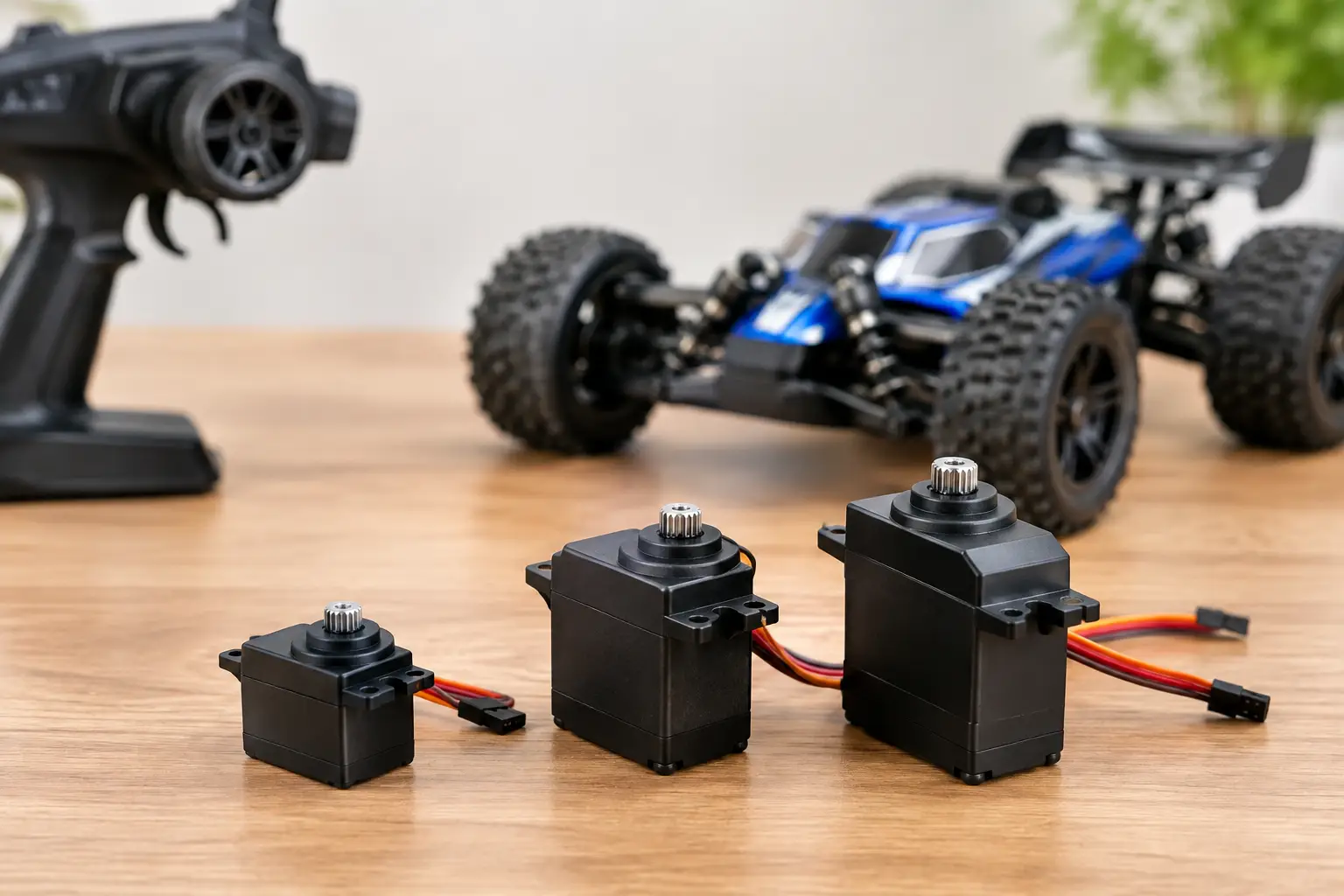
What Servo Torque Do I Need for My RC Car? Complete RC Servo Torque Guide
Choosing the right RC servo torque is essential for reliable steering, better handling and long-term performance. Whether you're upgrading a 1/10 RC buggy, replacing a faulty steering servo on a monster truck or building a high-performance rock crawler, selecting the correct servo can make a significant difference.
A servo that lacks sufficient torque may struggle to turn the wheels, chatter under load or fail to hold its position. On the other hand, buying the most powerful servo available isn't always necessary.
In this guide, we'll explain what servo torque means, how much torque different RC models require, and what to check before choosing your next servo.
Looking for a replacement or upgrade? Browse our complete range of RC servos at RC Model Shop UK.
What Is RC Servo Torque?
Servo torque measures the rotational force a servo can produce. It is commonly expressed in kg-cm (kilogram-centimetres).
For example, a servo rated at 20 kg-cm can theoretically produce enough torque to support a 20 kg force at a distance of 1 cm from its output shaft, under the manufacturer's specified test conditions.
Generally, the higher the torque rating, the more force the servo can apply to the steering mechanism.
However, the amount of torque your RC model requires depends on several factors:
-
Vehicle size and overall weight
-
Tyre diameter and grip
-
Steering geometry and linkage design
-
Driving surface and terrain
-
Battery and BEC voltage
-
Intended use, such as racing, bashing or crawling
A lightweight RC buggy running on loose gravel will usually require less steering torque than a heavy rock crawler fitted with oversized tyres and brass upgrades.
RC Servo Torque Guide by Vehicle Type
The following table provides practical starting points when selecting a steering servo.
| RC Vehicle Type | Recommended Servo Torque |
|---|---|
| 1/16 and 1/18 RC cars | 2–8 kg-cm |
| 1/10 on-road RC cars | 8–15 kg-cm |
| 1/10 RC buggies | 8–15 kg-cm |
| 1/10 short course trucks | 15–25 kg-cm |
| 1/10 monster trucks | 15–25 kg-cm |
| 1/8 RC buggies | 20–35 kg-cm |
| 1/8 truggies and monster trucks | 25–40 kg-cm |
| 1/10 RC rock crawlers | 25–50+ kg-cm |
| Heavy-duty and modified crawlers | 35–60+ kg-cm |
These figures are general recommendations rather than manufacturer specifications. Always confirm the correct servo size, operating voltage and fitment for your particular model.
Best Servo Torque for 1/10 RC Cars
For most 1/10 RC cars, a steering servo rated between 10 and 25 kg-cm is a practical choice.
Lightweight on-road cars and buggies can often operate effectively with a lower torque rating, particularly when driven on smooth or loose surfaces.
Larger 1/10 monster trucks and bashers generally benefit from additional torque because of their larger tyres, increased weight and greater steering loads.
If you're replacing a standard factory servo, selecting a suitable metal-geared replacement with slightly higher torque can improve steering authority and durability.
Best Servo Torque for 1/8 RC Cars
Larger 1/8 scale RC vehicles place significantly greater demands on their steering servos.
For many 1/8 buggies, truggies and monster trucks, 20–35 kg-cm provides a useful starting range, with heavier models potentially benefiting from 40 kg-cm or more.
These vehicles frequently experience substantial steering loads during high-speed cornering, jumps and rough-terrain driving.
When upgrading, look for a servo offering a suitable balance of torque, speed, metal gears and electrical compatibility.
Best Servo Torque for RC Rock Crawlers
Rock crawlers are particularly demanding because their steering systems often operate under heavy loads at very low speeds.
When a crawler's front tyres are pressed against rocks or wedged between obstacles, the servo must generate enough torque to turn the wheels or maintain their position.
For many 1/10 crawlers, 25–35 kg-cm is a reasonable starting point.
Heavier crawlers with brass upgrades, oversized tyres and high-grip compounds may benefit from servos rated at 40–50 kg-cm or higher.
However, additional torque should be supported by a suitable BEC, steering linkage and servo horn.
Does Higher Servo Torque Mean Faster Steering?
No. Servo torque and servo speed are two different specifications.
Torque determines the force the servo can produce, while speed determines how quickly it can rotate through a specified angle.
Servo speed is commonly expressed in seconds per 60 degrees.
For example:
-
0.08 sec/60°: Very fast response, suitable for demanding racing applications.
-
0.12 sec/60°: Fast response for performance RC cars.
-
0.16 sec/60°: Suitable for many general-purpose RC vehicles.
-
0.20 sec/60°: Slower response, which may be acceptable for some crawling and scale applications.
These figures are illustrative, and actual speed depends on operating voltage and load.
A powerful 40 kg-cm servo with a relatively slow transit time may feel less responsive than a faster 20 kg-cm servo in a lightweight racing buggy.
For racing, prioritise a good combination of speed and adequate torque. For crawling, holding power and controlled steering under load are particularly important.
Why Servo Voltage Matters
One of the most commonly overlooked factors when choosing an RC servo is operating voltage.
A servo's advertised torque rating is usually measured at a specific voltage.
For example, a high-voltage servo might be rated at:
| Operating Voltage | Example Torque |
|---|---|
| 6.0V | 20 kg-cm |
| 7.4V | 27 kg-cm |
| 8.4V | 32 kg-cm |
Example figures only. Actual performance varies by servo.
If your ESC's built-in BEC supplies only 6V, you cannot expect the servo to produce its advertised 7.4V or 8.4V torque.
Before upgrading, check:
-
The servo's supported voltage range.
-
The ESC's BEC output voltage and current capacity.
-
The receiver's supported operating voltage.
-
Whether the servo requires a separate power supply.
A powerful digital servo can draw considerable current when working under load. If the BEC cannot supply sufficient current, the receiver may experience a voltage drop or temporary loss of power, commonly known as a brownout.
Never increase the BEC voltage without confirming that all connected components can safely handle it.
Metal Gear vs Plastic Gear RC Servos
Servo gear construction is another important consideration.
Metal Gear Servos
Metal-geared servos are commonly preferred for off-road RC cars, monster trucks and crawlers.
They generally offer improved resistance to gear damage from steering loads and impacts.
However, metal gears are not indestructible. Severe impacts, excessive steering endpoints or an incorrectly adjusted servo saver can still cause damage.
Plastic Gear Servos
Plastic-geared servos are often lighter and more affordable.
They can be suitable for smaller RC models, lightweight aircraft and applications where steering loads are relatively low.
For a powerful off-road steering setup, a quality metal-geared servo is generally the better option.
Browse our RC steering servos and replacement servos to explore suitable options.
Check Servo Size and Spline Compatibility
Not every servo fits every RC vehicle.
Before ordering a replacement, check the original servo's mounting dimensions and output spline.
Common servo sizes include standard, low-profile, mini and micro.
Many standard-size servos use a 25-tooth (25T) output spline, but 23T and 24T versions also exist.
A replacement servo may fit the mounting tray perfectly but still require a different servo horn.
For higher-torque applications, a correctly sized alloy clamp-style servo horn can provide a secure connection, provided the steering system is designed to handle the additional load.
How Much Servo Torque Do Nitro RC Cars Need?
Nitro RC vehicles often use separate servos for steering and throttle/brake operation.
The steering servo generally requires considerably more torque because it must turn the front wheels under load.
A typical nitro throttle/brake servo may only require approximately 5–10 kg-cm, depending on the model and linkage arrangement.
Reliable centring, appropriate speed and correct linkage adjustment are particularly important.
Always follow the manufacturer's recommendations and ensure the throttle and brake linkages move freely without binding.
Servo Torque for RC Aircraft and Boats
Servo torque requirements are not limited to RC cars.
For RC aircraft, the correct torque depends on the size of the control surfaces, model speed, linkage geometry and aerodynamic loads.
Fitting an unnecessarily heavy servo can affect the aircraft's balance, particularly when installed towards the tail.
For RC boats, rudder servos can experience considerable loads at high speeds. Larger and faster boats may require stronger servos and effective protection against water ingress.
In both applications, the manufacturer's recommended servo specifications should be your starting point.
Why Is My RC Steering Servo Buzzing or Chattering?
A servo that continuously buzzes, chatters or becomes unusually hot may not necessarily need replacing with a more powerful unit.
Common causes include:
-
Steering endpoints set beyond the mechanical steering limits
-
Binding steering linkages or damaged bearings
-
Incorrectly adjusted servo saver
-
Insufficient BEC voltage or current
-
Damaged internal servo gears
-
Excessive steering load from oversized tyres
-
Faulty servo electronics or unsuitable radio settings
Before replacing your servo, disconnect the steering linkage where practical and check that the steering mechanism moves freely.
Then check the servo horn position and steering endpoints.
If the servo continues attempting to move beyond the steering system's mechanical limits, it can overheat, drain the battery and eventually fail.
A stronger servo will not resolve a mechanically binding steering system.
Should You Upgrade to a Higher Torque Servo?
Upgrading can be worthwhile if your original servo struggles under normal driving conditions.
You may benefit from additional torque if you have:
-
Installed larger or heavier tyres
-
Added brass weights to a crawler
-
Increased vehicle weight
-
Changed to higher-grip tyres or surfaces
-
Experienced poor steering response under load
-
Found the original servo unable to hold steering position
However, increasing torque alone does not guarantee better performance.
A well-matched 25 kg-cm servo with suitable speed, a reliable power supply and correctly adjusted steering can outperform a poorly installed 50 kg-cm servo.
Find the Right RC Servo at RC Model Shop UK
Whether you're replacing a faulty steering servo, upgrading a monster truck or improving the steering performance of your rock crawler, choosing the right specification is essential.
At RC Model Shop UK, we stock a range of RC servos for different models and applications.
Explore our range here:
Shop RC Servos at RC Model Shop UK
Not sure which servo is compatible with your RC model?
Contact our team with your vehicle's manufacturer, model number and current servo details, and we'll help you identify suitable options.
WhatsApp: 07424 365806
Telephone: 01922 494608
Frequently Asked Questions About RC Servo Torque
Is a 20 kg servo enough for a 1/10 RC car?
Yes, a 20 kg-cm servo is generally sufficient for many 1/10 RC cars, buggies and general-purpose bashers. Heavy crawlers or vehicles with oversized tyres may benefit from more torque.
Is a 35 kg servo good for a rock crawler?
A 35 kg-cm servo can be a very good choice for many 1/10 rock crawlers. Heavily modified crawlers may require higher torque, particularly when running brass weights and large high-grip tyres.
Can I fit a 50 kg servo to my RC car?
Potentially, provided the servo fits correctly and your receiver, BEC and steering components are compatible. More torque than necessary will not automatically improve steering performance.
What happens if my RC servo doesn't have enough torque?
An underpowered servo may struggle to turn the wheels, fail to hold its position under load, respond slowly or become excessively hot.
Does a higher torque servo use more battery power?
Not necessarily at all times, but a more powerful servo can draw significantly more current under heavy loads. Its actual power consumption depends on its design, operating voltage and the work being performed.
What is the difference between a 25T and 23T servo?
The figures refer to the number of teeth on the servo's output spline. A 25T servo horn will not correctly fit a 23T output shaft. Always check compatibility before purchasing.
Final Thoughts
Choosing the right RC servo is about finding the correct balance between torque, speed, durability, voltage and compatibility.
For most general-purpose 1/10 RC cars, 10–25 kg-cm is a useful starting range. Larger 1/8 vehicles and demanding rock crawlers often benefit from higher torque ratings.
Always check the manufacturer's specifications and the condition of your steering system before upgrading.
Ready to replace or upgrade your RC servo?
Browse Our Full Range of RC Servos
RC Model Shop UK – RC Cars, Parts, Accessories and Expert Advice.