
Which RC Battery Connector Fits Your Model?
30/07/2026
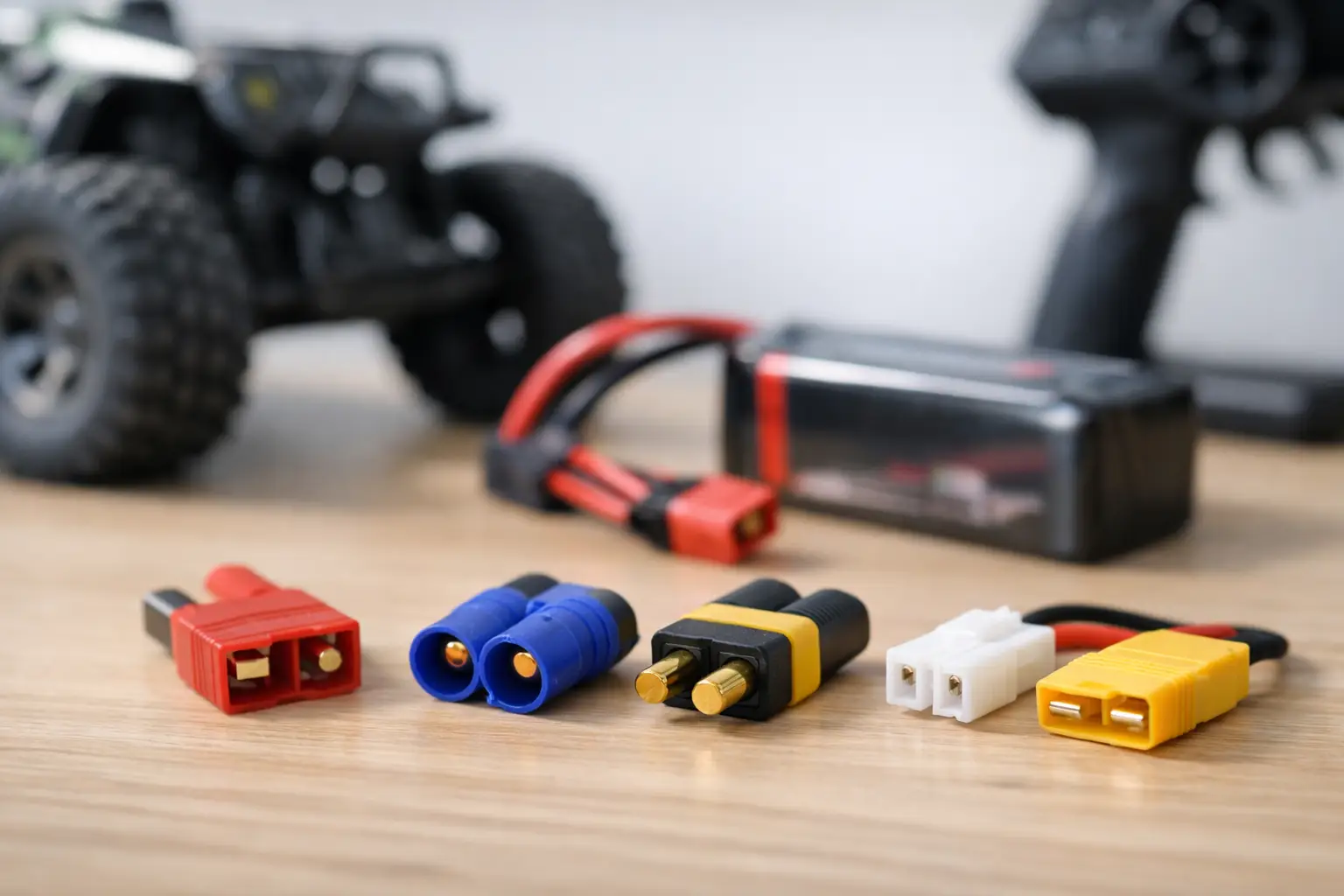
Which RC Battery Connector Do I Need? A Complete Guide to Traxxas, IC3, IC5, XT60, XT90, Deans, Tamiya & JST Connectors
Buying a new RC battery should be straightforward. You find the correct voltage, capacity and C-rating, place your order, then head out for a day of driving.
Unfortunately, many people discover the battery won't even plug into their model.
The connector is one of the most commonly overlooked parts when buying an RC battery. A battery can have the perfect specifications, but if the connector doesn't match your vehicle, it simply won't work.
The good news is that choosing the correct connector is usually very simple once you know what to look for.
In this guide, we'll explain the most common RC battery connectors, when adaptors are suitable, what else you need to check before ordering, and how to avoid buying the wrong battery.
Start With Your Vehicle - Not the Battery
The easiest way to choose a battery is to look at the connector fitted to your vehicle's ESC (Electronic Speed Controller).
Turn the model off, unplug the battery and examine the connector attached to the vehicle.
Your replacement battery should have the matching connector.
Don't rely purely on product titles or descriptions that say "male" or "female" connectors. Different manufacturers describe connector genders differently, particularly with enclosed connector designs. Comparing the actual connector shape is always the safest option.
Choosing the correct connector means:
-
The battery plugs straight in.
-
No unnecessary adaptors.
-
Less electrical resistance.
-
A tidier installation.
-
Fewer potential failure points.
Common RC Battery Connectors Explained
Traxxas High-Current & Traxxas iD
Traxxas connectors are fitted to many Traxxas RTR vehicles and batteries.
Traxxas iD batteries include an integrated balance connection designed to work with compatible Traxxas chargers, making charging quick and straightforward for users staying within the Traxxas ecosystem.
You can browse our range of Traxxas connectors, adaptors and leads here:
Remember that the main power connector and the balance connector perform different jobs. Always make sure both are compatible with your charger.
IC3 & IC5 Connectors
Spektrum's IC connector range has become extremely popular and is commonly found on ARRMA, Losi and Spektrum models.
Generally speaking:
-
IC3 is found on many 2S and 3S vehicles.
-
IC5 is designed for larger, higher-current applications.
Although IC and EC connectors share similarities, always check your specific model before assuming compatibility.
View our IC3 and IC5 connectors and adaptors here:
A larger connector doesn't increase performance on its own—it simply allows the electrical system to safely handle higher current where required.
XT60 & XT90
XT connectors are among the most widely used connector systems in RC.
XT60 is commonly used on:
-
2S batteries
-
3S batteries
-
Medium-sized RC cars
-
Aircraft
-
Boats
XT90 is designed for higher current systems including:
-
Large scale vehicles
-
4S setups
-
6S setups
-
8S setups
Using a connector that's too small for a high-current application can generate excess heat and unnecessary voltage drop.
Browse our XT60 and XT90 connectors here:
Deans (T-Plug), EC Connectors & Tamiya
Deans connectors remain popular thanks to their compact size and excellent current handling.
Many older brushless systems and aircraft still use:
-
Deans (T-Plug)
-
EC3
-
EC5
The white Tamiya connector is generally found on:
-
Entry-level RC models
-
NiMH batteries
-
Lower-current brushed systems
It's generally not recommended for modern high-power brushless setups.
Browse our Deans and Tamiya connectors here:
JST Connectors
JST connectors are commonly found on:
-
Micro RC cars
-
Small aircraft
-
Receivers
-
LED accessories
-
Low-current electronics
There are numerous JST connector variations, many of which look almost identical.
Never assume two JST plugs are compatible simply because they appear similar.
See our JST connector range here:
Don't Confuse the Main Connector with the Balance Connector
Every LiPo battery normally has two separate connections.
The main connector powers the vehicle.
The balance connector allows the charger to monitor and balance each individual cell during charging.
Typically:
-
2S batteries use a 3-wire balance plug.
-
3S batteries use a 4-wire balance plug.
-
4S batteries use a 5-wire balance plug.
Most hardcase car LiPos use JST-XH balance connectors, but it's always worth checking before purchasing charging leads or balance boards.
Never attempt to power your vehicle using the balance connector.
The Connector Is Only One Part of Choosing the Right Battery
Matching the connector is important—but it's only one part of selecting a suitable battery.
You should also confirm:
Voltage
Always use the voltage approved by the vehicle manufacturer.
A 2S vehicle should not automatically be upgraded to 3S.
More voltage means:
-
Higher speed
-
More heat
-
Greater drivetrain stress
-
Increased current demand
Unless your ESC, motor and drivetrain are designed for it, fitting a higher-voltage battery can cause expensive damage.
Capacity (mAh)
Higher capacity generally means:
-
Longer runtime
-
More weight
-
Larger battery dimensions
Always measure your battery tray before ordering.
Even a battery with the correct connector may not physically fit.
Discharge Rating (C Rating)
The discharge rating determines how much current the battery can safely deliver.
A battery with an insufficient discharge capability may:
-
Feel sluggish
-
Suffer voltage sag
-
Run hotter than expected
Buying from a reputable manufacturer with realistic specifications is usually far more important than simply chasing the highest advertised C rating.
Are Battery Adaptors Safe?
Battery adaptors certainly have their place.
They're useful if:
-
You own multiple RC models.
-
You occasionally borrow batteries.
-
You need to connect different charger leads.
-
You're waiting to replace a connector properly.
However, they're not always the best long-term solution.
Every adaptor introduces:
-
Extra electrical resistance.
-
Additional solder joints.
-
More connection points.
-
Greater potential for heat build-up.
This becomes increasingly important on:
-
4S vehicles
-
6S vehicles
-
Large bashers
-
Heavy crawlers
-
High-current speed runs
If you're regularly using the same battery with the same vehicle, replacing one connector correctly is usually the cleaner and more reliable option.
If soldering is required, polarity must always be checked carefully. Reversing positive and negative connections can destroy an ESC almost instantly.
You can browse our complete range of RC connectors, adaptors and charging leads here:
https://www.applianceelectronics.co.uk/products/439/connectors-adapters-leads
Quick Battery Buying Checklist
Before adding a battery to your basket, double-check these five points:
? Connector matches your vehicle's ESC lead
? Voltage approved by the manufacturer
? Battery dimensions fit the tray
? Suitable discharge capability (C rating)
? Charger compatibility, including the balance connector
If you're ever unsure, simply take a clear photo of your existing battery and your vehicle's battery lead. Identifying the correct replacement is much easier from a photograph than guessing connector names.
Frequently Asked Questions
Can I use an adaptor instead of changing connectors?
Yes, for occasional use. A quality adaptor is perfectly acceptable in many situations, but for high-current models it's usually better to have matching connectors fitted directly.
Does a bigger connector make my RC car faster?
No.
The connector only allows current to flow safely. Performance is determined by the battery voltage, capacity, discharge capability, motor, ESC and gearing.
Can I charge through the main battery connector only?
LiPo batteries should normally be balance charged using both the main power connector and the balance lead. This ensures each individual cell charges evenly and safely.
Are XT60 and XT90 interchangeable?
No.
Although both use the XT design, XT90 connectors are physically larger and designed for higher current applications.
Which connector do ARRMA vehicles use?
Many ARRMA vehicles use IC5 connectors, while smaller models may use IC3 depending on the model. Always check your specific vehicle before ordering.
Which connector do Traxxas vehicles use?
Most Traxxas models use the Traxxas High-Current Connector, with many batteries featuring the Traxxas iD charging system.
Need Help Choosing the Right Battery?
Choosing the correct RC battery isn't just about voltage or capacity.
The right battery should:
-
Plug directly into your model.
-
Fit securely in the battery tray.
-
Meet your vehicle's voltage and current requirements.
-
Work with your charger safely.
If you're unsure which connector you need, send us a clear photo of your existing battery and the connector on your vehicle. Our team will happily help you identify the correct battery, connector, adaptor or charging lead before you order.
At RC Model Shop, we're always happy to help you get the right battery the first time, so you spend less time troubleshooting and more time enjoying your RC hobby.
Written by RC Model Shop
RC Model Shop is one of the UK's leading specialist RC retailers, supplying hobby-grade RC cars, trucks, crawlers, boats, aircraft, batteries, chargers, electronics, upgrade parts and accessories from the world's biggest brands.
Our guides are written using hands-on product knowledge and years of experience helping thousands of RC enthusiasts choose the right equipment, solve common problems and get the best performance from their models. Every article is designed to provide clear, practical advice you can trust, whether you're buying your first RC vehicle or upgrading an experienced collection.