
What Servo Size Do I Need for My RC Model?
11/08/2026
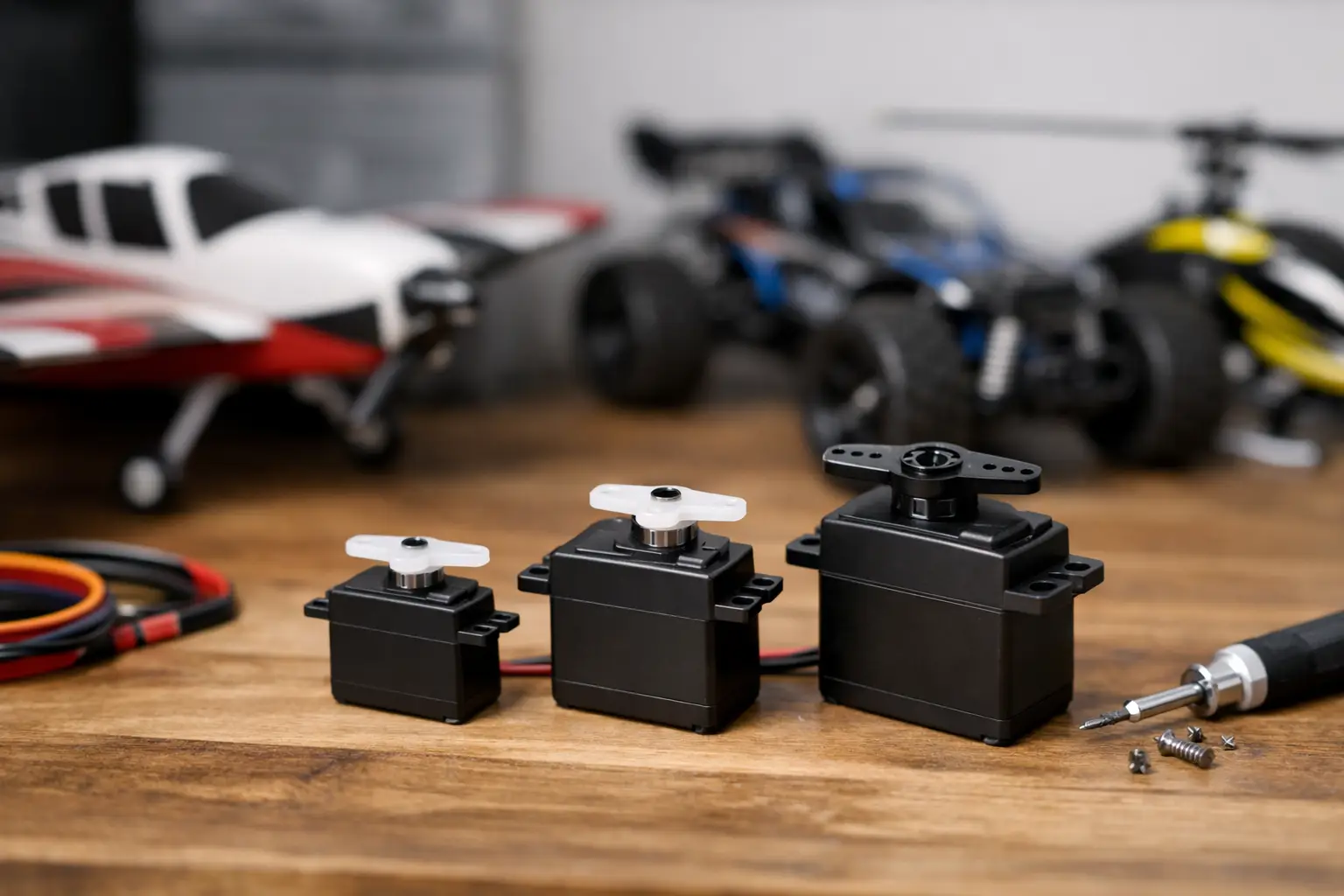
A steering servo that physically fits but lacks torque is one of the most frustrating RC upgrades you can make. The wheels may turn happily on the bench, then struggle as soon as the model is on the ground.
If you are asking, “what servo size do I need?”, the answer is not simply standard, mini or micro. You need to match the servo’s physical dimensions, mounting arrangement, torque, speed, voltage and output spline to the model and the way you drive it.
For most RC cars, the original servo is the best starting point. Measure it, check its specifications where available, and then decide whether you need a like-for-like replacement or a stronger upgrade.
This avoids buying a powerful servo that cannot be mounted properly, or one that does not work with your existing servo horn.
You can also browse our full range of RC servos while using this guide to compare the specifications that actually matter.
What Servo Size Do I Need? Start with the Case
Servo size normally refers to the physical dimensions of the case rather than its pulling power.
RC servos are commonly grouped into micro, mini, standard and large-scale sizes. These labels are useful, but they are not a universal guarantee of fitment. Mounting tabs, case height, cable exit position and hole spacing can vary between manufacturers.
Standard-size servos
A standard-size servo is common in many 1/10 scale RC cars, trucks, buggies, crawlers and monster trucks.
Typical dimensions are around 40 x 20 x 38 mm, although this should only be treated as a rough guide.
Always check the actual servo dimensions and compare them with the original part or servo tray before ordering.
Mini servos
Mini servos are commonly used where space and weight are more restricted.
They can appear in smaller cars, some touring applications, compact buggies and aircraft.
Do not assume every mini servo shares identical mounting dimensions.
Micro servos
Micro servos are widely used in small aircraft, compact RC models and lightweight applications.
Because of their reduced size, they generally have lower torque capacity than a full-size servo, although modern high-performance micro servos can still be surprisingly capable.
Large-scale servos
Large-scale RC cars and specialist applications can use oversized servos with significantly higher torque and a larger mounting footprint.
These servos should not be confused with high-torque standard-size servos. A servo can produce very high torque while still using a standard-size case.
Measure Before Ordering a Servo
Before buying a replacement servo, measure more than just the width.
Check:
-
Overall case width
-
Case depth
-
Case height
-
Distance between the mounting holes
-
Available space above and below the servo
-
Cable exit position
-
Servo horn clearance
Also check whether the chassis uses rubber servo grommets and brass eyelets, direct mounting screws or a clamp-style servo mount.
A servo can be the correct width but still sit too tall for the receiver box, body or chassis brace.
Do Not Force a Standard Servo Into a Small Tray
Servo adapters can be useful when fitting a smaller servo into a larger mounting area, especially where saving weight matters.
Going the other way is usually less straightforward.
Cutting a chassis or forcing mounting tabs into place can create alignment problems, weaken the mounting area and place unnecessary stress on the servo case.
Unless you are deliberately building a custom RC project, choose a servo designed to fit the existing mounting position cleanly.
How Much Servo Torque Do I Need?
Torque is the servo’s turning force and is commonly stated in kg-cm.
A rating of 20 kg-cm means the servo can theoretically produce 20 kg of force at a distance of 1 cm from the centre of the output shaft.
In a real RC vehicle, however, steering geometry, tyre grip, wheel offset, vehicle weight and operating voltage all affect how much steering force is actually available.
Use the torque figure as a useful comparison between servos rather than an absolute guarantee of real-world performance.
Servo torque for 1/10 RC cars
As a broad starting point, many 1/10 scale on-road and off-road models work well with around 10 to 20 kg-cm of torque.
Lightweight cars running on relatively low-grip surfaces may need less.
Servo torque for bashers and monster trucks
Heavier bashers and monster trucks often benefit from around 20 to 35 kg-cm or more.
Large tyres, high grip levels and heavier vehicle weight all increase the load on the steering system.
Servo torque for RC crawlers
Crawlers commonly benefit from 25 kg-cm upwards because their steering is frequently under load at very low speed or while the vehicle is stationary.
A crawler with large sticky tyres, brass portal weights and a heavy scale body may require substantially more steering torque than a lighter trail model.
Servo torque for large-scale RC cars
Large-scale RC models place much greater load on steering components and normally require servos specifically designed for large-scale applications.
Do not assume that a very powerful standard-size servo is automatically an appropriate replacement.
More Servo Torque Is Not Always Better
It is tempting to buy the highest torque figure available, but the rest of the steering system has to cope with that force.
A very powerful servo can expose weak components such as:
-
Plastic servo savers
-
Flexible steering racks
-
Worn bellcranks
-
Plastic servo horns
-
Weak rod ends
-
Damaged steering hubs
If you are upgrading to a significantly stronger servo, inspect the complete steering system first.
The best setup is one where the servo, servo horn, saver and steering linkage work together rather than transferring the weak point to another component.
What Servo Speed Do I Need?
Servo speed is normally shown as the amount of time required for the output shaft to move through 60 degrees.
For example:
0.10 sec/60°
A lower number means a faster servo.
Speed matters most in racing, high-speed driving and applications where quick steering corrections are required.
Bashing
For general bashing, a reasonably quick servo with sufficient torque usually provides the best balance.
Extreme speed is rarely necessary.
Crawling
Crawlers normally prioritise torque, accurate centring and smooth control.
However, an excessively slow servo can still make a crawler feel awkward when you are trying to make quick corrections on technical terrain.
Racing
Race buggies, stadium trucks and on-road cars can benefit considerably from faster servos.
Quick transit speed can make the car feel sharper and more precise, provided the steering geometry and driver can make use of it.
Do not choose solely by the fastest number on the specification sheet.
A fast servo with insufficient torque can slow dramatically once it is under load. A slightly slower servo with stronger holding power may perform far better with the tyres actually on the ground.
Check Servo Voltage Before Upgrading
Every servo has a supported operating voltage.
Traditional receiver-powered RC systems commonly operate around 6V, while high-voltage servos may support 7.4V or sometimes higher.
A compatible servo usually produces more torque and faster transit speeds when operated at a higher supported voltage.
That does not mean you can simply increase the voltage.
Understand the ESC BEC Rating
In most electric RC cars, the ESC's built-in BEC, or Battery Eliminator Circuit, supplies power to the receiver and steering servo.
If your ESC provides 6V, a high-voltage servo that supports 6V can usually still operate, but it will only produce the performance specified for that voltage.
If the ESC has an adjustable BEC and you increase it to 7.4V, make sure the following components are all rated accordingly:
-
Steering servo
-
Receiver
-
Auxiliary servos
-
Lighting controllers
-
Fans or other receiver-powered accessories
Never increase BEC voltage based solely on the steering servo specification.
Can a Servo Be Too Powerful for the BEC?
Yes.
High-torque digital servos can draw substantial current under load.
A weak BEC may struggle to supply enough current even if its voltage is technically correct.
Possible symptoms include:
-
Receiver rebooting
-
Steering temporarily cutting out
-
Servo twitching
-
Loss of radio control under heavy steering load
-
Electronics resetting when full steering lock is applied
This is particularly common in crawlers, large vehicles and heavily modified models.
In some setups, a suitable higher-capacity or external BEC may be required rather than simply fitting another servo.
Match the Servo Spline to the Horn
The spline is the toothed output shaft that the servo horn fits onto.
This is easy to overlook and can stop an otherwise suitable servo from being installed.
Common spline counts include:
-
23T
-
24T
-
25T
Many aftermarket RC servos use 25T splines, while some original equipment servos use different spline types.
Do not assume your existing horn will fit a replacement servo.
Check both the servo specification and the servo horn before ordering.
If you are replacing or upgrading a steering servo, you can compare options in our RC servo range.
Should I Fit a Metal Servo Horn?
A metal clamp-style servo horn can be a worthwhile upgrade on a high-torque steering system.
However, it removes some of the flexibility that a plastic horn can provide.
On a hard-used basher, that means impacts may transfer more force into the servo gears or steering system.
Whether a metal horn is appropriate depends on the model and how it is used.
Keep the horn length reasonably close to the original unless you understand how changing it affects steering geometry.
Longer servo horn
A longer horn can provide additional steering movement but reduces effective leverage and may make steering feel more aggressive.
Shorter servo horn
A shorter horn can improve leverage but may reduce maximum steering throw.
After fitting a replacement servo, centre it electronically before installing the horn.
Then set the transmitter steering endpoints so the servo is not forcing the linkage against its mechanical stops.
Metal Gear or Plastic Gear Servo?
For heavily used RC cars, metal gears are usually worthwhile.
They generally withstand shock loads better than nylon or plastic gears and are particularly useful in:
-
Monster trucks
-
Crawlers
-
Bashers
-
Heavier vehicles
-
Models running large tyres
Metal gears do not make a servo indestructible.
A sufficiently hard wheel impact can still damage the geartrain, output shaft, servo horn or other steering components.
For lighter models and less demanding applications, a good-quality plastic or nylon-geared servo can still be perfectly suitable.
Do I Need a Waterproof Servo?
For UK running conditions, waterproofing is a useful feature.
Wet grass, mud and puddles are common, particularly with bashers and crawlers.
However, read the manufacturer's description carefully.
A waterproof servo does not automatically mean the entire vehicle can be submerged.
Damage to cable seals, case seals or screws can also compromise water resistance over time.
If you regularly use your RC car in wet or muddy conditions, inspect the servo and wiring as part of routine maintenance.
Digital vs Analogue RC Servos
Digital servos are common in performance RC applications because they can offer strong holding power, accurate centring and quick response.
They can also draw more current than basic analogue servos.
That makes BEC capacity particularly important.
For a straightforward replacement in a lightweight or relatively low-demand model, a good analogue servo can still be completely suitable.
There is no need to buy a digital servo simply because it sounds more advanced.
How to Choose an RC Servo With Confidence
A sensible order for checking servo compatibility is:
-
Confirm the physical dimensions and mounting style.
-
Check the required torque for the vehicle.
-
Choose an appropriate steering speed.
-
Confirm the supported operating voltage.
-
Check the ESC's BEC voltage and current capability.
-
Confirm the output spline.
-
Check servo horn compatibility.
-
Inspect the existing steering system.
-
Centre the servo and set steering endpoints after installation.
This approach prevents most servo compatibility problems before they happen.
Replacing vs Upgrading an RC Servo
For a first RC repair, replacing the original servo with one of the same dimensions and similar specification is often the simplest route.
If you are upgrading, identify the problem you are actually trying to solve.
Crawler cannot turn its tyres
Prioritise torque, reliable centring and sufficient BEC output.
Race car steering feels delayed
A faster servo may improve response, assuming the existing servo already provides enough torque.
Basher keeps stripping servo gears
A stronger metal-geared servo may be worthwhile, but also inspect the servo saver and steering linkage.
Steering cuts out under load
Do not automatically blame the servo.
Check the ESC BEC output and receiver power supply.
RC Servo FAQs
What size servo do I need for a 1/10 RC car?
Many 1/10 RC cars use a standard-size servo, but not all of them do.
Measure the existing servo and mounting area before ordering rather than relying solely on the vehicle scale.
How much torque does a 1/10 RC car servo need?
Around 10 to 20 kg-cm can be a useful starting range for many general 1/10 models, while heavier trucks, bashers and crawlers may require considerably more.
Vehicle weight, tyre size and surface grip all matter.
Is a 20kg servo enough for a crawler?
It can be enough for a relatively light crawler, but heavier builds with larger tyres or brass components often benefit from more torque.
There is no single torque figure that suits every crawler.
Will any standard-size servo fit my RC car?
No.
Even if both servos are described as standard size, mounting tabs, height, spline type and cable position can differ.
Always compare dimensions.
Can I use a 7.4V servo on a 6V BEC?
Usually yes if the servo's specified operating range includes 6V.
However, the servo will only provide the torque and speed available at that lower voltage.
Can I increase my BEC voltage to make the servo stronger?
Only if every connected component is rated for the higher voltage.
This includes the receiver and any other equipment powered by the receiver circuit.
What does 25T mean on a servo?
25T refers to the number of teeth on the servo output spline.
The servo horn must be compatible with the spline.
Is a metal gear servo better?
For high-load applications, metal gears generally provide better durability.
For light-duty models, plastic or nylon gears can still be perfectly suitable and may also be lighter.
Why does my steering servo buzz at full lock?
The servo may be trying to push beyond the physical limit of the steering system.
Reduce the transmitter steering endpoint until the servo reaches full useful steering travel without constantly straining.
Why does my receiver reset when I steer?
A high-current servo may be overloading the ESC's BEC or receiver power supply.
Check the servo current requirements and BEC specification before replacing components.
Find the Right RC Servo for Your Model
The right servo should fit without modification, steer confidently under load and operate comfortably within the limits of the rest of your electronics.
Do not choose purely on torque, speed or price.
Case dimensions, mounting arrangement, operating voltage, BEC capacity and spline compatibility are just as important.
If you know the model name, current servo dimensions and existing servo specification, those details make finding a suitable replacement much easier.
You can browse our full range of RC servos, or contact the RC Model Shop team if you need help narrowing down a compatible replacement.
Written by RC Model Shop
This article was written by the team at RC Model Shop, one of the UK's leading specialists in hobby-grade radio-controlled vehicles.
With years of hands-on experience selling, repairing and upgrading RC cars, crawlers, boats and aircraft, we regularly help customers diagnose steering problems and choose replacement servos that are suitable for their models.
Servo selection involves considerably more than choosing the biggest torque figure available. Physical fitment, spline compatibility, steering geometry, BEC output, operating voltage and the strength of the rest of the steering system all affect whether an upgrade will work properly.
Our advice is based on practical RC experience and compatibility rather than specifications alone.
Whether you're replacing a failed standard servo, upgrading the steering in a crawler, improving response in a race car or strengthening a hard-used basher, our aim is to help you choose components that work reliably together.
For replacement and upgraded steering options, browse our full range of RC servos at RC Model Shop.