
What Motor KV Means in RC Models
20/04/2026
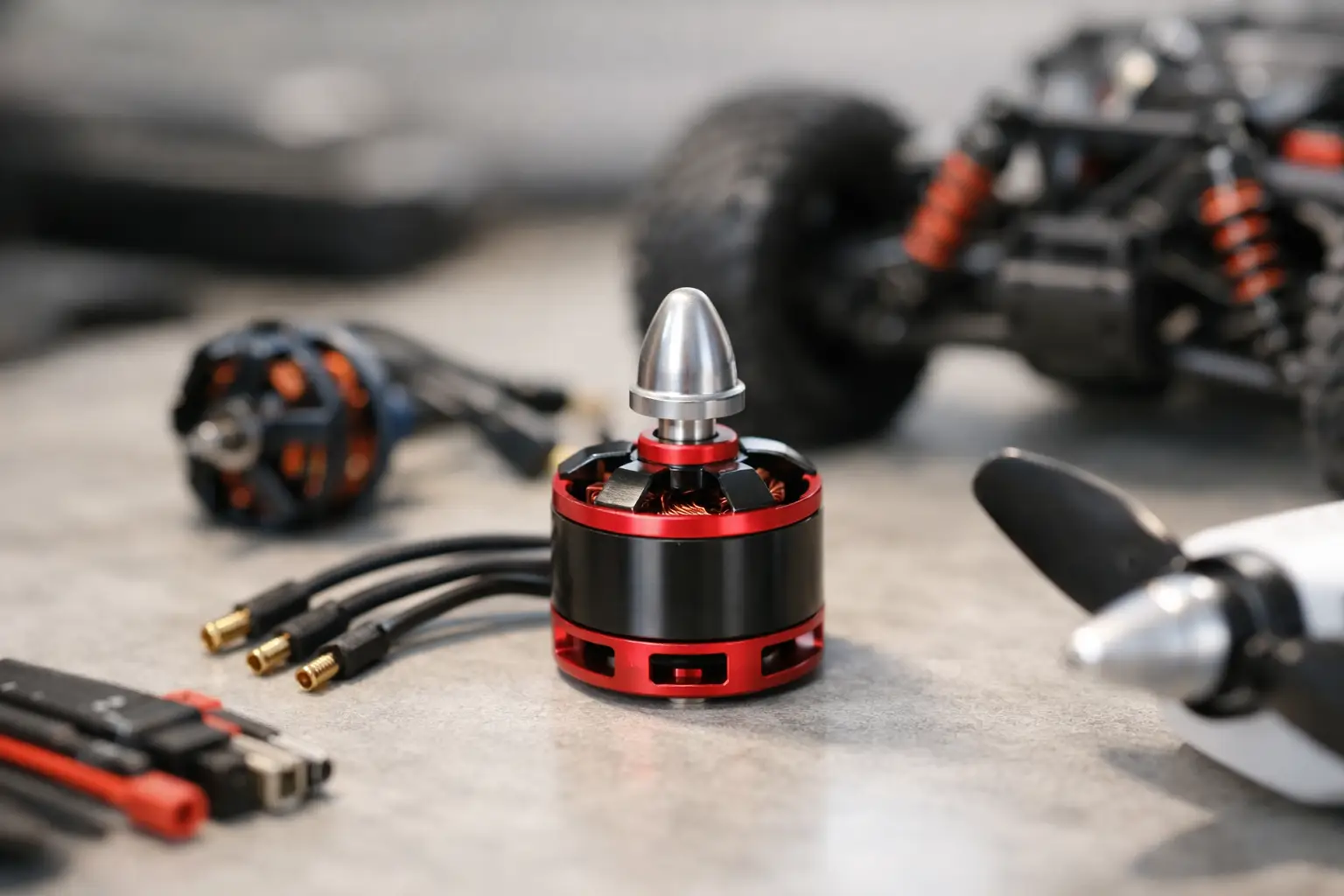
What Motor KV Means - Understanding RC Motor KV Without the Confusion
Pick up two RC brushless motors that look almost identical and one may say:
-
2300KV
while another says: -
4000KV
That single number changes how the RC vehicle behaves completely.
If you have ever wondered what motor KV means, the short answer is:
KV tells you how many RPM the motor will try to spin per volt applied before load is added.
Simple on paper.
Often misunderstood in practice.
Higher KV does NOT automatically mean:
-
more power
-
better performance
-
faster real-world driving
Lower KV does NOT automatically mean:
-
weak performance
-
slow setups
-
poor acceleration
The correct KV depends on:
-
battery voltage
-
gearing
-
vehicle weight
-
tyre size
-
intended use
RC Model Shop stocks a large range of RC motors, brushless systems and replacement RC electronics suitable for bashers, crawlers, race cars and high-performance RC builds.
What motor KV actually means
In RC:
KV = RPM per volt.
Example:
-
3000KV motor
-
running on 7.4V 2S LiPo
Theoretical no-load RPM:
22,200 RPM
The same motor on:
-
11.1V 3S LiPo
would theoretically reach:
33,300 RPM
However:
that is no-load speed only.
Once installed in an RC car, crawler or aircraft:
-
gearing
-
tyres
-
weight
-
terrain
-
drivetrain drag
-
temperature
all change the real result dramatically.
Still, KV remains useful because it gives a strong starting point for understanding:
-
motor behaviour
-
setup balance
-
intended application
Higher KV vs lower KV in real-world RC use
Higher KV motors
Higher KV motors usually:
-
spin faster per volt
-
suit higher RPM applications
-
support stronger top-end speed potential
They are common in:
-
on-road RC cars
-
speed-focused builds
-
lightweight race setups
However:
more KV also increases demand.
Higher KV setups often:
-
generate more heat
-
stress ESCs harder
-
require careful gearing
-
punish weak batteries quickly
Lower KV motors
Lower KV motors generally:
-
spin slower per volt
-
provide smoother control
-
handle load more comfortably
-
run cooler under stress
They are common in:
-
crawlers
-
larger RC vehicles
-
heavy bashers
-
technical trail trucks
This is why:
lower KV often feels stronger under load.
Not because the number itself magically creates torque, but because the setup suits the application better.
Why voltage changes everything
KV alone means very little without battery voltage.
Example:
Setup A
-
2000KV
-
4S LiPo (14.8V)
Theoretical no-load RPM:
29,600 RPM
Setup B
-
3000KV
-
2S LiPo (7.4V)
Theoretical no-load RPM:
22,200 RPM
So despite the lower KV:
the 2000KV motor on higher voltage spins faster overall.
This is why experienced hobbyists always look at:
-
KV
AND -
voltage
together.
Higher voltage with lower KV is often favoured in:
-
larger RC vehicles
-
high-efficiency setups
-
demanding off-road systems
because it can reduce:
-
current draw
-
heat
-
electrical stress
while still producing excellent performance.
Does lower KV mean more torque?
This gets oversimplified constantly online.
In practical terms:
lower KV motors of similar size usually produce more torque per amp.
That is why lower KV often feels:
-
smoother
-
stronger under load
-
easier to control
especially in:
-
crawlers
-
heavy RC trucks
-
technical terrain
However:
KV alone does not define torque.
Motor size matters massively too.
A larger-can motor with:
-
moderate KV
can massively outperform:
-
a tiny low-KV motor
because:
-
rotor size
-
can length
-
magnet strength
-
winding design
all matter too.
This is why:
motor KV should never be viewed in isolation.
Motor size matters as much as KV
A 1/10 crawler, 1/8 basher and touring car all place completely different demands on the motor.
Even identical KV ratings can feel dramatically different depending on:
-
motor size
-
rotor design
-
vehicle weight
Examples:
-
larger tyres increase load
-
heavier vehicles increase current demand
-
rough terrain increases heat
This is why:
the “best KV” depends on the whole setup.
Gearing changes motor behaviour massively
KV and gearing always work together.
Higher KV often requires:
-
smaller pinions
-
shorter gearing
to control:
-
temperatures
-
current draw
-
drivetrain stress
Lower KV may allow:
-
taller gearing
-
larger pinions
-
smoother acceleration
without overheating.
This is why:
changing motor KV without checking gearing is risky.
A setup running perfectly on:
-
moderate gearing
can suddenly:
-
overheat
-
cog
-
stress the ESC
if KV increases aggressively.
RC Model Shop stocks a large range of RC pinions and gearing upgrades suitable for brushed and brushless RC systems.
What KV suits different RC vehicles?
Crawlers
Crawlers usually benefit from:
-
lower KV
-
smoother throttle
-
better low-speed control
Too much KV often makes crawlers:
-
twitchy
-
difficult to place
-
harder to control on climbs
Bashers
Bashers need:
-
balanced RPM
-
usable acceleration
-
manageable temperatures
Too much KV in:
-
a heavy 4WD basher
often becomes:
-
heat
-
drivetrain wear
-
battery stress
very quickly.
On-road and speed builds
On-road cars and speed setups often favour:
-
higher KV
-
strong RPM
-
aggressive acceleration
However:
gearing and temperatures still matter massively.
A setup that overheats after five minutes is not a good speed setup.
RC aircraft
Aircraft KV depends heavily on:
-
propeller size
-
voltage
-
intended flight style
Generally:
-
higher KV → smaller props / higher RPM
-
lower KV → larger props / stronger pull
Matching:
-
motor
-
propeller
-
ESC
-
battery
properly matters heavily in aircraft setups.
Common mistakes when choosing motor KV
The biggest mistake is:
chasing the biggest number.
Higher KV sounds exciting, but often creates:
-
overheating
-
short runtimes
-
drivetrain stress
-
difficult handling
Other common mistakes include:
-
ignoring battery voltage
-
forgetting gearing changes
-
overlooking motor size
-
using weak ESCs
-
poor cooling setup
A setup that feels:
-
fast
-
controllable
-
reliable
-
cool-running
is usually much better than a setup that is:
-
technically faster
but constantly overheating.
ESC compatibility matters too
The ESC must support:
-
the voltage
-
the current demand
-
the intended motor type
High KV often increases:
-
current spikes
-
ESC load
-
battery demand
This is why balanced ESC and motor matching matters heavily.
RC Model Shop stocks a large range of:
suitable for crawlers, bashers and performance RC vehicles.
Battery quality affects motor performance too
Weak batteries can make:
-
strong motors
-
expensive ESCs
feel disappointing.
Poor battery delivery causes:
-
voltage sag
-
inconsistent throttle
-
heat
-
reduced punch
This matters especially on:
-
high-KV setups
-
4WD bashers
-
speed-run vehicles
You can browse a large range of RC batteries and LiPo packs suitable for brushless RC systems.
A smarter way to choose RC motor KV
The best motor KV is usually the one that:
-
suits the chassis
-
matches the battery voltage
-
runs cool
-
supports the gearing properly
-
delivers usable performance
rather than simply producing the biggest RPM figure possible.
If replacing a failed motor:
staying close to the original KV is often safest.
If upgrading:
-
decide the goal first.
Do you want:
-
more top speed?
-
smoother crawling?
-
cooler temperatures?
-
better efficiency?
-
stronger acceleration?
Then work backwards through:
-
voltage
-
gearing
-
ESC capability
-
motor size
At RC Model Shop, the focus is always helping hobbyists match:
-
motors
-
ESCs
-
gearing
-
batteries
properly as a complete system rather than chasing isolated specifications.
The best RC setup is usually the one that:
-
stays reliable
-
runs cool
-
feels controllable
-
delivers consistent performance
pack after pack.
Frequently Asked Questions
What does motor KV mean in RC?
KV means:
RPM per volt.
It shows how fast a motor will theoretically spin for each volt applied before load is added.
Is higher KV always faster?
Not necessarily. Battery voltage, gearing and load all affect real-world performance heavily.
Does lower KV mean more torque?
On similar motor sizes, lower KV often provides better torque delivery under load, especially in heavier RC vehicles.
What KV is best for crawlers?
Lower KV motors are generally better for crawlers because they provide:
-
smoother control
-
better low-speed behaviour
-
improved efficiency
Why does my high-KV setup overheat?
Possible causes include:
-
aggressive gearing
-
oversized tyres
-
insufficient ESC
-
poor cooling
-
excessive load
Written by the RC team at RCModelShop.co.uk / Appliance Electronics UK Ltd, UK supplier of RC motors, ESCs, batteries and RC upgrade electronics.