
What Charger Does My LiPo Need for My RC Model?
28/07/2026
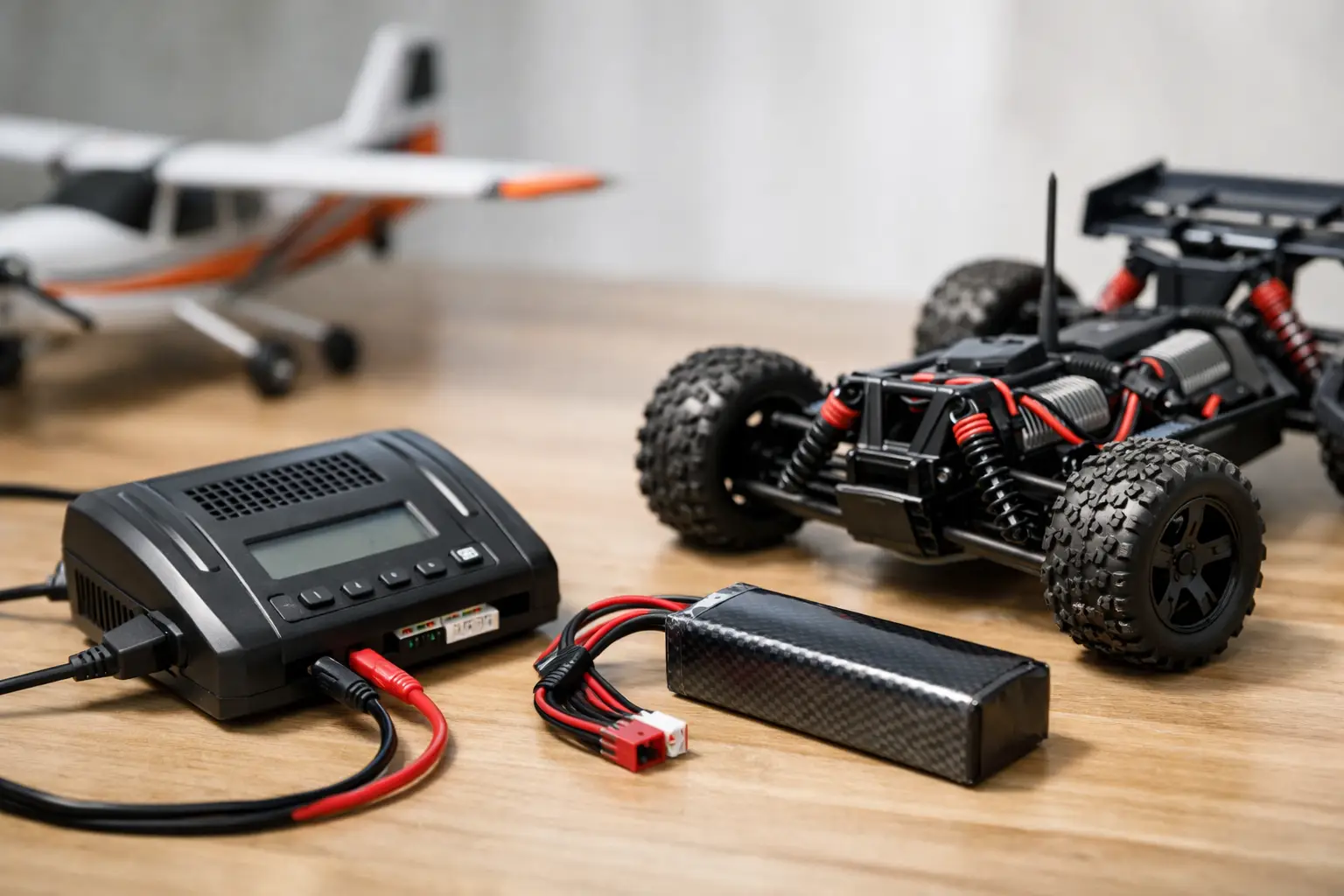
What Charger Does My LiPo Need? The Complete RC LiPo Charging Guide (2026)
A new LiPo battery can completely transform the performance of your RC model. Faster acceleration, longer run times and more consistent power are just some of the benefits. However, getting the most from your battery starts with using the correct charger.
One of the questions we're asked most at RC Model Shop is:
"What charger does my LiPo need?"
The short answer is a dedicated RC balance charger that's compatible with your battery's cell count, chemistry, connector type and recommended charge rate.
The longer answer is important because using the wrong charger—or simply selecting the wrong charging programme—can reduce battery life, affect performance and even create a safety risk.
This guide explains everything you need to know about choosing the right LiPo charger.
Why You Need a Balance Charger
Unlike older battery types, LiPo batteries are made up of multiple individual cells connected together.
For example:
- 2S LiPo = 2 cells
- 3S LiPo = 3 cells
- 4S LiPo = 4 cells
- 6S LiPo = 6 cells
Each individual cell should finish charging at 4.20 volts.
A balance charger monitors every cell separately through the battery's balance lead, ensuring they all reach the same voltage safely.
Without balance charging, one cell may overcharge while another remains undercharged, reducing performance and potentially damaging the battery.
For this reason, you should always use LiPo Balance Charge Mode whenever possible.
Start With Your Battery Label
Everything you need to set up your charger correctly is printed on the battery itself.
Check for:
- Cell count (2S, 3S, 4S or 6S)
- Capacity (2200mAh, 5000mAh, 8000mAh etc.)
- Maximum charge rate (1C, 2C, 5C etc.)
- Connector type
Your charger must support your battery's cell count.
For example:
- A 2S battery needs a charger capable of charging 2S batteries.
- A 6S battery requires a charger that supports 6S operation.
Always check the battery label rather than guessing based on the size of the vehicle.
What Charge Rate Should I Use?
Most modern LiPo batteries can technically be charged faster than 1C.
However, for everyday use we recommend charging at 1C.
Charging at 1C:
- Produces less heat
- Places less stress on the battery
- Maximises battery lifespan
- Is the safest everyday charging rate
Examples:
| Battery Capacity | 1C Charge Rate |
|---|---|
| 2200mAh | 2.2A |
| 3300mAh | 3.3A |
| 5000mAh | 5.0A |
| 6000mAh | 6.0A |
| 8000mAh | 8.0A |
If you're unsure, 1C is almost always the correct choice.
Understanding RC Battery Connectors
Your charger also needs the correct charging lead.
Common RC battery connectors include:
- XT60
- XT90
- Deans (T-Plug)
- EC3
- EC5
- IC3
- IC5
Most LiPo batteries also use a JST-XH balance connector.
Many quality chargers accept interchangeable charge leads, making it easy to charge different batteries from one charger.
Never force connectors together or use damaged charging leads.
Charger Power Matters
Many people only look at the maximum cell count.
In reality, the charger's wattage is just as important.
For example:
A small 50W charger may comfortably charge:
- 2S batteries
- 3S batteries
But may struggle with:
- Large 4S batteries
- 6S packs
- High-capacity LiPos
As battery voltage increases, so does the power required to maintain the chosen charging current.
Buying a charger with a little extra power today often saves upgrading later.
AC Chargers vs DC Chargers
AC Chargers
AC chargers plug directly into a UK mains socket.
Advantages include:
- Simple setup
- Ideal for beginners
- No external power supply required
- Perfect for home use
Most hobbyists starting out will find an AC charger the easiest option.
DC Chargers
DC chargers require an external power supply.
Advantages include:
- Higher charging power
- Better suited to larger batteries
- Faster charging capability
- Often preferred by experienced RC users
Always ensure the power supply provides enough wattage for the charger.
A powerful charger connected to an underpowered power supply cannot perform to its full capability.
Single Output vs Dual Output Chargers
Single Output
A single-output charger is ideal if you usually charge one battery at a time.
Benefits include:
- Lower cost
- Smaller size
- Easier to use
Dual Output
A dual-output charger allows two batteries to be charged independently.
This is ideal if you:
- Own multiple RC vehicles
- Run twin battery setups
- Want less downtime between runs
Each output should normally be configured separately for the battery connected.
Smart Chargers
Some manufacturers now offer smart battery ecosystems.
Smart chargers can often:
- Detect battery information automatically
- Set charging parameters
- Display battery health
- Record charging history
These systems are convenient if all your batteries use the same connector ecosystem.
If you own batteries from multiple manufacturers, a traditional balance charger generally offers greater flexibility.
Never Mix Battery Chemistries
Always select the charging mode that matches your battery.
Standard LiPo batteries charge to:
4.20V per cell
LiHV batteries charge to:
4.35V per cell
Only use LiHV mode if the battery is clearly labelled LiHV.
Never attempt to charge a standard LiPo using:
- LiHV mode
- NiMH mode
- NiCd mode
- Lead Acid mode
Always double-check before pressing Start.
Check Cell Detection
Before charging begins, your charger should correctly detect the battery.
For example:
Battery:
3S
Charger:
3S
Everything is correct.
If your charger detects:
Battery:
3S
Charger:
2S
Stop immediately.
Possible causes include:
- Loose balance connector
- Damaged wiring
- Faulty battery
- Cell imbalance
Investigate before attempting to charge again.
Storage Charging Is One Of The Most Useful Features
LiPo batteries should never be stored:
- Fully charged
- Completely discharged
Instead, they should be stored at approximately:
3.8V per cell
Most quality chargers include a Storage Mode that automatically charges or discharges the battery to the correct long-term storage voltage.
If you don't use your batteries every week, this feature is extremely valuable.
Helpful Charger Features
Many quality chargers also include:
- Cell voltage display
- Internal resistance testing
- Capacity readings
- Charge history
- Discharge mode
These tools help monitor battery condition and identify ageing packs before they become unreliable.
Safe LiPo Charging
Always follow safe charging practices.
? Charge on a non-flammable surface.
? Use a LiPo charging bag or fire-resistant charging case.
? Never leave batteries charging unattended.
? Allow batteries to cool after running.
? Connect both the main lead and balance lead.
? Check all connectors are secure.
? Charge at the correct current.
Never charge a battery that is:
- Swollen
- Puffed
- Punctured
- Excessively hot
- Has damaged wiring
- Shows significant cell imbalance
A charger cannot repair a physically damaged battery.
Which Charger Should You Buy?
Beginners
Choose an AC balance charger that supports:
- 2S–4S LiPo
- Balance Charge Mode
- Storage Mode
- Interchangeable charge leads
Perfect for:
- RTR cars
- Crawlers
- Touring cars
- Boats
- Aircraft
Regular RC Users
A higher-powered AC/DC charger supporting:
- 2S–6S
- Higher wattage
- Faster charging
- Larger batteries
Ideal for owners of ARRMA, Traxxas, Losi, Team Corally and larger aircraft.
Heavy Users
If you regularly charge multiple batteries, consider a dual-output charger with independent charging channels.
It provides quicker turnaround and far greater convenience.
Shop RC Batteries & Chargers
Whether you're buying your first LiPo battery or upgrading your charging setup, we've got everything you need.
Shop RC Batteries
https://www.applianceelectronics.co.uk/products/432/batteries
Shop Battery Chargers
https://www.applianceelectronics.co.uk/products/447/battery-chargers
Shop Charge Leads & Adapters
https://www.applianceelectronics.co.uk/search?searchField=CHARGE+LEAD
If you're unsure which charger is compatible with your battery, our team is always happy to help you choose the correct charger, connector and charging accessories before you buy.
Frequently Asked Questions
Can I use any charger for a LiPo battery?
No. LiPo batteries should only be charged using a dedicated RC balance charger with a LiPo Balance Charge programme.
What does 1C mean?
A 1C charge rate means charging the battery at a current equal to its capacity.
Examples:
- 2200mAh = 2.2A
- 5000mAh = 5.0A
- 8000mAh = 8.0A
Is it safe to fast charge a LiPo?
Some batteries support faster charging, but unless you specifically need the quicker turnaround, charging at 1C is generally the best option for long battery life.
Do I need to connect the balance lead every time?
Yes. When using Balance Charge mode, always connect both the main battery lead and the balance lead.
Can I leave a LiPo charging overnight?
No. LiPo batteries should never be left charging unattended.
What voltage should I store my LiPo at?
Approximately 3.8 volts per cell using your charger's Storage Mode.
Why is my charger showing the wrong cell count?
This is usually caused by a loose balance connector, damaged wiring or a battery fault. Stop charging and investigate before continuing.
Can I charge a LiHV battery in LiPo mode?
Yes, but it will only charge to 4.20V per cell rather than its full 4.35V per cell capacity. Always use LiHV mode for batteries specifically labelled LiHV.
What charger do I need for a 6S LiPo?
Choose a charger that supports 6S batteries and has enough wattage to comfortably charge your battery at the recommended current.
Can I charge two batteries at once?
Yes, if you're using a dual-output charger. Each battery should be connected to its own independent charging channel unless you're experienced with correctly configured parallel charging.
Related RC Guides
- LiPo Battery Safety Guide
- LiPo Storage Explained
- LiPo vs LiHV Batteries
- Understanding LiPo C Ratings
- How to Choose the Right RC Battery
- Beginner's Guide to RC Chargers
Written by RC Model Shop
RC Model Shop is one of the UK's leading specialist RC retailers, supplying hobby-grade RC cars, trucks, crawlers, boats, aircraft, batteries, chargers, electronics, upgrade parts and accessories from the world's biggest brands.
Our guides are written using hands-on product knowledge and years of experience helping thousands of RC enthusiasts choose the right equipment, solve common problems and get the best performance from their models. Every article is designed to provide clear, practical advice you can trust, whether you're buying your first RC vehicle or upgrading an experienced collection.
Need help choosing the right charger or battery? Our team is always happy to help you find the correct products for your model before you order.