
UK RC Crawler Shop: How to Buy the Right Rig
26/07/2026
How to Choose the Right RC Crawler: A UK Buyer’s Guide
A crawler that looks perfect in a product photo can still be the wrong choice for your local woodland trail, rocky quarry or carefully built scale course. A good UK RC crawler shop should help you match the vehicle to your terrain, experience and the kind of build you genuinely want to own—not simply steer you towards the biggest specification sheet.
RC crawling is one of the most approachable parts of the hobby, but choosing carefully makes a big difference. Speed is rarely the priority. Control, grip, smooth low-speed response and reliable parts support matter far more when the wheels are picking their way over roots, rocks and steep banks.
What to Expect From a UK RC Crawler Shop
A specialist RC crawler retailer should offer more than complete vehicles. Replacement parts, suitable batteries, compatible chargers and worthwhile upgrades should all be available in the same place.
A ready-to-run crawler gets you moving quickly, but every model will eventually need maintenance. Tyres wear, steering components take knocks and gears or body mounts can become damaged during demanding trail use. Being able to identify and order the correct replacement part without guesswork saves considerable frustration later.
Technical support matters just as much. Crawler setups may appear simple, but relatively small changes can have a noticeable effect on performance.
For example:
-
A battery mounted too high can make the crawler roll more easily on side slopes.
-
Overly stiff suspension can prevent the tyres from following uneven ground.
-
Heavier wheels may improve stability but add strain to the drivetrain and steering servo.
-
Incorrect gearing can reduce low-speed control or cause unnecessary heat.
Clear advice about batteries and charging is particularly valuable for first-time buyers. Some crawlers include everything needed to run, while others require a separate battery, charger, transmitter batteries or all three. Always check what is included before ordering.
RC Model Shop stocks crawlers, batteries, chargers, spare parts and upgrades from leading RC brands, helping you put together a practical and compatible package.
Choose the Crawler Before Choosing the Upgrades
It is tempting to start planning brass portal covers, beadlock wheels and a new motor before the first run. Start with the vehicle itself.
The right platform should perform well in its standard form. Driving it before modifying it also helps you understand what each future upgrade is meant to improve.
Trail Truck or Technical Rock Crawler?
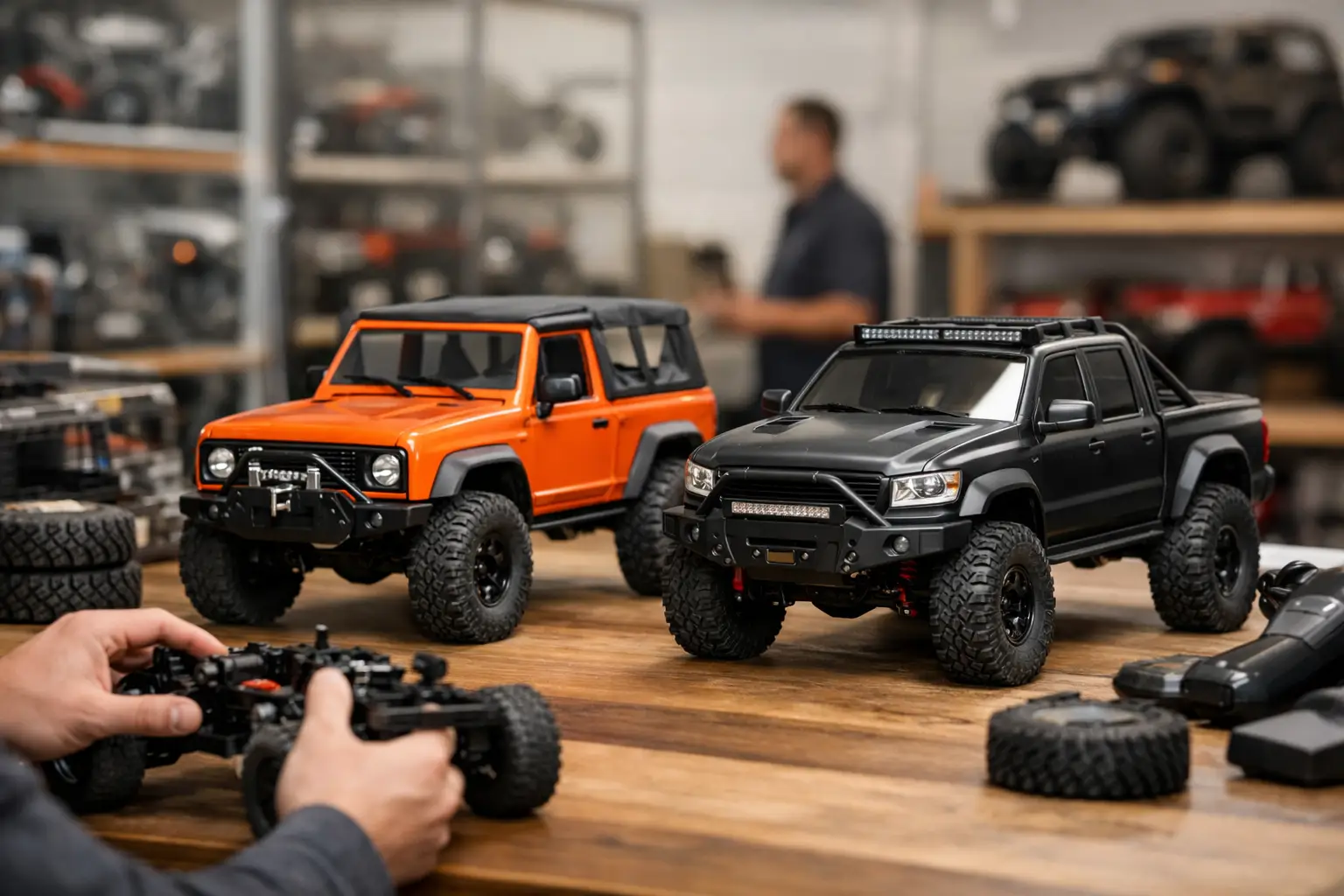
A scale trail truck is designed to look and drive like a real off-road vehicle. It may include a detailed body, lights, bumpers, mirrors and a realistic ride height.
These models are excellent for:
-
Woodland walks
-
Group trail runs
-
Scale courses
-
Realistic builds
-
Drivers who enjoy adding accessories and body details
Their realistic proportions can limit ground clearance, suspension travel and tyre size, but overcoming those limitations is part of the appeal for many owners.
A technical rock crawler is more focused on difficult obstacles. It will often have greater articulation, lower gearing, a lower centre of gravity and tyres designed to maximise grip. It may look less realistic, but it can tackle lines that would stop many scale trucks.
Neither type is automatically better. Choose a trail truck if the journey, appearance and realism matter most. Choose a more technical crawler if slow and challenging terrain is the main attraction.
Size Changes the Experience
Smaller crawlers are easy to carry, require less storage space and can turn a garden, living room or small pile of rocks into an enjoyable course. They are ideal when space is limited or you want something convenient to use after work.
However, their smaller tyres and lighter weight can make wet roots, deep mud and loose stones surprisingly difficult.
A 1/10-scale crawler is a popular all-round choice. It has enough weight and wheelbase to feel stable outdoors, while the scale has excellent support for bodies, wheels, electronics and replacement parts.
The trade-off is that a 1/10-scale model requires more storage and a larger running area. If your usual course is a small patio or indoor space, a large crawler may feel awkward rather than impressive.
What Makes an RC Crawler Perform Well?
An RC crawler does not need maximum power. It needs smooth, predictable control at walking pace.
This is why the motor, electronic speed controller, steering servo and tyres deserve more attention than headline speed figures.
Brushed or Brushless?
A brushed motor system is often a sensible choice for a beginner, casual trail driver or realistic scale build. It is affordable, straightforward and can provide excellent low-speed control when properly set up.
A sensored brushless system can offer:
-
Smoother low-speed response
-
Greater efficiency
-
More power
-
Improved throttle control
-
Reduced maintenance
However, sensored systems cost more and are not essential for every crawler. A well-geared brushed setup can be more than capable for relaxed trail driving.
Steering Servo Strength
Steering strength is important because crawler tyres frequently become wedged against rocks while the vehicle is stationary.
When choosing a servo, check:
-
Servo torque
-
Operating voltage
-
Waterproofing
-
Physical size
-
Mounting arrangement
-
Servo spline and horn compatibility
-
ESC BEC output
A stronger servo can be a worthwhile upgrade, but fitting an unsuitable high-voltage servo without checking the ESC’s BEC output may prevent it from performing properly.
Tyres and Foams
Tyres have one of the biggest effects on real-world crawling performance. A soft-compound tyre with a suitable foam insert can completely change how a crawler climbs and holds a side slope.
Very soft tyres are not always the best choice, however. They may wear more quickly, deform under a heavy model or feel vague on firm surfaces.
For mixed UK terrain, a balanced tyre and foam combination is usually more useful than simply buying the softest compound available.
RC Crawler Batteries and Charging
Many modern RC crawlers use LiPo batteries, although some entry-level models still use NiMH packs.
LiPo batteries provide strong performance for their size, but they require a compatible balance charger and responsible handling. Always use the correct charging mode, charge on a suitable non-flammable surface and never use a battery that is damaged, punctured or swollen.
Battery capacity is not only about run time. A larger pack adds weight, changes weight distribution and may not fit the battery tray.
Before buying, check:
-
Battery dimensions
-
Connector type
-
Recommended cell count
-
Maximum battery capacity supported
-
Available space in the battery tray
-
Whether the model includes a charger
A 2S LiPo is a common starting point and is often all a crawler needs. A 3S battery can provide additional wheel speed and power, but it may make throttle control less forgiving and place greater strain on the motor, drivetrain and other electronics.
Never assume a crawler is compatible with 3S simply because the battery fits. Check the manufacturer’s specifications for the exact model and electronics.
For a first crawler, buying a matched battery and charger package removes much of the uncertainty. Experienced drivers may prefer batteries that match their existing chargers and connector system, but compatibility still needs to be confirmed.
Upgrade Your Crawler With a Purpose
Modification is a big part of crawler ownership, but the most satisfying builds usually develop gradually.
Drive the model on familiar terrain before deciding what needs to change. Fit upgrades to solve a real limitation rather than assuming every aluminium component will improve performance.
Adding Weight Down Low
Weight positioned low on the crawler can improve side-slope stability and front-end grip. Common options include brass portal covers, steering knuckles and wheel weights.
There is a limit, though. Excessive unsprung weight can make the suspension less responsive and place additional strain on:
-
Axles
-
Bearings
-
Driveshafts
-
Steering components
-
The steering servo
Metal suspension links may improve durability and appearance, but correct length and geometry are more important than the material alone.
Which Upgrades Should Come First?
A sensible upgrade order for many crawlers is:
-
Tyres and foam inserts
-
Steering performance
-
Weight distribution
-
Suspension setup
-
Gearing and electronics
-
Cosmetic and scale accessories
Premium components, including Vitavon upgrades for compatible platforms, make the most sense when they address a known weak point or support the type of terrain you regularly drive on.
Check Spare Parts Before Buying a Crawler
Every crawler takes knocks. That is normal, especially while learning accurate wheel placement or attempting steeper and more technical lines.
Before committing to a platform, check the availability of common service parts such as:
-
Internal gears
-
Driveshafts
-
Axle housings
-
Suspension links
-
Wheel hexes
-
Body mounts
-
Bearings
-
Servo mounts
-
Electronics trays
Also consider how easy the crawler is to work on. A model with accessible fixings, exploded diagrams and reliable parts support is a better long-term prospect than a cheap vehicle with uncertain spares availability.
The lowest initial price can quickly become poor value if a minor breakage leaves the crawler unusable for weeks.
This is where a genuine specialist retailer earns its place. Accurate product information, compatible-part guidance and knowledgeable support are especially valuable when different versions of the same model use different components.
Make Your First Run Count
Before the first outing:
-
Check the wheel nuts.
-
Inspect the suspension fixings.
-
Check the pinion and spur gear mesh where accessible.
-
Make sure the steering is centred.
-
Set the throttle trim to neutral.
-
Confirm that the battery is secured properly.
-
Test the failsafe before driving away.
Begin on easy ground and practise gentle starts, controlled descents and slow steering inputs.
Crawling is less about forcing the vehicle over an obstacle and more about reading the terrain, choosing a line and placing the tyres accurately. Reversing and trying a different approach is often the quickest way through.
Start with a crawler that suits your terrain, buy the battery equipment it genuinely requires and keep the likely replacement parts in mind.
The best crawler is not necessarily the one with the longest upgrade list. It is the one you will be happy to carry outside, drive regularly and gradually make your own.
Frequently Asked Questions
What is the best RC crawler for a beginner?
A ready-to-run crawler with good spare-parts support is normally the best place to start. Choose a model that suits the space and terrain you have available rather than buying purely on appearance or specification.
A smaller crawler can be ideal for gardens and indoor courses, while a 1/10-scale model is generally better suited to woodland trails and larger outdoor obstacles.
Is a 1/10-scale crawler too big for a beginner?
No. A 1/10-scale crawler can be an excellent beginner’s choice because it is stable outdoors and benefits from a wide selection of replacement parts and upgrades.
However, it needs more storage and running space than a smaller crawler. Consider where you will drive and how you will transport it before deciding.
Is a brushed or brushless motor better for crawling?
A brushed setup is affordable, simple and often provides excellent low-speed control. It is a perfectly sensible option for beginners and relaxed trail driving.
A sensored brushless system can offer improved efficiency, power and throttle response, but it costs more and is not essential for every crawler.
Can I use a 3S LiPo battery in my RC crawler?
Only if the crawler’s ESC, motor and drivetrain are designed to support 3S power. A 3S battery can provide greater wheel speed and power, but it may also increase heat and drivetrain stress.
Always check the manufacturer’s specifications for your exact model before connecting a higher-voltage battery.
What should I upgrade first on an RC crawler?
Tyres and foam inserts are often the most effective first upgrade because they directly affect grip and stability.
After that, consider steering performance, weight distribution and suspension setup. Avoid replacing parts simply because an aluminium alternative is available.
Are brass upgrades worth fitting to a crawler?
Brass parts can improve stability by adding weight low down, particularly around the front axle. However, adding too much weight can reduce suspension response and increase strain on the steering servo, bearings and drivetrain.
Use brass parts strategically rather than fitting every available option.
What do I need with a ready-to-run RC crawler?
The contents vary between models. Some include a battery and charger, while others require these separately. You may also need AA batteries for the transmitter.
Check the product description carefully for a “needed to complete” section before placing your order.
Why is spare-parts availability important?
Crawler parts gradually wear and can become damaged during trail use. Reliable access to gears, driveshafts, suspension components and body mounts means a small failure will not keep the vehicle out of action for an extended period.
Written by RC Model Shop
This article was written by the team at RC Model Shop, one of the UK’s leading specialists in hobby-grade radio-controlled vehicles.
With years of hands-on experience selling, repairing and upgrading RC crawlers, we help customers choose suitable vehicles, replacement parts, batteries, chargers and performance upgrades for their needs. Our advice is based on real-world RC experience rather than manufacturer specifications alone.
Whether you are choosing your first trail truck, building a detailed scale crawler or improving the performance of an existing model, our goal is to help you buy compatible equipment and get more enjoyment from the hobby.
For expert advice or help choosing the correct RC crawler and supporting equipment, contact the team at RC Model Shop.