
Traxxas vs ARRMA Bashers - Which Suits You?
09/08/2026
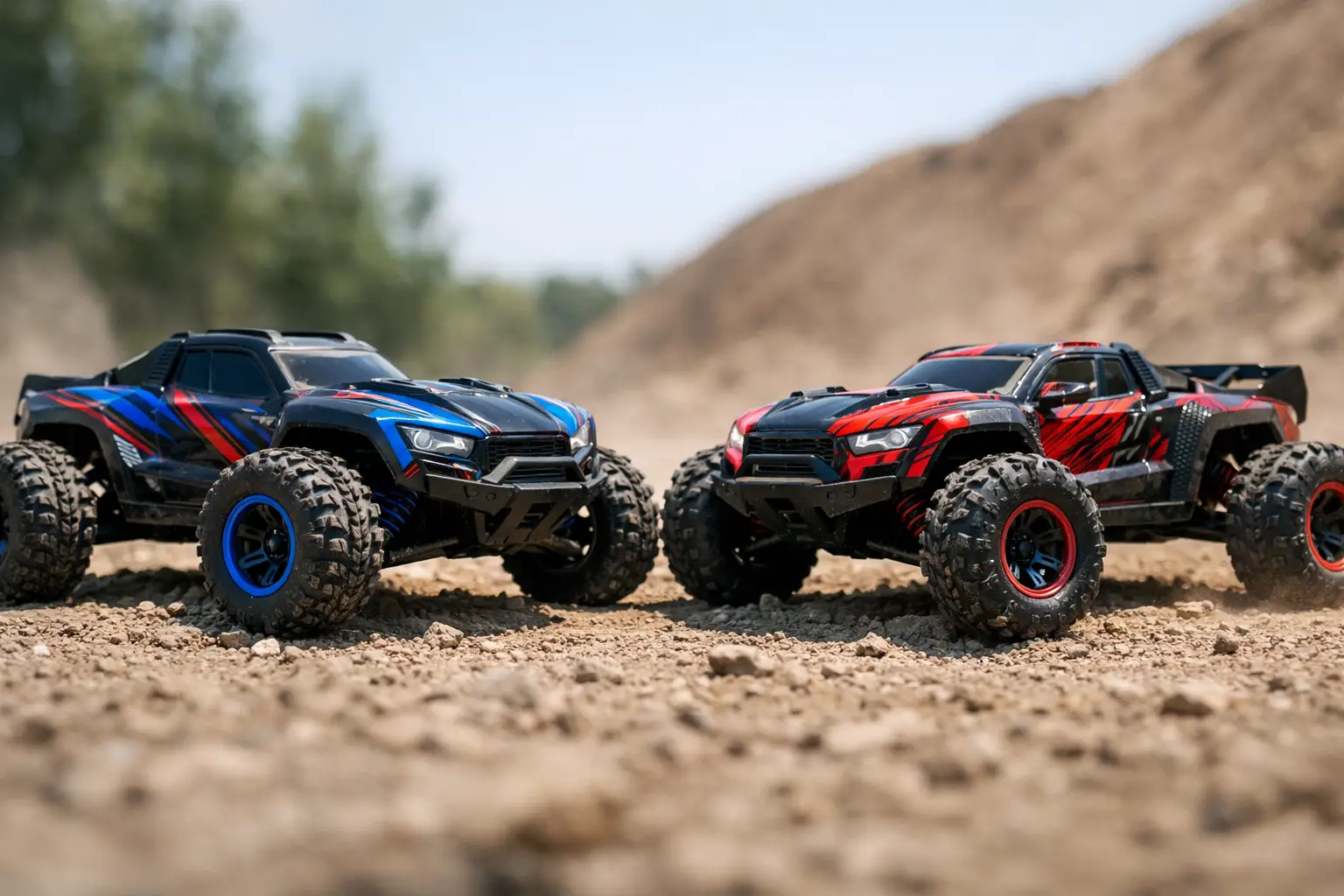
A wet grass field, a BMX-style dirt mound and a spare battery in your pocket will reveal more about an RC car than a spec sheet ever can.
The Traxxas vs ARRMA bashers question comes up constantly because both brands make fast, capable models that are built to be driven hard. The better choice is not simply the one with the biggest motor or the highest claimed speed. It is the one that suits where you drive, how you maintain your cars and how far you intend to push the hobby.
Traxxas and ARRMA both cover a wide range, from approachable models for newer drivers to serious high-power bashers.
Their cars share plenty of qualities: ready-to-run convenience, four-wheel-drive options, waterproof electronics on many models and strong performance with modern LiPo batteries.
The meaningful differences appear in driving feel, model choice, electronics ecosystems, battery compatibility and the way each platform responds to repeated hard use.
You can compare our current ranges of ARRMA RC cars and Traxxas RC cars while using this guide to decide which platform suits you best.
Traxxas vs ARRMA Bashers: The Short Answer
Choose Traxxas if you want a polished ownership experience, a wide model range and a straightforward route into hobby-grade RC.
Models such as the Slash, Rustler, Stampede and Maxx have become popular because they are easy to understand, enjoyable on a wide variety of surfaces and backed by a large parts and accessories range.
Traxxas can also suit drivers who value an integrated battery and charger ecosystem and electronic driving aids such as Traxxas Stability Management on compatible models.
Choose ARRMA if your priority is aggressive bashing, high-speed rough-ground driving and platforms designed around strong 3S, 4S, 6S and larger-power systems.
The Granite, Vorteks, Senton, Typhon, Kraton and Outcast ranges give buyers clear choices across monster trucks, stadium-style trucks, short-course trucks, buggies and stunt-focused models.
Many experienced bashers are drawn to ARRMA's larger platforms because of their planted feel and strong performance potential.
That is the broad picture, but the badge on the body shell matters less than choosing the correct model and power level.
A 3S monster truck and a 6S truggy are not direct competitors simply because they come from rival brands.
Start With Where and How You Drive
Terrain and available space should lead the decision before brand loyalty does.
A model that feels brilliant in a large open field may be frustrating in a small garden or crowded park.
Smaller spaces and local parks
For a first serious RC car, a 1/10-scale 2WD or 4WD basher is often easier to carry, easier to control and less costly to repair after a major impact than a larger high-voltage model.
Modern 2S and 3S vehicles can still be extremely fast, so they should not be treated as soft options.
They simply make more sense for tighter spaces and shorter driving sessions.
Traxxas has particularly broad appeal here.
The Slash short-course platform provides substantial wheel and suspension protection from its body, while the Rustler offers a more lively stadium-truck feel.
The Maxx sits higher up the range for drivers who want a serious monster truck without immediately stepping into the size, weight and battery demands of the largest models.
You can browse our Traxxas RC car range to compare the different platforms.
Rough ground and harder bashing
ARRMA has equally compelling choices, particularly for drivers interested in rougher terrain and stronger power systems.
A Granite is a familiar answer for rough grass, loose surfaces and skatepark-style use.
The Senton provides the planted feel and body protection of a short-course truck, while the Kraton and Outcast platforms appeal to drivers who have enough space to use considerably more power.
On a small playing field, a large 6S car can reach the boundary remarkably quickly.
For drivers who already know they want aggressive off-road performance, browse our ARRMA RC car range.
UK Weather Changes the Buying Decision
British weather matters.
Damp grass, mud, loose grit and wet tarmac all place extra demands on an RC car.
Ground clearance, tyre choice and maintenance become particularly important.
Waterproof electronics can provide useful protection, but waterproof does not mean maintenance-free.
After wet or muddy running:
-
Remove grass and debris.
-
Dry the chassis and electronics.
-
Check bearings and driveshafts.
-
Inspect steering components.
-
Check cooling fans for trapped dirt.
-
Make sure battery connectors are clean and dry.
Repeatedly putting a wet RC car straight back into storage will eventually create more problems than the original driving session.
Traxxas vs ARRMA Driving Feel
The two brands can feel noticeably different even when the headline specifications appear similar.
How Traxxas cars tend to feel
Traxxas models often feel accessible from the first battery pack.
The control layout, battery ecosystem and model-specific documentation are generally designed to reduce the amount of setup required before driving.
Features such as Traxxas Stability Management, where fitted, can help keep a powerful car pointed in the intended direction on slippery grass or loose gravel.
It is not a replacement for good throttle control, but it can make a fast model easier to manage while the driver gains experience.
How ARRMA cars tend to feel
ARRMA bashers often appeal to drivers who enjoy a more aggressive, planted style of driving.
On larger models, the combination of chassis layout, suspension and weight can provide confidence when carrying speed over rough ground.
That does not mean an ARRMA is indestructible.
A badly judged jump, kerb strike or full-throttle collision can damage any hobby-grade RC car.
The difference is that many ARRMA platforms are bought specifically by users who intend to drive them hard.
Which Brand Is More Durable?
There is no useful answer that says every Traxxas is stronger than every ARRMA or vice versa.
Durability depends on the exact platform, impact, terrain and setup.
A smaller 3S vehicle crashing at moderate speed may survive an impact that would cause considerable damage to a much heavier 6S or 8S model carrying far more energy.
Driving style also matters.
Landing jumps while applying full throttle or heavy braking places severe load on driveshafts, differentials and gears.
Repeated high-speed impacts into kerbs will eventually overcome almost any suspension design.
Setup can create reliability problems too.
Over-gearing a car, fitting very heavy tyres or using unsuitable batteries can turn a dependable model into an overheating or drivetrain-breaking one.
A well-driven standard vehicle will often deliver more enjoyment than an overpowered build that spends every other weekend on the bench.
Traxxas vs ARRMA Batteries and Chargers
Battery choice is one of the clearest practical differences between the two ecosystems.
Traxxas batteries and iD charging
Traxxas uses its own connector system and promotes its iD battery and charger ecosystem.
For newer owners, this can make choosing compatible equipment straightforward.
A matched Traxxas iD battery and charger can reduce the amount of battery setup and connector knowledge required.
That convenience is one of the reasons Traxxas can be an easy route into higher-performance RC.
ARRMA and Spektrum Smart electronics
Many current ARRMA platforms use Spektrum electronics and IC-series connectors.
When paired with compatible Spektrum Smart batteries and chargers, the system can provide useful battery information and simplified charging features.
However, exact connector arrangements and battery requirements can vary between ARRMA platforms and model generations.
Always check the individual product specification before ordering a battery.
Is Traxxas or ARRMA Better for Beginners?
For a complete newcomer, Traxxas often offers one of the easiest routes into hobby-grade RC.
The broad model range, integrated battery ecosystem and large amount of model-specific information can simplify the first purchase.
That does not mean a beginner should avoid ARRMA.
A suitable ARRMA 2S or 3S model can make an excellent first hobby-grade RC car.
The important factor is selecting a sensible model rather than immediately buying the fastest platform available.
A high-power 6S or 8S car can be difficult to control, expensive to run and capable of causing considerable damage in a collision.
There is nothing wrong with starting on 2S or 3S and moving up once you understand throttle control, maintenance and LiPo battery care.
Do Not Buy Based on Top Speed Alone
Top-speed claims attract attention, but they tell you very little about whether you will enjoy owning the model.
Higher speed normally means:
-
More space required
-
Greater stopping distance
-
Increased battery cost
-
More drivetrain load
-
More tyre wear
-
Greater impact energy
-
More expensive crashes
A car capable of extreme speeds is only useful if you have somewhere appropriate to run it.
For many UK users, a strong 3S setup provides more usable performance than a larger 6S or 8S vehicle.
Spares, Repairs and Parts Support
Both brands have extensive exploded diagrams and strong replacement-parts support.
That matters because hobby-grade RC vehicles are designed to be repaired.
Crashes happen, tyres wear out and drivetrain components eventually need attention.
For regular bashers, it can be sensible to keep common wear or impact parts available.
Depending on the model, these might include:
-
Suspension arms
-
Steering components
-
Body clips or mounts
-
Wheel hexes
-
Bearings
-
Spare fasteners
-
Tyres
-
Driveshaft components
Traxxas has a particularly extensive range of model-specific accessories and upgrade parts.
ARRMA also benefits from excellent standard and aftermarket support, especially around popular 3S and 6S platforms.
Traxxas vs ARRMA Upgrades
Upgrades should solve a problem rather than simply make the parts list longer.
If a standard component repeatedly fails during normal use, a carefully selected stronger replacement may make sense.
If the model works perfectly well in standard form, replacing half the chassis with aluminium can create new problems.
Aluminium is not always stronger in practice
A flexible plastic suspension arm can absorb energy in a crash.
Replacing it with rigid aluminium may transfer that impact into the bulkhead, chassis or differential housing.
That can turn a cheap repair into an expensive one.
Upgrade where it matters
Useful upgrades can include:
-
Better-quality servo systems
-
Improved shock components
-
Stronger braces
-
Appropriate drivetrain upgrades
-
Better tyres for your terrain
-
Improved cooling where genuinely needed
Premium aftermarket components can make sense on heavily modified or high-power builds, but they are not essential for every weekend basher.
Traxxas vs ARRMA: Which Has Better Parts Availability?
Both brands benefit from strong parts support.
Availability for a specific model can still vary, particularly when generations change or a vehicle has recently been released.
Before buying any RC car, it is worth checking whether commonly damaged parts are readily available.
A fast model is not much fun if a minor broken component leaves it off the road for weeks.
Which Basher Offers Better Value?
Value is not just the price of the car.
A realistic budget should include:
-
Batteries
-
Charger
-
Charging accessories
-
Replacement tyres
-
Spare parts
-
Routine maintenance items
-
The first inevitable crash repair
A lower-priced model can become expensive if you immediately need a different radio system, battery setup or major upgrades to make it suitable for your use.
Equally, buying the largest and fastest model available can offer poor value if it is too intimidating or impractical to drive regularly.
Traxxas vs ARRMA for Different Types of Buyer
First hobby-grade RC
Traxxas is often particularly easy to recommend because of the accessible ownership ecosystem and large range of models.
A suitable ARRMA 2S or 3S vehicle can be equally enjoyable if you prefer the model or driving style.
Park and field driving
Both brands offer excellent options.
Choose according to ground clearance, tyre type and the amount of space available rather than the badge.
Big jumps and stunt driving
ARRMA's stunt-focused and larger basher platforms are popular with drivers who enjoy aggressive jumps and rough use.
Traxxas also offers highly capable options, so compare equivalent power and scale classes rather than brands in isolation.
High-speed running
Both manufacturers produce extremely fast models.
Make sure your intended location is large and safe enough before choosing a vehicle primarily for speed.
Family use
A manageable 2S or 3S platform is normally more sensible than immediately jumping into extreme power.
Lower running costs and easier control often mean the car gets used more frequently.
Traxxas vs ARRMA FAQs
Is ARRMA better than Traxxas?
Neither brand is universally better.
Traxxas may suit buyers who want a very accessible ownership experience and broad ecosystem, while ARRMA is particularly attractive to drivers interested in aggressive high-performance bashing.
The individual model matters more than the brand name.
Is Traxxas more reliable than ARRMA?
Reliability depends heavily on the vehicle, power system, driving style and maintenance.
Both brands can be extremely reliable when used within their intended limits.
Both can also break when subjected to hard enough impacts.
Which is better for beginners, Traxxas or ARRMA?
Traxxas often provides an especially straightforward first experience, but many ARRMA 2S and 3S models are also suitable for beginners.
Avoid choosing purely by maximum speed.
Which is better for bashing, ARRMA or Traxxas?
Both make excellent bashers.
ARRMA has a particularly strong reputation around aggressive 3S and 6S off-road platforms, while Traxxas offers everything from approachable park bashers to serious high-power monster trucks.
Are ARRMA parts easy to get in the UK?
Popular ARRMA models have strong replacement-parts support in the UK, although stock availability varies by individual component and model generation.
Are Traxxas parts easy to get in the UK?
Traxxas has an extensive parts catalogue and strong support for its major platforms.
As with any RC model, availability can vary by individual part.
Which is cheaper to run, ARRMA or Traxxas?
The power level matters more than the brand.
A 3S vehicle from either manufacturer will normally cost less to run and repair than a much larger 6S or 8S platform.
Is 3S enough for an RC basher?
For many drivers, absolutely.
Modern 3S bashers can be extremely quick and offer more than enough power for parks, fields, jumps and general off-road use.
Should I buy a 6S RC car as my first basher?
Usually not unless you already have relevant RC experience and enough space to use it safely.
A 2S or 3S model is normally easier and cheaper to learn with.
Which has better batteries, Traxxas or ARRMA?
Both ecosystems have advantages.
Traxxas iD prioritises simplicity and integration, while many ARRMA models use Spektrum Smart systems that can provide additional battery data with compatible equipment.
The better system depends on how much flexibility or convenience you want.
So, Should You Buy Traxxas or ARRMA?
For straightforward family use, local park driving and learning basic RC maintenance, Traxxas often provides an easy buying path with plenty of familiar model choices.
For drivers who already know they want aggressive rough-ground performance, large jumps and a strong route into 3S and 6S bashing, ARRMA can be particularly appealing.
But there is no rule that says one brand is for beginners and the other is for experts.
Choose the car, not just the badge.
Consider the scale, power system, terrain, battery cost, parts support and amount of space you actually have available.
You can compare our current ranges of Traxxas RC cars and ARRMA RC cars, or contact the RC Model Shop team if you want help choosing between particular models.
The best basher is the one you will drive often, repair confidently and enjoy improving over time.
Pick a scale that suits your space, start with power you can control and keep enough of your budget aside for batteries, charging equipment and the parts that keep the next session possible.
Written by RC Model Shop
This article was written by the team at RC Model Shop, one of the UK's leading specialists in hobby-grade radio-controlled vehicles.
With years of hands-on experience selling, repairing and upgrading Traxxas, ARRMA and other hobby-grade RC cars, we regularly help customers decide which platform best suits their experience, available space and style of driving.
Comparing Traxxas and ARRMA involves much more than looking at advertised speed figures. Vehicle weight, battery voltage, drivetrain design, tyre choice, replacement-parts availability and the cost of running the model all affect the ownership experience.
Our advice is based on practical RC experience and helping customers choose vehicles they can actually use and maintain, rather than simply recommending the most powerful model available.
Whether you're choosing your first hobby-grade basher, moving from 3S to a larger 6S platform or deciding between equivalent Traxxas and ARRMA models, our team can help you understand the practical differences before you buy.
To compare available models, browse our Traxxas RC cars and ARRMA RC cars at RC Model Shop.