
Sensored vs Sensorless Motors: Which Suits You?
25/08/2026
Sensored vs Sensorless Motors: Which Is Best for Your RC Car?
A crawler that judders when you ease onto a rock can turn a carefully planned trail run into a frustrating afternoon. A basher, meanwhile, does not usually care about inch-perfect throttle control when it is clearing a jump at speed.
That difference is at the heart of sensored vs sensorless motors. Neither is automatically better – the right choice depends on how, where and how hard you drive your RC model.
For many RC cars, the motor is only half of the decision. The ESC, battery voltage, gearing, vehicle weight and intended use all affect the result. Understanding what the sensor system does makes it far easier to choose a brushless RC motor setup that feels right rather than simply chasing the biggest kV number.
What is the difference between sensored vs sensorless motors?
Both motor types are brushless motors. They use an ESC to switch power through the motor windings, creating the rotating magnetic field that turns the rotor. The difference is how the ESC knows the rotor's position.
A sensorless motor has no separate feedback connection. The ESC estimates rotor position by reading the electrical feedback, often called back EMF, produced as the motor spins. Once the motor is moving, this works very well. It is simple, reliable and common in ready-to-run bashers, stadium lorries and high-speed RC cars.
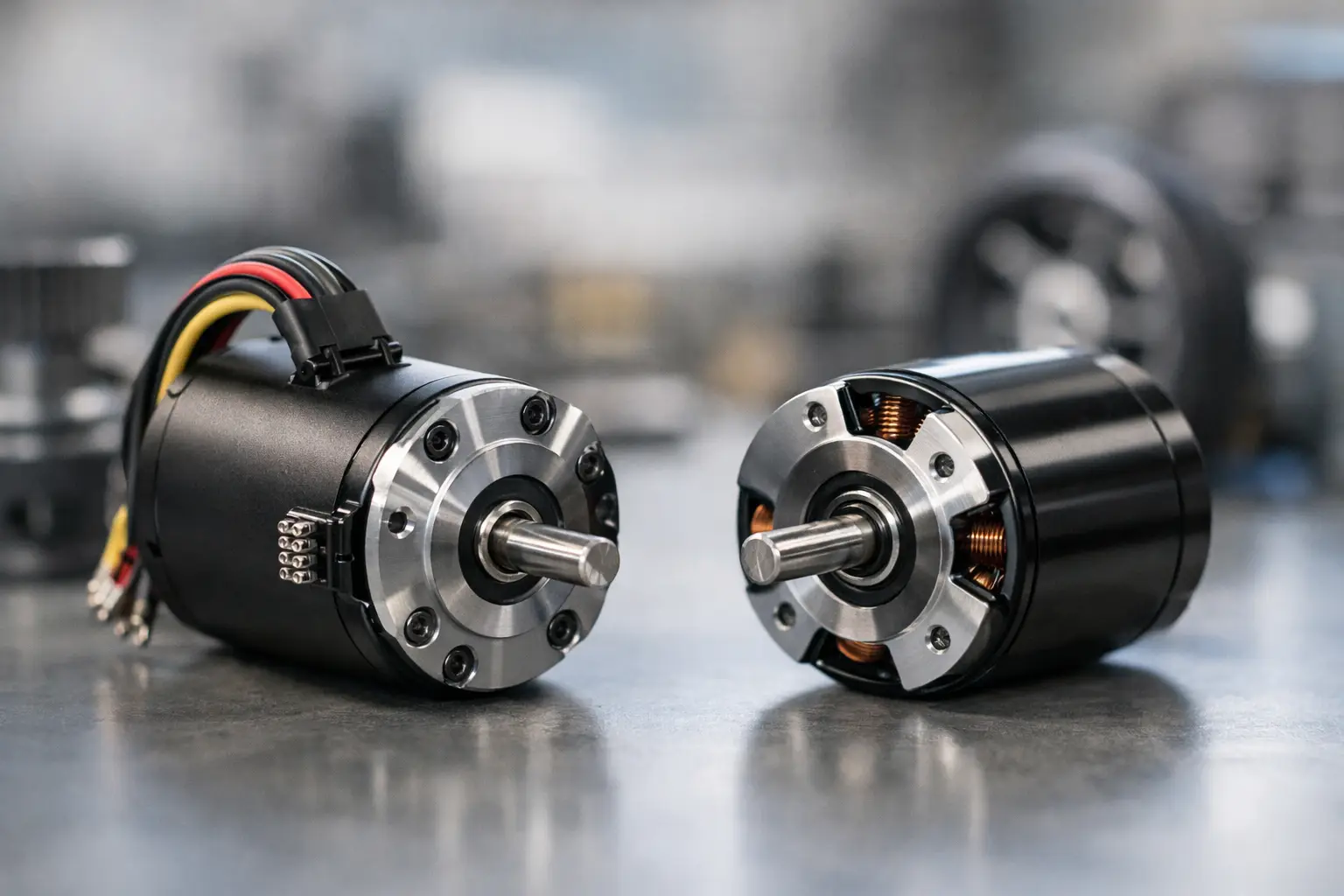
A sensored motor adds a small sensor board inside the endbell and a sensor wire running from the motor to a compatible ESC. The sensors tell the ESC exactly where the rotor is before and during rotation. That extra information gives the ESC much better control at very low speed and from a standstill.
The practical result is straightforward: a sensored system generally starts more smoothly, crawls more precisely and offers more predictable throttle response. A sensorless system is usually simpler and often represents better value for fast, general-purpose driving.
Why low-speed control changes everything
Sensorless motors can sometimes hesitate or shudder when moving away very slowly, especially under load. This is known as cogging. It happens because the ESC has to make its best estimate of where the rotor is before enough rotational feedback is available.
In a lightweight buggy launched on a firm surface, that moment is often barely noticeable. In a heavy crawler trying to move one tyre at a time over uneven rocks, it is much more obvious. The vehicle may lurch, lose its line or suddenly apply more wheel speed than intended.
Sensored systems reduce this problem because the ESC already knows the rotor position. The throttle can feel almost proportional at walking pace: a small trigger movement produces a small, controlled movement of the vehicle.
For technical crawling, scale trail lorries, competition rock racers and some racing classes, this precision is a real performance advantage rather than a luxury.
That does not mean every crawler must use a sensored setup. A carefully geared sensorless system can be enjoyable on relaxed trails, particularly in a lighter model. But if smooth take-offs, controlled descents and fine manoeuvring are priorities, sensored equipment is usually the sensible place to start.
Sensorless motors suit speed and straightforward bashing
For bashing, speed runs and many off-road vehicles, sensorless brushless systems remain hugely popular for good reasons.
They are comparatively uncomplicated, widely available and capable of serious power. Once the motor is spinning, a quality sensorless ESC and motor combination can deliver strong acceleration and impressive top speed.
Sensorless setups also avoid the separate sensor lead. That is one less wire to route through the chassis, one less plug to check after a heavy crash and one less component exposed to mud and moisture.
For an RC car that spends its weekends being launched off ramps, driven through loose dirt and occasionally rolled at speed, simplicity has value.
Many ready-to-run models use sensorless systems because they provide a good balance of cost, durability and performance. They suit drivers who want to fit a charged LiPo, pull the trigger and have fun without tuning for ultra-slow control.
There are limits. A high-kV sensorless motor on an overgeared, heavy vehicle can run hot and feel harsh at low speed. More power is not a cure for poor gearing.
If temperatures rise after a few hard runs, reduce the pinion size, check drivetrain binding and make sure the battery and ESC are suited to the current draw.
You can browse our range of brushless RC motors when choosing a replacement motor or planning a new brushless setup.
Sensored systems are not only for crawlers
Although crawling is the most obvious use, sensored brushless systems are also common in racing.
On a technical circuit, controlled power delivery can help a driver carry speed through tight corners, manage a slippery surface and accelerate cleanly out of turns. The initial throttle response is more consistent, which can make a car easier to place accurately.
Some sensored ESCs offer detailed settings for boost, turbo timing, throttle curves and motor timing. These adjustments can produce excellent results in the right hands, but they are not a requirement for a good setup.
For a first sensored system, sensible gearing, conservative ESC settings and regular temperature checks matter more than chasing advanced timing settings.
A useful middle ground is the sensored/sensorless capable ESC. These ESCs can run a sensored motor with the sensor cable connected, while compatible systems may also operate without sensored feedback if required.
Compatibility still needs checking carefully, but this flexibility can be useful for enthusiasts running different vehicles or motor types.
Compatibility checks before buying
A motor and ESC are not interchangeable just because both are brushless.
Before fitting a new system, confirm the motor type, sensor compatibility and voltage rating. A sensored motor needs an ESC with a compatible sensor port if you want the benefits of sensored operation.
Also check the motor size. A 3652, 3660, 4074 or 4282 motor designation generally refers to the approximate motor can dimensions, and the physical space available in your chassis matters.
The shaft diameter must suit your pinion gear, while the mounting holes and wire routing need to work with the motor mount and chassis layout.
Check the kV rating
kV should be considered alongside battery voltage and gearing.
Higher kV generally means more unloaded motor rpm per volt. It does not automatically mean that the motor is a better or more powerful choice for your particular vehicle.
A high-kV motor on 3S or 4S may be suitable in one lightweight vehicle but excessive in another. Lower-kV motors can provide excellent performance when paired with the correct voltage and gearing, particularly in heavier vehicles.
Check the ESC
The ESC needs to be capable of handling the motor and battery combination you intend to use.
Do not assume that an existing ESC will automatically be suitable simply because the replacement motor physically fits the vehicle.
Voltage limits, motor recommendations and the intended application all need to be considered.
Check the connectors
Finally, inspect the connectors.
Battery, ESC and motor connectors need to handle the expected current safely. Poor solder joints, undersized plugs or damaged wiring create resistance and heat – problems no motor upgrade can solve.
If you're unsure which motor will work with your existing setup, check the specifications carefully or speak to us before ordering from our brushless motor range.
Durability, maintenance and wet running
Sensorless motors have fewer external connections, which can make them a practical option for rough use.
Sensored motors are still durable, but the sensor cable and socket deserve attention. Route the lead away from spur gears, driveshafts and hot motor cans, and leave enough slack where necessary to prevent the wire being pulled tight.
If the car takes a hard impact, check that the plug is fully seated before assuming there is a motor fault.
Water resistance varies by product. Do not assume that a sensored motor, sensor board or ESC is waterproof simply because the vehicle has been driven through puddles before.
Check the manufacturer specification for the complete system, including the sensor connection.
After wet or muddy running, clean the model, dry it thoroughly and inspect bearings, plugs and wires.
Motor temperature is another useful health check. Excessive heat can point towards gearing, drivetrain, battery or setup issues.
A cooling fan can help control normal operating temperatures, but it should not be used to disguise a fundamentally overgeared or unsuitable combination.
Sensored vs sensorless motors at a glance
| Feature | Sensored | Sensorless |
|---|---|---|
| Low-speed control | Excellent | Can vary |
| Smooth start-up | Excellent | May cog at very low speed |
| Crawling | Excellent choice | Suitable for some applications |
| Bashing | Suitable | Excellent choice |
| Racing | Very popular | Application dependent |
| High-speed use | Excellent with correct setup | Excellent |
| Additional sensor cable | Yes | No |
| Setup complexity | Slightly higher | Simpler |
| Typical cost | Often higher | Often lower |
| Maintenance | Sensor connection needs checking | Relatively straightforward |
The table is a general guide rather than a compatibility chart. Individual motor and ESC specifications should always be checked before buying.
Which motor type should you choose?
Choose a sensored setup when low-speed control is central to the experience.
That includes serious crawlers, scale trail models, technical racing and drivers who want the smoothest possible throttle feel. It can cost more and adds a sensor lead, but the improvement in precision can be immediate.
Choose sensorless when you want a simple, proven brushless system for bashing, general off-road running, speed-focused driving or a budget-conscious upgrade.
It is often the best fit for vehicles that spend most of their time at medium to high speed, where sensorless control is at its strongest.
If you are unsure, start with the vehicle's real job rather than the headline specifications. Think about the surface you drive on, the speeds you actually use and whether you need millimetre-by-millimetre control or full-throttle durability.
The best motor system is the one that makes your RC car more enjoyable every time you reach for the transmitter.
Frequently Asked Questions
Is a sensored RC motor better than a sensorless motor?
Not automatically. Sensored motors generally provide better low-speed control, while sensorless motors provide a simple and effective solution for bashing, general off-road use and high-speed driving. The best option depends on the vehicle and how you use it.
Why does my sensorless brushless motor cog?
Cogging commonly occurs at very low motor speeds when the ESC is trying to determine the rotor's position. Vehicle weight, gearing, motor choice and drivetrain load can all affect how noticeable it is.
Are sensored motors better for RC crawlers?
They are often an excellent choice because crawling requires extremely precise low-speed throttle control. A sensored ESC knows the rotor position from a standstill, helping provide smoother initial movement.
Can I use a sensored motor with a sensorless ESC?
Compatibility depends on the individual equipment. Some sensored brushless motors can operate without the sensor connection, effectively running sensorless, but you should always check the specifications of the motor and ESC before connecting them.
Is higher kV always faster?
Not necessarily. kV describes the motor's approximate unloaded rpm per volt. Actual vehicle speed and performance also depend on battery voltage, gearing, tyre diameter, vehicle weight, ESC capability and load.
Should I upgrade my RC motor or ESC first?
It depends on the existing system. Before changing either component, establish what you want to improve and check whether the existing ESC, motor, battery and gearing can support the proposed change.
Where can I buy brushless RC motors in the UK?
RC Model Shop UK stocks a range of brushless RC motors for different RC applications. Check the motor dimensions, kV, shaft size, voltage requirements and ESC compatibility before ordering.
Written by RC Model Shop UK
This article was written by the team at RC Model Shop UK, specialists in hobby-grade RC cars, crawlers, boats, aircraft, electronics, batteries and performance upgrades.
Motor upgrades are one of the areas where simply comparing headline specifications can lead to an unsuitable setup. Our team regularly helps customers work through motor dimensions, kV ratings, battery voltage, ESC compatibility, gearing and the type of driving the vehicle will actually be used for.
We also work with RC models in our repair workshop, giving us practical experience of problems such as overheating motors, incorrect gearing, damaged connectors, drivetrain resistance and power systems that are simply mismatched to the vehicle.
Whether you're replacing a failed motor or planning a complete brushless conversion, the aim should be a balanced system rather than the highest specification available.
Browse our range of brushless RC motors or contact RC Model Shop UK if you need help working out which motor is suitable for your RC model.