
RC Suspension Setup for Better Control and Grip
28/09/2026
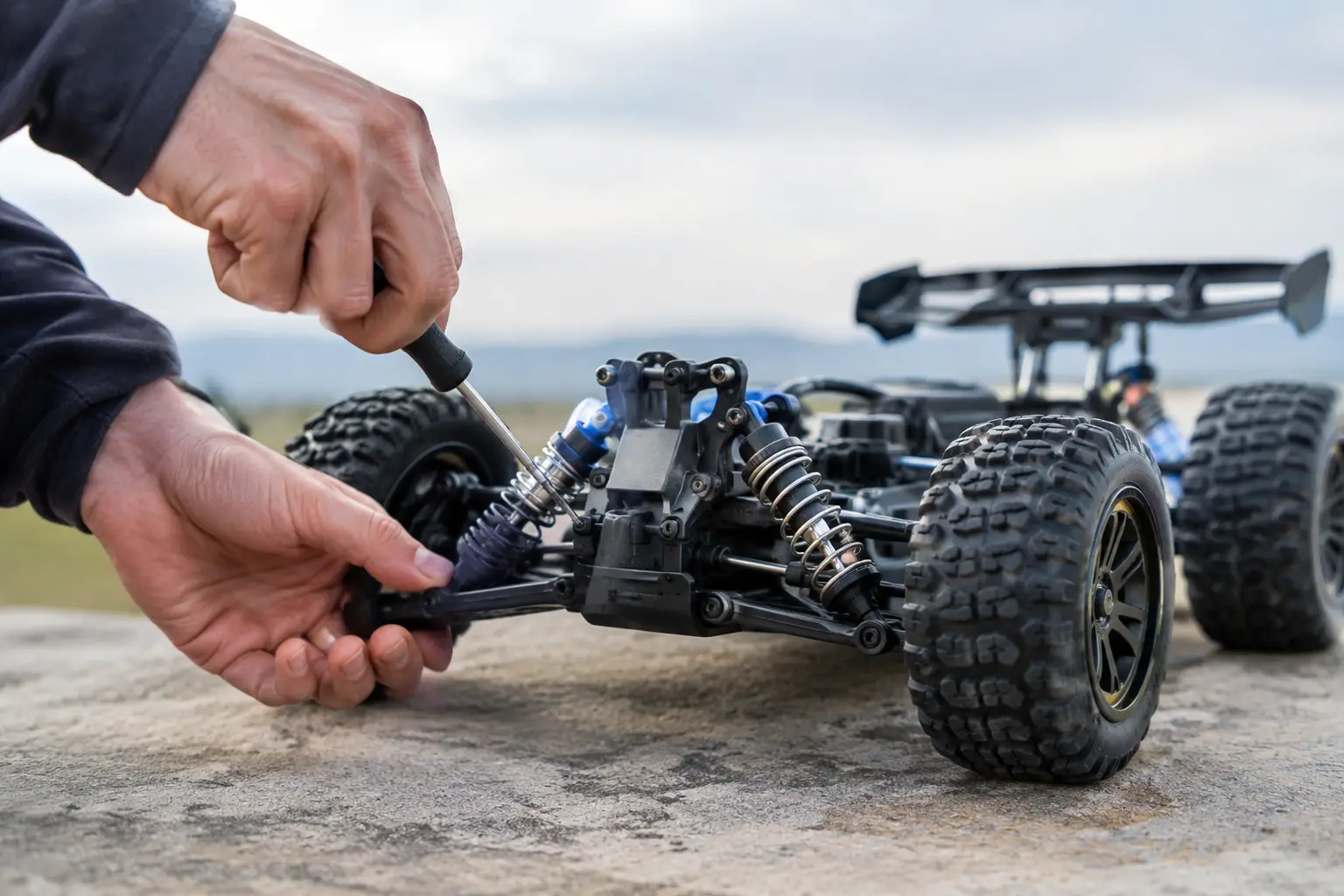
A good RC suspension setup is often the difference between a model that feels nervous and unpredictable and one you can place exactly where you want it. More power will not fix a car that skips across rough ground, rolls over in corners or bottoms out on every landing. Before fitting upgrades, take time to make the suspension work with the surface, driving style and weight of your model.
The aim is not to make every vehicle as stiff or as low as possible. A race buggy on a prepared track, a monster truck in a field and a scale crawler on rocks need very different things from their shocks. Start with a sound baseline, change one item at a time and test in the same area where possible. That approach saves parts, time and guesswork.
Start with a healthy suspension
Suspension tuning only works if the hardware is free to move properly. With the wheels off the ground, press each corner down and let it return. The arms should move smoothly, without sticking, excessive play or a bent hinge pin changing the angle of travel.
Check for leaking shock caps and shafts, damaged O-rings, cracked rod ends and bent shock shafts. A shock may still hold enough oil to look fine on the bench while offering very little damping once it is being worked hard. Also inspect the springs for damage and make sure the preload collars have not moved.
On vehicles that have seen wet UK running, clean the shock shafts before compressing them. Grit dragged through the seals shortens their life quickly. If a model pulls to one side under braking or lands unevenly, compare left and right shock lengths, spring settings and wheel movement before changing oils or springs.
Ride height comes before fine tuning
Ride height is where the chassis sits when the vehicle is ready to run, with its battery fitted. It affects ground clearance, cornering stability, steering response and how much suspension travel remains for bumps and landings.
For a basher, you usually want enough clearance to prevent the chassis constantly striking ruts, grass and loose stones. Setting it very high can make the model roll more easily and feel vague in turns, so aim for usable clearance rather than maximum height. A track car generally benefits from a lower, more controlled stance, provided the chassis is not slapping the surface over every bump.
Set ride height mainly with spring preload. Adding preload raises the chassis, but it does not make the spring genuinely stiffer. This distinction matters. If the model settles correctly at rest but uses all its travel too easily, more preload may mask the problem while leaving the real issue - a spring rate that is too soft.
Use equal preload side to side as a starting point. Small differences can be useful on a race circuit, but they are not the first answer to a model that handles poorly.
Check droop and available travel
Droop is the amount the suspension can extend when the wheels hang. Too little extension can make a car lose contact with uneven ground, while excessive droop can make it pitch, traction roll or feel slow to change direction.
Many ready-to-run models have sensible factory limits, so avoid changing droop without a clear reason. If you fit longer shocks, different arms or large wheels, check that the driveshafts do not bind at full extension and that tyres do not catch the body or suspension components at full compression.
Springs control support and balance
Springs carry the model's weight and determine how strongly it resists roll, squat and dive. Shock oil controls the speed of movement, while springs determine the support available throughout the travel. They work together, but they are not interchangeable fixes.
A spring that is too soft allows the chassis to roll heavily in corners, dive under braking and bottom out on landings. A spring that is too hard can make the model bounce, lose grip over small bumps and skate across loose surfaces. The right rate depends on vehicle weight, battery choice, terrain and whether you prioritise corner speed, jump control or scale realism.
If the front end dives badly but rear grip is good, a slightly firmer front spring may help. If the rear squats, bottoms out and pushes the front wide on acceleration, look at firmer rear springs. Make modest changes. Moving several steps at once makes it difficult to know what actually improved the handling.
For crawlers, softer springs and more articulation can help tyres maintain contact on uneven rock. There is still a limit: a very soft, tall setup can shift weight abruptly and cause the vehicle to fall onto its side. A lower centre of gravity and controlled travel usually produce more useful grip than simply fitting the softest springs available.
Use shock oil to control movement
Shock oil provides damping. Thicker oil slows compression and rebound; thinner oil lets the suspension move more freely. Oil weight labels can vary between brands, so treat them as a guide rather than an exact cross-brand measurement.
If a model lands from jumps and quickly smacks the chassis into the ground, thicker oil may slow the compression. If it feels harsh over ripples and struggles to follow uneven terrain, thinner oil may allow the wheels to react faster. The answer depends on the spring rate and the surface, which is why copying a setup from another vehicle rarely produces identical results.
A common mistake is filling shocks without bleeding them properly. Air trapped inside creates inconsistent damping and can make the car behave differently from one corner to another. Rebuild all four shocks carefully, use the correct diaphragm or bladder arrangement, and make sure each shaft extends and compresses with a similar feel.
Front-to-rear oil balance
The relationship between front and rear damping affects how the vehicle transfers weight. More damping at the front can reduce rapid dive and sharpen initial response, but too much can make the front tyres struggle for grip on rough ground. More rear damping can control squat and make launches tidier, though excessive rear damping may reduce traction over bumps.
There is no universal front-to-rear oil combination. A high-grip track, loose gravel and short grass place different demands on the same car. Use how the model behaves as your guide, rather than chasing a particular number on a bottle.
Make one change, then test it properly
A productive RC suspension setup process is deliberately boring. Choose a repeatable test area, run the same section several times, and make one adjustment at a time. Watch what happens during braking, corner entry, acceleration, rough sections and landings.
Keep a note on your phone or in a workshop notebook. Record spring rate, oil weight, ride height, tyre choice and ambient conditions. This is especially useful in Britain, where a dry hard-packed surface can become damp and loose after a short shower. Tyres often make a bigger difference than suspension, so do not diagnose every loss of grip as a shock problem.
If the model is new to you, begin with the factory settings unless there is an obvious fault. Manufacturers normally develop a usable all-round setup for the supplied tyres and electronics. From there, make changes to suit how and where you actually run.
Upgrades that are worth considering
Aluminium shock bodies, threaded preload collars and quality spring sets can make adjustment easier and more consistent, particularly on higher-powered bashers and race-focused models. They are not automatic handling upgrades, though. A well-built plastic shock with fresh seals and the correct oil will outperform an expensive shock that is poorly assembled.
Stronger suspension arms, shock towers and aftermarket components can be sensible where breakages are common, but check compatibility carefully. Geometry changes, different shock lengths and heavier parts can all alter the way a model handles. Fit upgrades to solve a known weakness or meet a clear goal, not simply because they look impressive.
RC Model Shop can help identify suitable shock oils, springs, rebuild parts and compatible upgrades for specific models when the standard setup is no longer meeting the job.
The best setting is the one that gives you confidence to drive harder without fighting the car. Start with smooth, reliable movement, tune for the ground beneath your tyres, and let each small change earn its place.