
LiPo Batteries for RC Models Made Simple
21/08/2026
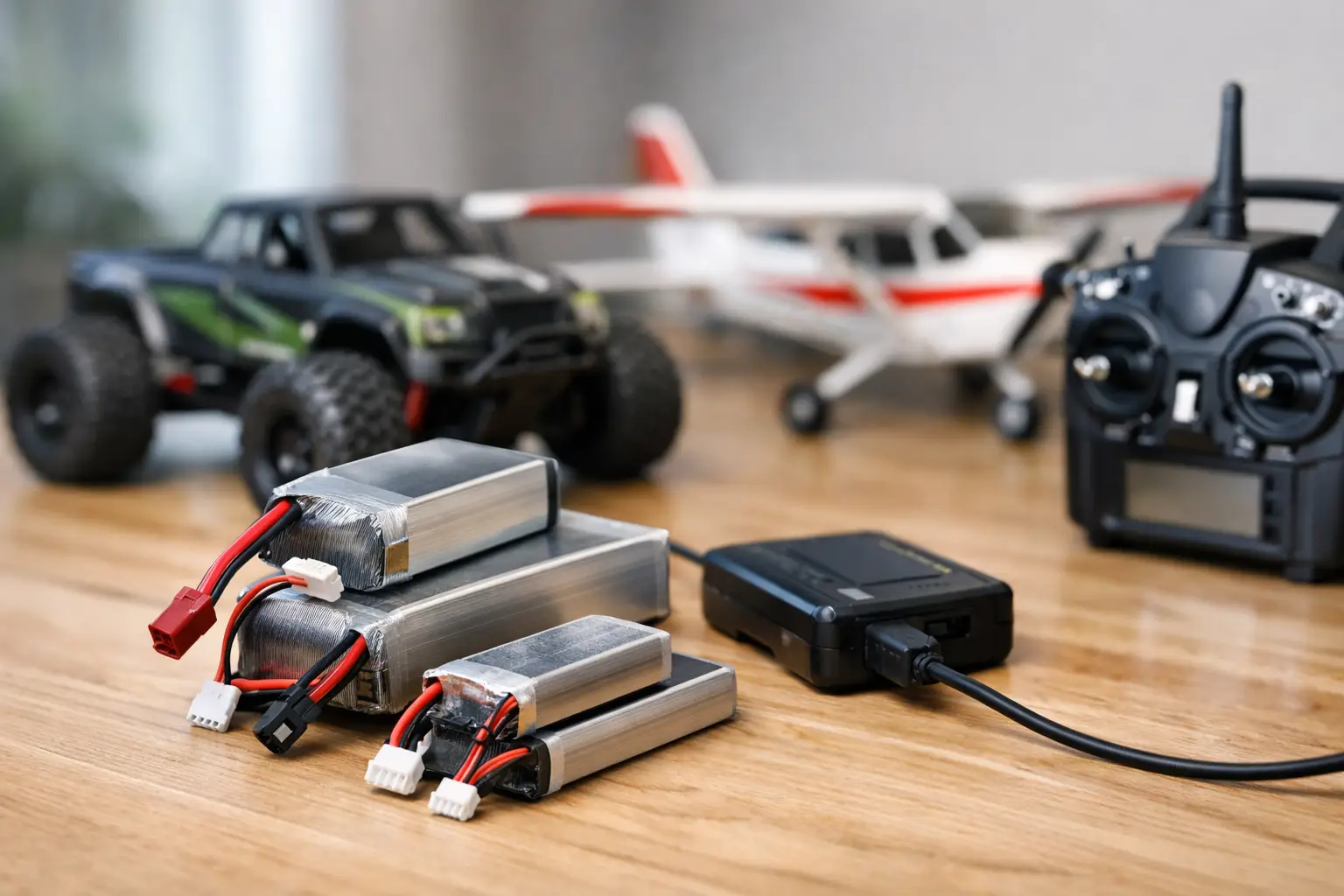
LiPo Batteries for RC Cars: Voltage, C Ratings, Charging & Safety
A LiPo pack can turn a lively RC car into a seriously quick one, but it is not simply a case of fitting the biggest battery that will fit in the tray.
Voltage changes the speed and punch of the model. Capacity affects run time and weight. Discharge rating determines whether the pack can keep up when you pull the trigger.
Get those details right and LiPo batteries deliver the performance RC hobbyists expect. Get them wrong and you can face poor handling, overheating or an expensive damaged model.
This guide covers the numbers on the label, how to match a pack to your vehicle and the practical habits that help batteries last.
You can browse our current range of LiPo RC batteries at RC Model Shop UK.
What makes LiPo batteries different?
LiPo stands for lithium polymer.
Compared with traditional nickel-metal hydride packs, LiPo packs store more energy for their size and weight, can supply much higher current and hold their voltage better under load.
In real terms, that means stronger acceleration, higher top speed where the model is geared for it, and less of the fading feel often noticed near the end of a NiMH run.
The trade-off is that LiPos need more care.
They must be charged with a compatible LiPo charger, should not be discharged too far, and need to be stored at the correct voltage when they will not be used for a while.
The small amount of extra routine is worthwhile, but it is not optional.
Choosing LiPo batteries for your RC model
The right pack starts with the vehicle manual.
It will state the supported cell count, battery dimensions, connector type and sometimes a recommended capacity range.
Treat the maximum voltage as a firm limit.
A model designed for 2S may not tolerate a 3S pack, even if the connector fits.
LiPo cell count and voltage
A standard LiPo cell has a nominal voltage of 3.7V and reaches 4.2V when fully charged.
Packs are described by the number of cells connected in series.
-
2S LiPo – 7.4V nominal
-
3S LiPo – 11.1V nominal
-
4S LiPo – 14.8V nominal
-
6S LiPo – 22.2V nominal
These are nominal voltages. A fully charged 2S pack is approximately 8.4V, a 3S pack approximately 12.6V and a 6S pack approximately 25.2V.
2S suits many beginner vehicles, crawlers and smaller RC models.
3S offers a noticeable step up in speed and acceleration for compatible cars, lorries and boats.
4S, 6S and higher-voltage systems are commonly found in larger and more demanding RC vehicles and require suitable electronics, gearing and driving space.
More cells do not automatically make a model better.
Putting a 3S battery into a model designed only for 2S can overstress the ESC, motor, drivetrain and tyres.
Even in a 3S-capable model, reducing throttle output can sometimes be a sensible starting point for a less experienced driver.
For crawlers, additional voltage can provide useful wheel speed, but smooth low-speed control and usable run time may be more important than outright power.
Always check the specification of the exact RC model before increasing battery voltage.
LiPo capacity and physical battery size
Capacity is shown in milliamp-hours, or mAh.
A 5000mAh pack stores more energy than a 2500mAh pack and, under similar conditions, should provide significantly more run time.
Actual run time depends on factors including:
-
Terrain
-
Throttle use
-
Gearing
-
Motor efficiency
-
Vehicle weight
-
Driving style
-
Temperature
-
Tyre size
Higher capacity generally means a physically larger and heavier battery.
That is why choosing a battery purely by mAh can cause problems.
Check the battery tray's:
-
Length
-
Width
-
Height
-
Retaining system
-
Connector position
A pack that is only a few millimetres too tall may stop a battery strap or tray from securing it properly.
Weight also matters.
On a lightweight racing buggy, additional battery weight can affect balance and responsiveness.
On a large basher, the same additional weight may be an acceptable trade-off for longer running time.
When browsing our LiPo RC batteries, compare the physical dimensions as carefully as the voltage and capacity.
Understanding LiPo C ratings
The C rating indicates how quickly a battery is claimed to be able to supply current relative to its capacity.
To calculate the theoretical continuous current, convert the capacity to amp-hours and multiply it by the C rating.
For example:
5000mAh = 5Ah
A 5000mAh 50C battery would therefore have a theoretical rating of:
5Ah × 50C = 250A
That figure can be useful when comparing batteries, but it should not be treated as proof that every battery with the same C rating will perform identically.
Construction quality, cell quality, internal resistance and how conservatively the manufacturer rates the pack all matter.
A reputable battery with an appropriate specification is usually more useful than simply chasing the largest C number printed on a label.
If a battery, connector, motor or ESC becomes excessively hot after a run, stop using the vehicle and investigate the cause.
LiPo connectors must match safely
Your battery connector needs to match the connector used by the ESC.
Common RC battery connector types include systems from manufacturers such as Spektrum and Traxxas, as well as widely used connector formats such as XT60, XT90, Deans-style and EC-series connectors.
The correct connector depends on the individual model and power system.
Adapters can be useful in some situations, but adding unnecessary connections to a high-current power system can introduce extra resistance and additional points of failure.
Any connector or wiring used must also be capable of handling the current demanded by the vehicle.
Never force connectors together.
Keep exposed battery terminals away from tools, keys, screws and other conductive objects. A LiPo short circuit can release extremely high current very quickly.
If you are unsure which connector your model needs, contact us before choosing from our LiPo battery range.
Charging LiPo batteries safely
LiPo batteries must be charged using equipment suitable for lithium polymer batteries.
For packs with a separate balance connector, balance charging allows the charger to monitor the individual cell voltages and keep them closely matched.
Make sure the charger is set to:
-
The correct battery chemistry
-
The correct number of cells
-
The correct charge current
Never rely solely on the connector fitting.
What charge rate should you use?
A common standard charge rate is 1C, unless the battery manufacturer specifically states that a different charge rate is supported.
For a 5000mAh battery:
5000mAh = 5Ah
A 1C charge rate would therefore be:
5A
For a 2200mAh battery, 1C would be approximately 2.2A.
Always follow the manufacturer's charging specification for the exact pack.
Charging more quickly may save time where the pack specifically permits it, but a sensible charge rate remains a good approach for everyday battery care.
Where should you charge a LiPo battery?
Charge LiPo batteries on a suitable non-flammable surface and remain nearby while they are charging.
A LiPo charging bag or other appropriate fire-resistant charging solution can provide an additional layer of protection.
Do not charge a battery that is:
-
Swollen
-
Punctured
-
Badly deformed
-
Physically damaged
-
Wet
-
Unusually hot
After a hard run, allow the battery to cool naturally before charging it again.
Before each charge, inspect the wiring, battery case or shrink wrap, connectors and balance lead.
If a soft-case pack has puffed or swollen, do not try to squeeze it back into shape and continue using it.
Using LiPo batteries without shortening their life
Most modern RC ESCs designed for LiPo operation include a low-voltage cut-off, usually called LVC.
Make sure the LVC is enabled when using LiPo batteries.
Its purpose is to reduce or stop power when the battery voltage falls too low, helping prevent damaging over-discharge.
Once the LVC activates, stop driving.
Do not repeatedly pull the trigger trying to get another few minutes out of the battery.
Switch the vehicle off and remove the pack.
Repeated deep discharge can shorten battery life, reduce usable capacity and cause cells to become unbalanced.
Keep an eye on temperature
Temperature is one of the simplest indicators that something may be wrong with an RC power system.
After a run, a battery may be warm, particularly in a powerful model.
It should not be excessively hot.
Unusual heat can point towards issues including:
-
Overgearing
-
Drivetrain binding
-
An overloaded motor
-
An unsuitable battery
-
Poor connectors
-
High electrical resistance
-
Excessive vehicle weight
-
Incorrect setup
Check the motor and ESC as well as the battery.
The battery getting hot may be the symptom of another issue elsewhere in the vehicle rather than the original cause.
Using two LiPo batteries together
Some larger RC models use two battery packs simultaneously.
Where the manufacturer specifies matched packs, use batteries of the same:
-
Voltage
-
Capacity
-
Specification
-
Type
-
Similar age and condition
It is good practice to keep batteries used together as a pair.
Charge, use and store them consistently rather than repeatedly mixing different packs.
A heavily used battery paired with a brand-new one can behave differently under load.
Most importantly, follow the manufacturer's requirements for the exact vehicle and ESC configuration.
LiPo storage voltage
Do not leave LiPo batteries sitting fully charged for long periods.
If the pack will not be used for a while, use the storage programme on a suitable LiPo charger.
A typical LiPo storage voltage is around 3.8V per cell, although the exact target can vary slightly by charger and manufacturer.
Storage charging helps reduce the stress placed on the battery compared with leaving it completely full or heavily discharged.
For example, a 2S pack in storage mode will usually sit at approximately 7.6V overall.
Keep batteries somewhere:
-
Cool
-
Dry
-
Away from direct sunlight
-
Away from major heat sources
-
Away from combustible materials
Do not leave LiPo batteries sitting inside a hot vehicle.
Transporting LiPo batteries
When transporting batteries to a track, flying field, crawler course or bash spot, protect them from physical damage and accidental short circuits.
A suitable battery bag or protective case is useful.
Make sure connectors cannot contact loose tools or other conductive objects.
Do not throw LiPos loose into a toolbox containing wheel braces, screwdrivers, hex drivers and spare metal hardware.
When should an RC LiPo battery be replaced?
No rechargeable battery lasts indefinitely.
Signs that a LiPo may need to be retired include:
-
Swelling or puffing
-
Physical damage
-
A cell that repeatedly fails to balance correctly
-
Damaged wiring
-
Significant loss of capacity
-
Excessive voltage sag
-
Battery becoming unusually hot
-
Noticeably reduced run time
-
Unreliable performance
Do not keep using a visibly damaged battery simply because it still accepts a charge.
Follow the battery manufacturer's guidance for safe disposal.
LiPo batteries should be taken to an appropriate battery recycling facility and should not simply be placed into normal household waste.
What about LiHV batteries?
LiHV means lithium high voltage.
These batteries are similar to conventional LiPo packs but are designed to charge to a higher maximum cell voltage, typically up to around 4.35V per cell where specified by the manufacturer.
A LiHV pack must only be charged using a charger and programme designed for LiHV charging.
Do not select a LiHV charging mode for a conventional 4.2V-per-cell LiPo battery.
Likewise, if you buy a LiHV pack but charge it using a normal LiPo programme, you will not be charging it to its full rated voltage.
Always check the battery label and charger instructions.
Which LiPo battery should you buy?
Start with the specification of your RC model rather than the battery you would like to fit.
Check these five things:
-
Cell count and voltage
-
Physical battery dimensions
-
Connector type
-
Capacity
-
Discharge capability
The battery must satisfy all five.
A high-capacity 3S battery is no use if your model only supports 2S.
A battery with the correct voltage is no use if it will not fit the tray.
A powerful battery is no use if it has the wrong connector or adds so much weight that it ruins the way the vehicle handles.
A properly matched, well-looked-after battery is one of the most effective ways to get reliable performance from an RC model.
Browse our current selection of LiPo batteries for RC cars, crawlers, boats and other models to compare the available options.
Frequently Asked Questions
What does 2S or 3S mean on a LiPo battery?
The number describes how many LiPo cells are connected in series. A 2S LiPo is 7.4V nominal, while a 3S LiPo is 11.1V nominal. Always check the maximum battery voltage supported by your RC model.
Can I put a 3S LiPo into a 2S RC car?
Not unless the vehicle manufacturer specifically states that the ESC, motor and drivetrain support 3S. Installing too much voltage can damage electronics and mechanical components.
Does a higher mAh battery make an RC car faster?
Not directly. mAh primarily relates to battery capacity and potential run time. Voltage has a much more direct effect on motor speed. A higher-capacity battery can also be heavier, which may affect performance.
What does the C rating on a LiPo mean?
The C rating relates to the battery's claimed discharge capability. Capacity in amp-hours multiplied by the C rating gives the theoretical current rating. However, battery quality and internal resistance also matter, so do not choose a battery based only on the biggest C number.
Should I balance charge my RC LiPo battery?
Where the battery uses a balance connection, balance charging is the normal method because it allows the charger to monitor and balance the individual cells. Follow the instructions for your particular battery and charger.
How should I store RC LiPo batteries?
Use the storage mode on a suitable charger if the batteries will not be used for a while. Standard LiPo storage voltage is typically around 3.8V per cell. Store packs in a cool, dry and suitable location away from heat and combustible materials.
Is it safe to use a swollen LiPo battery?
A swollen or physically damaged LiPo should not continue to be used or charged. Follow the manufacturer's guidance for safe disposal and recycling.
Where can I buy RC LiPo batteries in the UK?
RC Model Shop UK stocks a range of LiPo RC batteries in different voltages, capacities, sizes and connector configurations for hobby-grade RC models.
Written by RC Model Shop UK
This guide was written by the team at RC Model Shop UK, specialists in hobby-grade RC vehicles, batteries, chargers, electronics, replacement parts and upgrades.
Battery advice is one of the areas where matching components correctly matters more than simply buying the largest specification available.
We regularly help customers work through battery dimensions, cell count, connector type, capacity, charger compatibility and the voltage limits of their RC electronics.
We also see many battery-related problems through customer support and our repair work, including batteries that have been over-discharged, unsuitable chargers, incorrect USB power supplies, damaged connectors and packs that physically do not fit the model they were purchased for.
Our approach is straightforward: start with the vehicle manufacturer's specification and build the battery choice around it.
A correctly matched battery should fit securely, provide the right voltage for the electronics and deliver the run time and performance appropriate for the way the model is actually used.
For a replacement battery or an additional pack for longer RC sessions, browse our range of LiPo RC batteries or contact RC Model Shop UK if you need help identifying the right battery for your model.