How to Choose RC ESC for Cars, Boats and More
07/08/2026
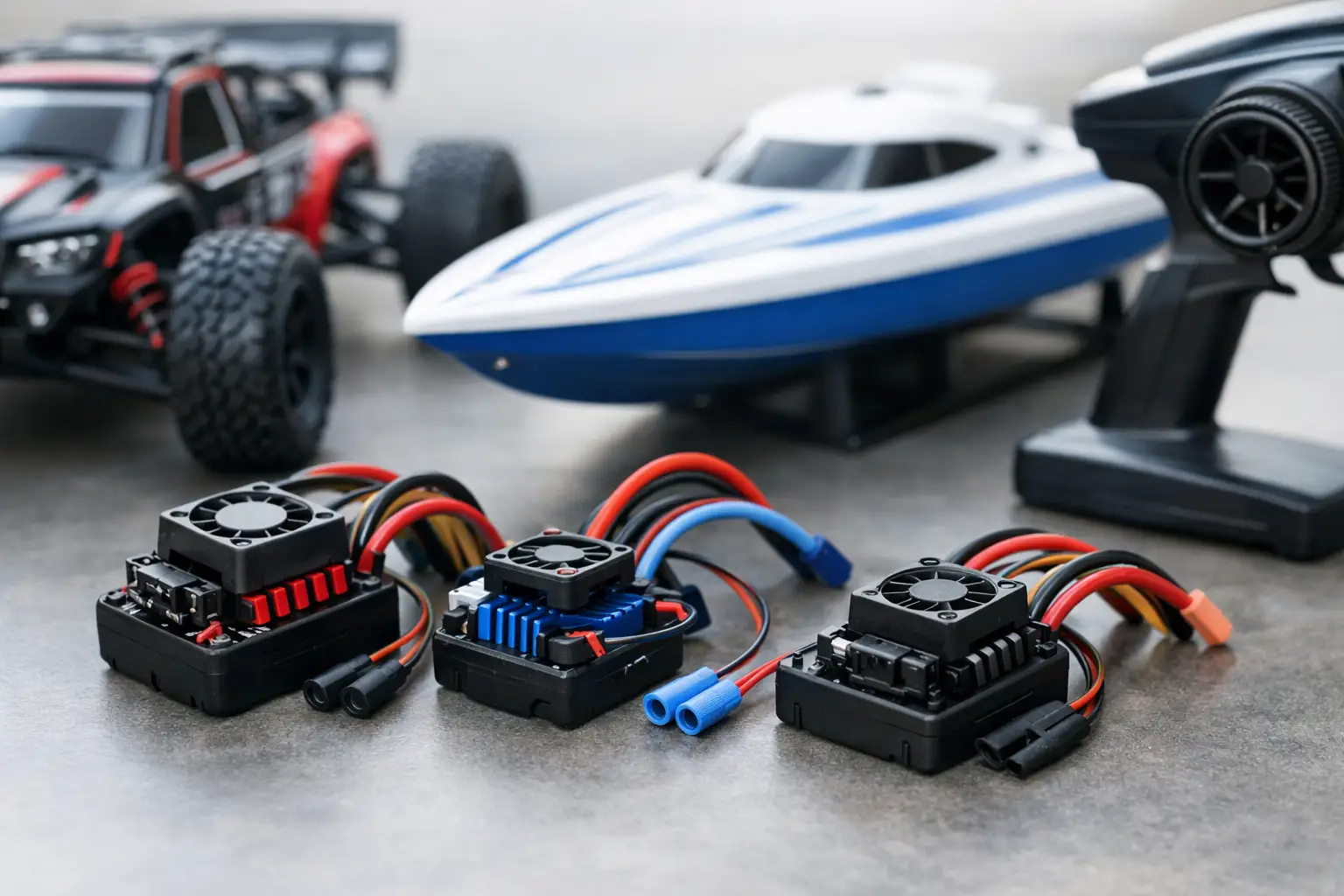
How to Choose an RC ESC: A Practical Buyer’s Guide
An electronic speed controller that is too small for a power system rarely fails politely. It may run for a few minutes, become excessively hot, cut power halfway through a run or permanently damage itself under load.
Knowing how to choose an RC ESC means looking beyond the largest amp figure printed on the box. The speed controller must be matched to the motor, battery voltage, gearing, steering servo, vehicle weight, driving style and conditions in which the model will be used.
An ESC regulates the power sent from the battery to the motor. In most RC cars, crawlers and boats, it also supplies power to the receiver and steering servo through a built-in BEC.
Choose the correct combination and the model should deliver predictable, reliable performance. Get one part wrong and even a good-quality ESC can become the weakest component in the system.
Start With the Motor Type
The first question is whether your RC model uses a brushed or brushless motor.
A brushed ESC is designed for a brushed motor and cannot operate a conventional brushless motor. A brushless ESC is designed for a brushless motor, but you must still check whether it supports sensored motors, sensorless motors or both.
Brushed RC Systems
Brushed systems are commonly found in:
-
Entry-level RC cars
-
Scale vehicles
-
Trail trucks
-
Rock crawlers
-
Models where maximum speed is not the priority
They are affordable, straightforward and can provide excellent low-speed control when properly set up.
Brushed motors contain brushes and a commutator that wear over time, so they eventually require maintenance or replacement. However, replacement brushed motors are generally inexpensive.
Brushless RC Systems
Brushless motors are generally more efficient and can offer:
-
Greater power
-
Higher speeds
-
Improved efficiency
-
Reduced motor maintenance
-
Better performance from a given battery size
That additional performance places more demand on the ESC, battery, drivetrain and tyres. The fact that a motor is brushless does not mean that any brushless ESC will be suitable for it.
Sensored and Sensorless Brushless ESCs
A sensored brushless system uses a sensor cable between the ESC and motor. This allows the controller to monitor the motor’s rotor position, helping provide smoother starts and more precise low-speed response.
Sensored systems are particularly useful for:
-
Rock crawling
-
Scale driving
-
Racing
-
Applications requiring precise throttle control
Sensorless systems are widely used in bashers, monster trucks and high-speed models. They are simple, powerful and effective at higher speeds, although some systems may cog or feel less smooth when pulling away slowly.
Some brushless ESCs can operate in both sensored and sensorless modes. Always confirm compatibility with the exact motor before purchasing.
Browse our available RC ESC and motor combinations.
Match the ESC to the Battery Voltage
Every ESC has a maximum input voltage, normally expressed as a LiPo cell count.
Common LiPo battery voltages include:
-
2S LiPo: 7.4V nominal
-
3S LiPo: 11.1V nominal
-
4S LiPo: 14.8V nominal
-
6S LiPo: 22.2V nominal
-
8S LiPo: 29.6V nominal
The ESC must be rated for the highest battery voltage you intend to use.
A controller rated for a maximum of 2S must not be connected to a 3S battery. Exceeding the ESC’s voltage limit can cause immediate and permanent damage.
If your model currently runs on 2S but you genuinely plan to upgrade to 3S or 4S, choosing an ESC with additional voltage capacity may prevent you from buying twice. However, the motor and complete drivetrain must also support the higher voltage.
A higher-voltage ESC does not automatically make the model safe to run on a higher-voltage battery.
The maximum safe voltage is determined by the lowest-rated component in the power system, including:
-
ESC
-
Motor
-
Battery
-
Drivetrain
-
Cooling system
-
Connectors
Battery voltage has a major effect on motor speed and heat. Installing a 3S battery in a system geared and cooled for 2S can turn a reliable model into an overheating one.
Check the motor’s recommended cell count as well as the ESC rating before increasing the battery voltage.
Check the Low-Voltage Cut-Off
A LiPo-compatible ESC should provide a suitable low-voltage cut-off.
This reduces or stops motor power before the LiPo battery becomes dangerously over-discharged. Continuing to run a LiPo below a safe voltage can cause permanent damage to the battery.
Make sure the ESC is programmed for the battery type being used.
If you change from LiPo to NiMH, or from NiMH to LiPo, confirm that the battery mode and low-voltage protection are set correctly. A NiMH battery behaves differently under load and may cause a LiPo cut-off to activate prematurely.
Never disable LiPo protection simply to extend the run time.
How to Choose the Correct RC ESC Amp Rating
ESC amp ratings are useful, but they do not tell the whole story.
A controller advertised as 120A is not necessarily twice as capable in real-world use as a 60A controller from another range. Manufacturers may use different test conditions and quote continuous, peak or burst current figures.
Use the ESC manufacturer’s recommended motor range as your main guide and leave sensible capacity above the expected load.
A standard model running conservative gearing on firm ground places less demand on its ESC than the same vehicle running:
-
A larger pinion
-
A high-kV motor
-
Oversized tyres
-
Heavy metal wheels
-
Deep grass
-
Thick mud
-
Repeated full-throttle speed runs
-
Additional vehicle weight
Current draw rises whenever the motor must work harder.
For a standard replacement, choose an ESC that supports at least the original motor, battery voltage and vehicle scale.
For an upgraded power system, select a controller with sensible headroom rather than running continuously at its claimed limit. Additional capacity can help reduce operating temperatures and improve reliability, although a larger controller may cost more and require additional mounting space.
Browse our range of electronic speed controllers.
Match the ESC to the Motor’s kV or Turn Rating
Motor compatibility is commonly stated using either a turn limit or kV rating.
Brushed motors are often described by the number of turns. A lower-turn brushed motor generally draws more current and produces more speed than a higher-turn motor of a similar design.
Brushless motors are commonly described using kV. This figure indicates the motor’s approximate unloaded revolutions per minute for each volt supplied.
A higher-kV motor is not automatically better. It can draw considerably more current, generate additional heat and place more strain on the ESC and drivetrain.
ESC compatibility can depend on:
-
Motor kV
-
Battery cell count
-
Motor size
-
Vehicle weight
-
Vehicle scale
-
Gearing
-
Sensored or sensorless operation
An ESC may support a particular motor on 2S but not on 3S or 4S. Always read the manufacturer’s motor-limit table for the battery voltage you intend to use.
Check the ESC’s BEC Rating
The BEC, or battery eliminator circuit, powers the receiver and steering servo from the main drive battery.
This is one of the most commonly overlooked parts of ESC selection.
A standard ready-to-run steering servo may work correctly with a modest BEC. A powerful metal-geared servo in a heavy 1/8-scale basher or crawler with large tyres may require considerably more current.
If the BEC cannot supply enough power, you may experience:
-
Weak or slow steering
-
Servo twitching
-
Receiver brownouts
-
Temporary loss of control
-
The receiver restarting under load
-
Unreliable radio operation
Check both the BEC voltage and its current rating.
Some speed controllers provide a fixed 6V output. Others offer selectable settings such as 6V, 7.4V or 8.4V for compatible high-voltage radio equipment.
Never increase the BEC voltage without checking the limits of:
-
The steering servo
-
The receiver
-
Auxiliary servos
-
Lights
-
Fans
-
Other receiver-powered accessories
A high-voltage servo can improve steering performance, but only if every connected component can safely accept the selected voltage.
A demanding servo may sometimes require a suitable external BEC. This must be installed correctly to avoid conflicting power supplies or damaging the radio equipment.
Choose an ESC for the Type of RC Model
An ESC for a crawler is selected differently from one intended for a speed-run car, racing buggy, aircraft or boat.
Crawler ESCs
A crawler benefits from:
-
Smooth low-speed response
-
Adjustable drag brake
-
Strong starting control
-
Quiet operation
-
Sensored compatibility where required
-
A capable BEC for a high-torque servo
Maximum speed is normally less important than smooth control and the ability to hold the vehicle on a slope.
Basher ESCs
An ESC for a basher should offer:
-
Strong current capacity
-
Effective cooling
-
Thermal protection
-
Suitable waterproofing
-
Adjustable punch and braking
-
A robust case and fan arrangement
Bashers experience sudden loads from hard acceleration, jumping, rough ground and impacts.
Racing ESCs
Race-focused controllers may offer detailed adjustment of:
-
Motor timing
-
Turbo and boost
-
Throttle response
-
Brake strength
-
Drag brake
-
Frequency settings
-
Data logging
These features can be useful for experienced racers but add cost and setup complexity.
Some racing clubs and competitions also restrict ESC modes or motor combinations. Check the relevant rules before buying.
Marine ESCs
Use an ESC intended for marine use when possible.
Marine controllers may use water cooling and can have different reverse or braking behaviour from car ESCs. A boat propeller maintains a heavy load on the motor, so the power system must be matched carefully.
Water cooling will only work when water is flowing correctly through the pipes and cooling jacket.
Aircraft ESCs
Aircraft ESCs are designed for a different application and may include motor-brake functions, soft-start settings and BEC ratings suited to aircraft servos.
They should not be treated as direct replacements for car speed controllers without confirming every part of the specification.
Waterproofing and Wet-Weather Use
A waterproof car ESC is useful for wet grass, puddles and muddy conditions, but it does not make the entire model waterproof or maintenance-free.
The following components may have different levels of water protection:
-
Cooling fan
-
Receiver
-
Servo
-
Connectors
-
Sensor port
-
Programming port
-
Battery
-
Motor
After wet use, disconnect the battery, clean the model and dry it thoroughly. Check plugs and exposed metal parts for moisture or corrosion.
Do not assume that a waterproof ESC is suitable for complete or prolonged submersion.
Check the Connectors Before Ordering
Check the battery and motor connectors before purchasing an ESC.
Some controllers arrive with connectors already installed, while others are supplied without plugs and require soldering.
Confirm:
-
Battery connector type
-
Motor connector size
-
Wire length
-
Wire gauge
-
Whether a sensor cable is included
-
Whether soldering is required
Avoid using unsuitable adaptors as a permanent solution, particularly in high-current systems. Additional connections create more electrical resistance and more potential points of failure.
Resistance produces heat, and excessive heat can damage plugs, wiring and surrounding components.
Larger brushless motors may use 4mm, 5mm or larger bullet connectors. The connector type and current capacity must suit the motor and ESC.
Follow the ESC instructions when connecting motor wires and changing motor direction. Do not randomly swap sensor wires on a sensored system.
Check the ESC Will Physically Fit
A suitable electrical specification is no use if the ESC does not fit securely inside the vehicle.
Before ordering, measure:
-
ESC tray length and width
-
Available height
-
Space beneath the body shell
-
Fan clearance
-
Distance to the motor
-
Distance to the battery
-
Access to the power switch
-
Space for receiver and sensor wires
The controller must be mounted securely and should receive suitable airflow.
Make sure wiring cannot touch rotating driveshafts, gears, wheels or hot motor components. Secure loose wires without pulling them tightly enough to strain the connectors.
Cooling and Gearing
Cooling fans and heat sinks can help manage normal operating temperatures, but they cannot correct a badly matched or overloaded power system.
If the ESC or motor runs excessively hot:
-
Reduce the pinion size.
-
Check the spur and pinion gear mesh.
-
Inspect the drivetrain for binding.
-
Check wheel bearings.
-
Remove grass and debris.
-
Check that the cooling fan works.
-
Reconsider the motor kV and battery voltage.
-
Check whether the tyres are too large or heavy.
Allow the motor, ESC and battery to cool between runs where necessary.
Do not continue driving through repeated thermal cut-outs. Thermal protection is a last line of defence, not a normal operating mode.
ESC Programming Features Worth Having
A straightforward ESC with basic throttle calibration may be all a beginner needs.
Adjustable settings become more useful when tuning the model for a particular surface or driving style.
Common programming options include:
-
Starting punch
-
Maximum brake force
-
Drag brake
-
Neutral range
-
Reverse strength
-
Running mode
-
Low-voltage cut-off
-
Thermal protection
-
Motor timing
-
BEC voltage
A programming card makes workbench adjustments quicker. Bluetooth or app-based programming can be convenient for owners who change settings regularly.
There is little benefit in paying for dozens of advanced settings if the vehicle will remain on standard gearing and be used for casual weekend bashing. Choose features that are genuinely relevant to your model.
Final Checks Before Buying an RC ESC
Before placing your order, confirm the following:
-
Brushed or brushless motor
-
Sensored or sensorless operation
-
Motor kV or turn rating
-
Maximum battery cell count
-
ESC continuous-current rating
-
BEC voltage and current
-
Vehicle scale and weight
-
Battery connector
-
Motor connectors
-
Physical dimensions
-
Waterproof rating
-
Programming requirements
-
Intended gearing and tyre size
If any part of the setup is uncertain, take clear photographs of the existing ESC label, motor label, battery and connectors.
Also identify the exact make, model and version of the vehicle. Similar-looking versions may use different motors, connectors or battery voltages.
A few minutes spent checking compatibility can prevent overheating, mismatched plugs and unnecessary returns.
The correct ESC is not necessarily the one with the highest amp rating. It is the controller properly matched to the complete model and the way it will be driven.
Frequently Asked Questions
What Size ESC Do I Need for My RC Car?
The ESC must support the motor type, motor rating, battery voltage and expected current load of the vehicle.
Use the manufacturer’s compatibility recommendations and allow sensible capacity above the expected demand. Do not choose an ESC by vehicle scale or amp rating alone.
Can I Fit a Higher-Amp ESC?
Yes, provided it is compatible with the motor, battery voltage, connectors and available mounting space.
A higher continuous-current rating can provide useful headroom, but it will not make an incompatible motor or battery safe to use.
Can I Use a Brushless ESC With a Brushed Motor?
Some specialist ESCs support both brushed and brushless motors, but most do not.
Only use the combination if the manufacturer specifically confirms that the controller has a suitable brushed operating mode.
Can I Use a 3S Battery With a 2S ESC?
No. Connecting a 3S LiPo to an ESC rated for a maximum of 2S can immediately damage the controller.
The ESC, motor and complete power system must all support the battery voltage.
What Does the BEC Do in an RC ESC?
The BEC supplies regulated power to the receiver, steering servo and other compatible radio equipment from the main drive battery.
Its voltage and current capacity must be suitable for every component connected to the receiver.
Why Does My ESC Keep Getting Hot?
Common causes include:
-
Aggressive gearing
-
An unsuitable motor
-
Excessive battery voltage
-
Oversized or heavy tyres
-
Binding in the drivetrain
-
Long grass or mud
-
Restricted airflow
-
A failed cooling fan
-
Repeated full-throttle running
Stop using the model and investigate the cause rather than relying on thermal protection.
Why Does My RC Car Cut Out Under Acceleration?
Possible causes include an overloaded ESC, weak battery, poor connector, receiver brownout, incorrect low-voltage cut-off or excessive current demand from the servo.
Check the complete electrical system rather than automatically replacing the ESC.
Do I Need a Sensored ESC for a Crawler?
A sensored system is not essential, but it can provide smoother starts and more precise low-speed control.
A well-matched brushed system or quality sensorless crawler ESC may also provide good performance, depending on the model and how it is used.
Can I Use a Car ESC in an RC Boat?
A marine ESC is normally the better choice because it is designed for the load, cooling requirements and operating conditions of a boat.
Do not assume that a waterproof car ESC is suitable for marine use.
Is a Waterproof ESC Completely Safe in Water?
No. Waterproofing does not necessarily cover the cooling fan, plugs, sensor port or other electronics in the model.
Avoid prolonged submersion and always clean and dry the vehicle after wet use.
Written by RC Model Shop
This article was written by the team at RC Model Shop, one of the UK’s leading specialists in hobby-grade radio-controlled vehicles.
With years of hands-on experience selling, repairing and upgrading RC cars, crawlers, boats and aircraft, we help customers choose compatible electronic speed controllers, motors, batteries and radio equipment. Our advice is based on practical RC experience rather than amp ratings and headline specifications alone.
Whether you are replacing a failed speed controller, building a new power system or upgrading an existing model, our goal is to help you choose components that work safely and reliably together.
For expert advice, contact the team at RC Model Shop or browse our RC ESC and motor combinations and electronic speed controllers.