
Choosing RC Servos for Cars, Crawlers and More
26/09/2026
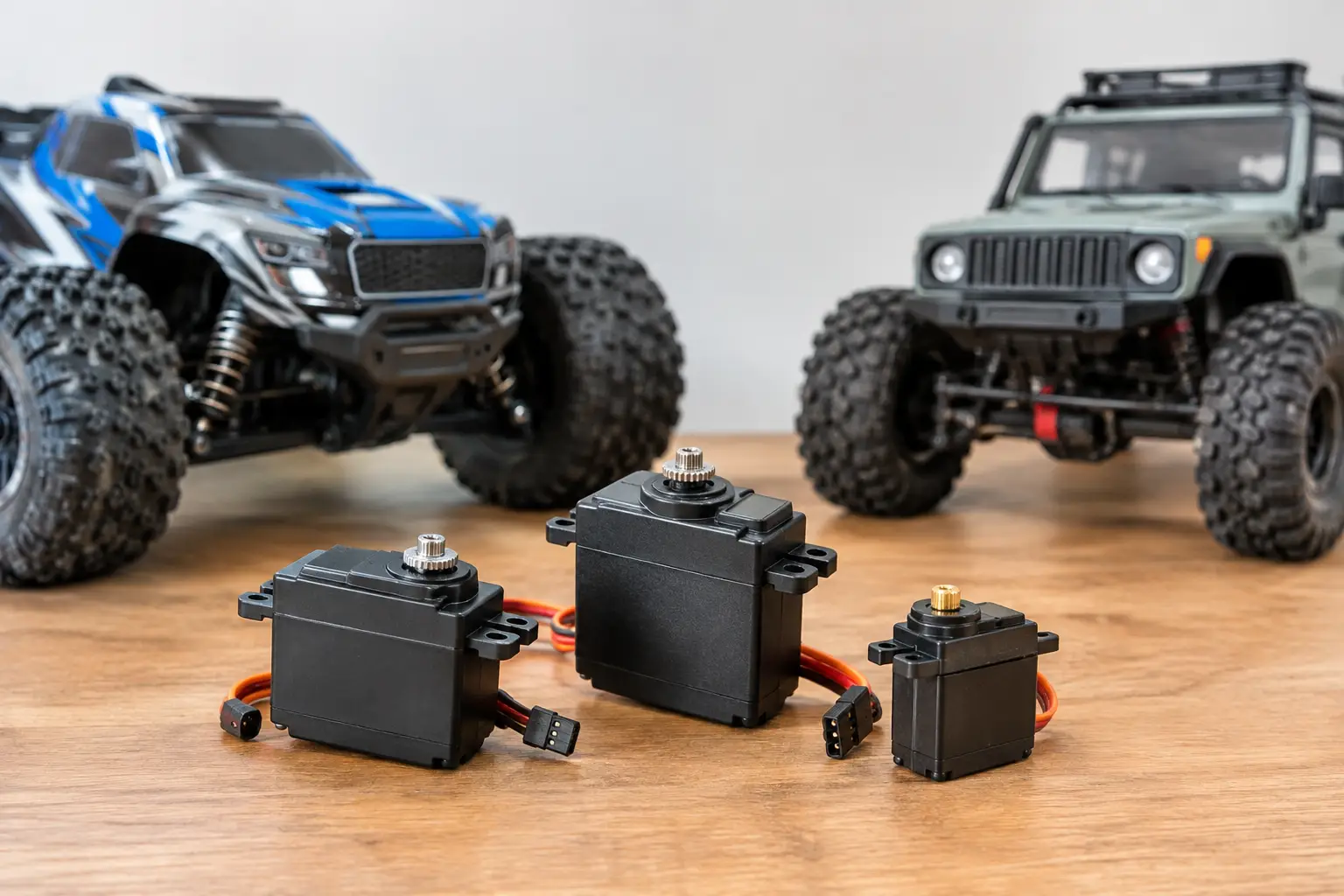
A servo can be the difference between a crawler that places its wheels precisely on a rocky line and one that keeps nudging past it. It can also decide whether a fast basher holds a clean turn or wanders wide when the surface gets rough.
RC servos may be small, but they do some of the hardest work in any model. They turn the wheels in RC cars, operate throttle and brake systems, move aircraft control surfaces and control rudders and other functions in RC boats.
Choosing the right RC servo is not simply a case of buying the one with the biggest torque figure. The correct specification depends on the weight and type of model, tyre size, steering geometry, operating voltage and the power available from the ESC's BEC. Physical size and spline type matter too, particularly when replacing a standard factory servo.
For UK drivers dealing with everything from wet crawler courses to high-grip tarmac and rough bashing ground, matching the servo to the model will usually give better results than chasing the highest specification on the box.
You can browse our full range of RC servos for steering, throttle and other RC applications.
What does an RC servo actually do?
A standard RC servo receives a signal from the receiver and moves its output shaft, known as the spline, to a requested position.
In a surface model, that movement is normally transferred through a servo horn and steering linkages to turn the wheels. In some models, servos can also operate throttle and brake systems.
Aircraft use servos to move control surfaces, while RC boats commonly use them for rudder control and other functions.
Most hobby servos are position servos, meaning they move to and hold a commanded angle rather than continuously rotating like an electric motor.
When comparing servos, the two performance figures that attract the most attention are torque and transit speed. However, operating voltage, gear material, dimensions, spline type and whether the servo is analogue or digital can be just as important.
For a direct replacement, check the original servo's dimensions, mounting tabs, lead length and spline before ordering. A powerful servo is no upgrade if it cannot be mounted correctly or used with the existing steering hardware.
Start with the torque requirement
Servo torque is generally shown in kg-cm. In simple terms, it describes how much turning force the servo can apply at its output shaft.
A lightweight 1/10 buggy on relatively low-grip dirt does not place the same load on its steering servo as a heavy 1/8 monster truck with large tyres.
Crawlers can be particularly demanding because the servo may need to turn soft, grippy tyres while they are pressed against rocks, roots and other obstacles.
As a broad starting point, many 1/10 on-road cars, buggies and stadium trucks can work well with around 10 to 20kg-cm.
A typical 1/10 crawler often benefits from around 20 to 35kg-cm or more, particularly if it has heavier wheels, brass upgrades or is regularly driven on technical terrain.
Large 1/8 and large-scale models may require 35kg-cm upwards.
These figures should be treated as starting points rather than fixed rules. A free-moving, correctly adjusted steering system requires less effort than one with binding linkages, damaged bearings or steering components that have been overtightened.
More servo torque is not automatically better
A very powerful servo can expose weak components elsewhere in the steering system.
Plastic servo horns, worn steering components and weak servo savers may flex or slip before the servo can use its full output.
If the model uses a servo saver, check that it is correctly adjusted and in good condition before assuming that a stronger servo will solve poor steering.
You can browse our available servo savers when repairing or upgrading the steering system.
The complete steering system needs to work together. Fitting a very high-torque servo while leaving a weak horn, badly adjusted saver or binding linkage in place can simply move the problem elsewhere.
Steering geometry changes how the servo performs
The position of the steering linkage on the servo horn changes the mechanical advantage available to the servo.
Moving the linkage closer to the spline increases leverage but reduces available movement. Moving it further away increases steering movement but reduces leverage.
This means horn setup can make a noticeable difference even when the servo itself has not changed.
Before replacing a crawler servo because it appears to lack strength, check that the steering linkage moves freely and that the horn position is sensible.
The same applies to bashers and race cars, where poor geometry can make an otherwise suitable servo feel slow or weak.
Set steering endpoints correctly
Transmitter endpoint adjustment is particularly important after changing a servo or servo horn.
The servo should reach the model's useful maximum steering angle without continuing to push after the steering mechanism has reached its physical limit.
If the servo buzzes heavily at full lock, it may be trying to move the steering beyond its available travel.
That creates unnecessary heat and current draw and can shorten the life of the servo. It can also place additional stress on the horn, servo saver and steering components.
With the model safely supported, slowly turn the steering from lock to lock and check that nothing binds before completing the setup.
Servo speed matters as well as torque
Servo speed is normally stated as the time required to move through 60 degrees.
A servo rated at 0.10 seconds is therefore faster than one rated at 0.20 seconds, provided the figures are measured at the same voltage.
Fast steering is particularly noticeable on:
-
On-road RC cars
-
Race buggies
-
Short course trucks
-
High-speed bashers
Quicker response can help the model change direction sharply, catch a slide and feel more directly connected to transmitter inputs.
For these vehicles, a balance between speed and torque is normally more useful than choosing one extreme.
Do RC crawlers need fast servos?
Crawlers have slightly different priorities.
Accurate and predictable steering is usually more important than outright speed when trying to position a tyre precisely on a rock, root or other obstacle.
A very fast servo can actually make small steering corrections harder for some drivers.
For crawler use, priorities will often include:
-
Strong torque
-
Good holding power
-
Reliable centring
-
Durable gears
-
Suitable water resistance
-
Correct operating voltage
Servo speed still matters, but it should be considered alongside the rest of the steering setup.
Check servo operating voltage before upgrading
Servo specifications often show different torque and speed figures at different voltages.
A servo may produce one level of performance at 6.0V and become both stronger and faster at 7.4V or 8.4V.
That does not mean every RC model can safely supply the higher voltage.
In many electric models, the BEC built into the electronic speed controller supplies power to the receiver and servo. Its output voltage and current capacity therefore need to be considered when fitting a more powerful servo.
What does the BEC do?
BEC stands for Battery Eliminator Circuit.
The BEC supplies a regulated voltage to the receiver and connected electronics in many electric RC models.
If a powerful servo demands more current than the BEC can reliably provide during a heavy steering load, the receiver voltage can drop.
Possible symptoms include:
-
Steering glitches
-
Receiver resets
-
Temporary loss of control
-
Servo cutting out
-
ESC behaviour that appears to be a fault
Heavy crawlers can be particularly demanding because the steering may remain under load for relatively long periods.
Lights, winches and other receiver-powered accessories can increase the demand further.
An external BEC can be useful on some high-load setups, but its output still needs to be compatible with the servo, receiver and any other connected electronics.
Never assume that because a servo can operate at 7.4V or 8.4V, everything connected to the receiver can safely operate at that voltage.
Digital vs analogue RC servos
Analogue servos remain useful for basic models and lower-load applications.
They are generally simple, economical and can be perfectly adequate where extremely fast response or strong holding power is not required.
Digital servos use a higher-frequency control system and normally provide stronger holding power, faster response and more precise centring.
For steering on performance cars, crawlers and larger models, a good digital servo is usually the more appropriate choice.
The trade-off is electrical demand.
A powerful digital servo can draw considerably more current, particularly when trying to hold steering position under load.
If an older analogue steering servo is being replaced by a much more powerful digital unit, check the BEC at the same time rather than treating the servo as an isolated upgrade.
Choose the right servo gear material
The gears inside a servo have a major effect on durability.
Plastic gears are lightweight and inexpensive, making them suitable for smaller models and less demanding applications.
Under repeated impacts or heavy steering loads, however, they are generally more vulnerable than a quality metal gear set.
Metal-geared servos are therefore a popular choice for off-road steering. They cope better with the shock loads created when a wheel hits a rock, kerb or rut while the steering is turned.
Titanium gears are found in some higher-end servos and can provide excellent strength and wear resistance without excessive weight, although they generally cost more.
For many bashers and crawlers, a good metal-geared digital servo provides a sensible balance between performance, durability and cost.
Aluminium servo cases
Some higher-performance servos use an aluminium centre section or a complete aluminium case.
An aluminium centre case can help support the gear train and dissipate heat, while a full aluminium case provides additional rigidity and protection.
This can be worthwhile on a hard-driven or high-load model, but it is not essential for every vehicle.
A quality composite-case servo may provide everything required for a lighter 1/10 model while keeping weight and cost lower.
Water resistance is useful in UK conditions
A water-resistant or waterproof servo makes sense on a model regularly used on wet grass, muddy trails and damp crawler courses.
It should not, however, be treated as proof that the entire RC model is waterproof.
The receiver, ESC, electrical connections and other electronics still need suitable protection.
After wet or muddy running, clean the vehicle and allow it to dry properly rather than leaving moisture and dirt around the electronics.
Pay particular attention to the servo horn and spline area. Grit trapped around moving steering components can increase resistance and wear, making the servo work harder than necessary.
Check the servo spline before ordering
Servo splines are not universal.
25T is one of the most common aftermarket specifications, but other spline counts are widely used.
A horn intended for one spline type should not be forced onto another.
Even if it appears close, an incorrect fit can damage the spline or allow the horn to slip under steering load.
Always check the servo manufacturer's spline specification before ordering a replacement horn or servo saver.
Standard, mini, micro and low-profile servos
Physical dimensions matter just as much as performance.
Standard-size servos are common in 1/10 and 1/8 vehicles, while mini, micro and low-profile servos are used where chassis space or weight is limited.
Low-profile servos are particularly popular in touring cars because of their compact height.
That does not automatically make them suitable for a heavy monster truck or crawler.
Before ordering, check:
-
Servo length
-
Servo width
-
Servo height
-
Mounting-hole positions
-
Servo horn clearance
-
Cable routing
Do not rely purely on the scale of the vehicle when choosing a servo.
A sensible way to choose an RC servo
Start with the job the servo needs to do.
For steering, consider:
-
Vehicle size and weight.
-
Tyre size and grip.
-
Driving terrain.
-
Required steering torque.
-
Required steering speed.
-
Servo dimensions.
-
Spline type.
-
Operating voltage.
-
BEC output.
-
Servo horn and servo saver compatibility.
For throttle, brake, aircraft control surfaces or boat rudders, concentrate on the actual load, required movement and available installation space rather than simply choosing the highest torque figure.
Once installed, check the steering mechanically and set the transmitter endpoints carefully.
The servo should reach full useful steering lock without forcing the steering against suspension arms, hubs or other mechanical stops.
Frequently Asked Questions
How much torque does a 1/10 RC car servo need?
There is no single torque figure suitable for every 1/10 RC car.
As a broad starting point, around 10 to 20kg-cm can suit many 1/10 on-road cars, buggies and stadium trucks.
Heavier models, larger tyres and high-grip surfaces may require considerably more.
How much servo torque does an RC crawler need?
Many 1/10 RC crawlers benefit from approximately 20 to 35kg-cm or more.
Vehicle weight, tyre size, brass upgrades, wheel offset and terrain can all increase the steering load.
The servo's torque should be considered alongside its operating voltage, BEC requirements and the strength of the steering components.
Is a digital RC servo better than an analogue servo?
Digital servos generally provide stronger holding power, quicker response and more precise centring, making them popular for performance steering applications.
Analogue servos can still be perfectly suitable for basic models and lower-load applications.
Remember that a powerful digital servo may also place greater demand on the ESC's BEC.
What does kg-cm mean on an RC servo?
Kg-cm is a measurement used to describe servo torque.
It indicates the turning force available at the servo output shaft.
A higher kg-cm figure generally means the servo can produce more steering force, although figures should be compared at the same operating voltage.
Is a 25T servo horn universal?
No.
Although 25T is one of the most common aftermarket servo spline specifications, not every RC servo uses a 25T spline.
Always check the manufacturer's spline specification before buying a servo horn or servo saver.
Can I fit a high-voltage servo to any RC car?
No.
The servo itself may support 7.4V or 8.4V operation, but the ESC BEC, receiver and other connected electronics must also be compatible with the selected voltage.
Check the complete receiver power system before increasing BEC voltage.
Why does my RC servo buzz at full steering lock?
A servo can buzz when it is trying to hold position against resistance.
If it happens mainly at full steering lock, check the transmitter endpoints and steering linkage.
The servo should not continue trying to move after the steering reaches its mechanical limit.
Can a more powerful servo damage my steering?
A substantial increase in servo torque can expose weak components in the steering system.
Plastic servo horns, worn servo savers, steering links and other components may flex, slip or fail under the additional load.
Check the complete steering system when making a major servo upgrade.
Is a metal gear servo better for an RC car?
Metal gears generally provide greater durability under heavy steering loads and impacts, which makes them particularly useful for bashers, crawlers and other off-road RC vehicles.
Plastic gears can still be suitable for lightweight or less demanding applications.
What RC servo should I buy?
Choose the servo according to the model rather than simply selecting the highest torque figure.
Check the vehicle weight, tyre size, required torque and speed, physical dimensions, spline type, operating voltage and BEC capacity.
If replacing an original servo, checking the specifications and dimensions of the factory unit is a good starting point.
Shop RC servos in the UK
The best RC servo is not necessarily the strongest or fastest model available.
A crawler may benefit from substantial torque and strong holding power without requiring exceptionally fast steering. A race buggy or fast basher may benefit from quicker response while still needing sufficient torque for the steering load.
The servo also needs to work as part of the complete model. Steering geometry, servo saver adjustment, BEC capacity, operating voltage and endpoint settings can all affect how well even a high-quality servo performs.
RC Model Shop UK stocks a range of RC servos for different RC applications, along with servo savers and other steering components.
If you are unsure which servo is suitable for your model, contact us with the exact RC model and, where possible, the existing servo specification so we can help check the size, spline and electrical requirements before ordering.
Written by RC Model Shop UK