Best RC Boats UK for Every Type of Water
13/08/2026
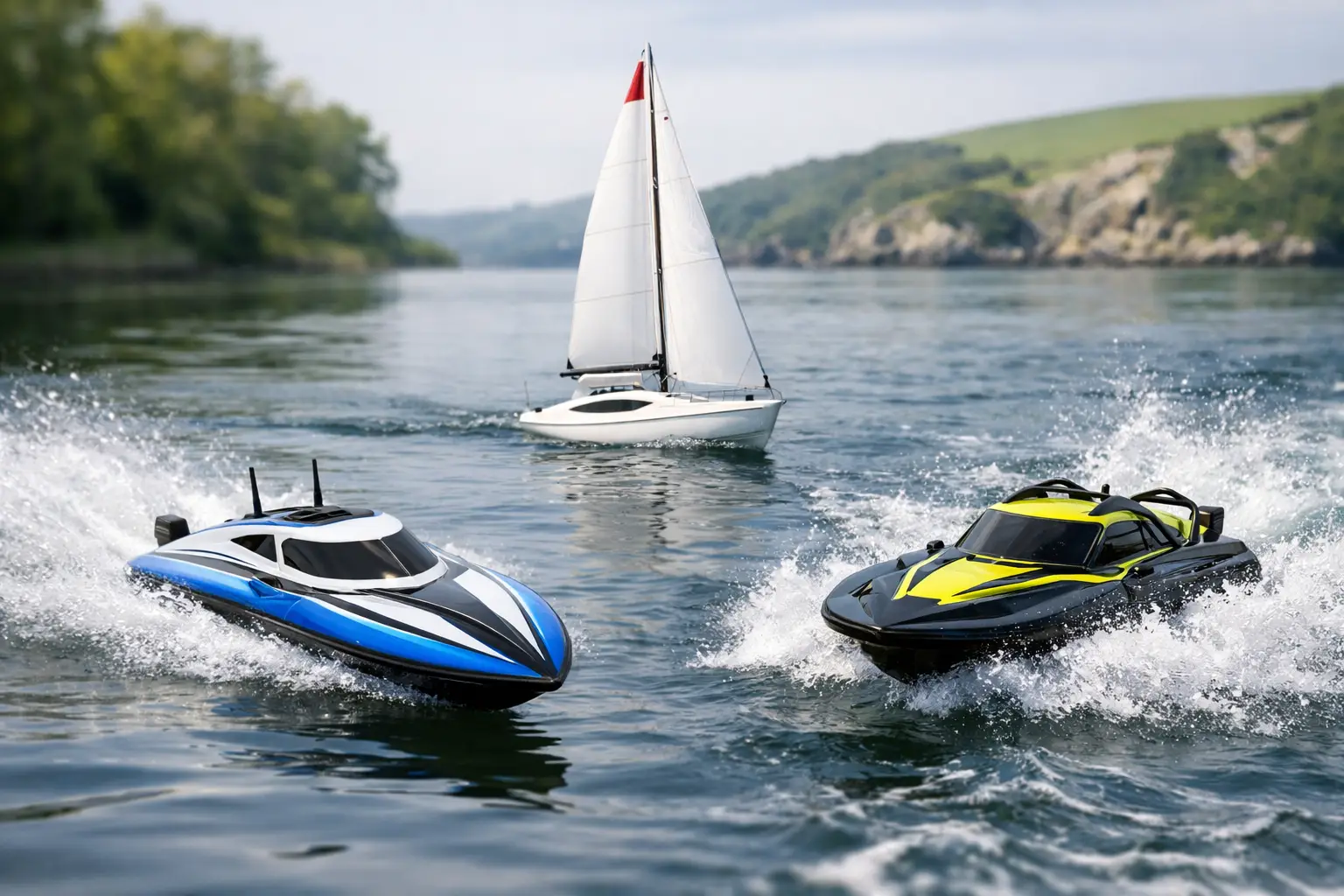
A fast electric hull skipping across a calm lake looks brilliant, but choosing the right boat starts well before the first launch. The best RC boats UK retailers stock are not necessarily the fastest or most expensive ones. They are the models that suit the water you can use, the experience you have and the level of maintenance you are happy to take on.
For a first boat, stability, simple controls and readily available spares usually matter more than headline speed. For an experienced hobbyist, a brushless deep-V or catamaran can provide serious performance, but it also needs the right batteries, a suitable launch area and a little more preparation.
Getting those basics right makes the hobby far more enjoyable.
If you're comparing different types and sizes, you can browse our full range of RC boats while using this guide to work out which type best suits you.
Best RC Boats UK Buyers Should Choose by Use
There is no single best RC boat for every owner.
A small, self-righting electric boat can be ideal for family use on suitable sheltered water, while a larger brushless model needs considerably more open space and room to run.
Start with where you expect to use the boat most often, then choose the model around that reality rather than buying purely on its advertised top speed.
Beginner-friendly ready-to-run boats
Ready-to-run, usually shortened to RTR, boats are the sensible starting point for most newcomers.
They normally include the boat, transmitter and installed electronics, so there is less equipment to source before your first outing. You may still need batteries and a suitable charger, so always check exactly what is included rather than assuming the box contains everything required.
Look for a manageable size and a hull designed for predictable handling. If the boat uses a water-cooled motor or ESC, check the manufacturer's instructions so you understand how the cooling system should operate.
A self-righting feature is particularly useful for beginners. If a boat flips in deeper water, being able to roll it back upright using the controls can save a difficult recovery and a disappointing end to the session.
Smaller RTR boats also make good gifts, although very small hulls can be more affected by wind and choppy water.
A compact model is convenient to carry, but a medium-sized boat can be easier to see and control at distance.
Fast brushless RC boats for open water
Brushless power is the right choice when speed and performance are the main attractions.
These boats accelerate hard, can cover a surprising amount of water very quickly and reward careful throttle control.
Deep-V hulls are popular because they tend to track confidently through light chop, while catamarans are particularly well suited to high-speed running on flatter water.
The trade-off is that higher performance creates higher demands.
Brushless RC boats commonly require LiPo batteries, a compatible balance charger and more attention before and after each session.
The motor and electronic speed controller need the cooling system working correctly, the propeller must be free from damage, and the drivetrain needs regular inspection.
A powerful boat is not automatically a beginner-friendly model simply because it is supplied RTR.
If you have never driven an RC boat before, start in a large, clear and permitted area. Use gentle throttle inputs and learn how the hull responds to steering before attempting full-speed passes.
Scale and working boats for patient hobbyists
Scale boats, tugs, yachts and working vessels offer a completely different kind of enjoyment.
Speed is not the point. Realistic detail, controlled manoeuvring and the opportunity to add lighting, sound systems or other scale features are what make these models satisfying.
They can be particularly well suited to calm club waters, but build quality and equipment requirements vary greatly.
A kit may need a motor, radio equipment, speed controller, battery and other running hardware chosen separately.
This is rewarding for a modeller who wants to build and customise a boat, but it is not necessarily the quickest route to getting on the water.
Sailboats when runtime isn't about a motor
An RC yacht does not rely on a propulsion motor to move, which completely changes the pace of the hobby.
RC sailing is quiet, technical and surprisingly absorbing, especially once you start learning how sail position, wind direction and steering affect the boat.
Sailing needs an appropriate stretch of permitted water and enough breeze to keep the boat moving.
It also asks more of the driver than simply applying throttle. For people who enjoy setup, strategy and smooth control, that is exactly the attraction.
Hull Shape Matters More Than Many First Buyers Expect
An RC boat's hull has a major influence on how it behaves on the water.
Understanding the basic differences can prevent you from buying a boat that looks impressive but does not suit the conditions where you intend to use it.
Deep-V RC boats
Deep-V models cut through mild chop and generally provide a planted feel, making them a strong all-round option for electric performance boating.
They lean naturally through turns and can remain composed when the water is not perfectly flat.
For many hobbyists looking for their first faster electric boat, a deep-V is a sensible hull style to consider.
Catamaran RC boats
Catamarans use two hull sections or sponsons and are designed to reduce drag and deliver high-speed performance.
They can be extremely impressive on smoother water, but sharp turns and rough conditions need to be treated with respect.
Driving technique becomes increasingly important as speed rises, particularly when changing direction.
Hydroplanes and other performance hulls
Hydroplanes are designed to ride high across the surface and can be extremely quick.
Their dramatic handling makes them better suited to experienced users with plenty of suitable open water.
Mono hulls and smaller jet boats can be easier to manage in tighter areas, although they are still affected by wind, waves and wake.
The important rule is to choose the hull for your regular launch spot, not for the rare perfect day.
A stable deep-V that performs well most weekends will probably deliver more enjoyment than an ultra-fast specialist hull that only feels comfortable when conditions are ideal.
Batteries, Chargers and Safe Run Times
Battery choice has a direct effect on speed, runtime, weight and reliability.
Many entry-level boats use NiMH or smaller lithium battery systems because they are appropriate for the power system supplied with the model.
Higher-performance brushless boats commonly use LiPo packs, which offer excellent power delivery and relatively low weight but need to be charged, stored and handled correctly.
Always match the battery voltage, connector type, physical dimensions and other requirements to the boat manufacturer's specification.
More voltage does not automatically mean a better setup.
Using a battery outside the manufacturer's recommended specification can overload electronics, damage the motor or ESC and make the boat difficult to control.
Use the correct charger
Always use a charger designed for the battery chemistry and specification you are charging.
For LiPo batteries, use a suitable balance charger and follow the battery and charger manufacturers' safety instructions.
Never leave charging batteries unattended, and do not charge a battery that is swollen, physically damaged or has been exposed to water.
After a run, allow the battery and electronics to cool before recharging.
How long do RC boat batteries last per run?
Runtime varies considerably between boats and driving styles.
A quoted runtime may be achievable under mixed-throttle conditions, but repeated full-throttle passes, cold weather, choppy water and increased propeller load can reduce it.
For many owners, buying a second compatible battery is more useful than trying to fit the largest-capacity battery possible.
A physically larger and heavier pack can alter the balance of the hull, and it may not be suitable for the boat even if the connector and voltage appear correct.
What to Check Before Ordering an RC Boat
Product specifications tell you a lot, but the smaller details often determine whether ownership is straightforward.
Check the listed dimensions and compare them with your car, storage space and likely launch site.
Larger boats can be easier to see and may handle rougher conditions better, but you also need a practical way to transport them without damaging the hull, rudder or propeller.
Check spare parts availability
Replacement parts are an important consideration with any hobby-grade RC boat.
Propellers, drive components, cooling tubing and other parts can eventually need replacement. Contact with weeds, debris or stones near the water's edge can also cause damage.
A model with good spare-parts support is much easier to keep running over the long term.
At RC Model Shop, we can help buyers decide between an entry-level RTR boat, a faster brushless model or the batteries and chargers required to run a particular boat correctly.
If you are unsure which direction to take, browse our RC boats and contact us before ordering if you need help checking compatibility or suitability.
Launching and Running Your RC Boat Responsibly
A good launch routine prevents many avoidable problems.
Before every run, inspect the propeller and drivetrain, secure the hatch, confirm the transmitter batteries are charged and make sure any cooling intake is clear.
Follow the manufacturer's specified switch-on and switch-off procedure for your particular radio system and model.
Never assume that because a lake or stretch of water is publicly accessible, powered RC boats are automatically permitted there.
Lakes, reservoirs, canals and other waterways can have local rules, fishing activity, wildlife protections or restrictions on powered model craft.
Check before launching.
Give anglers, swimmers, paddleboarders, other water users and wildlife plenty of space. Avoid running close to nesting birds or in crowded areas.
RC Boat Maintenance After Every Run
A few minutes of maintenance after each outing can prevent considerably more work later.
Remove and safely store the battery, dry the hull inside and out, and inspect the cooling system and drivetrain.
Check for water inside the hull even if the hatch appeared completely sealed. A small amount of water can enter around cooling lines, shafts and hatch seals.
If the boat has been used in salt or brackish water and the manufacturer permits this type of use, follow its cleaning instructions carefully. Salt is particularly aggressive towards bearings, fasteners, connectors and other metal components.
Inspect the propeller and driveshaft regularly and lubricate components at the intervals specified by the manufacturer.
Best RC Boats UK FAQs
What is the best RC boat for a beginner?
For most beginners, an RTR electric boat with predictable handling and good spare-parts availability is a sensible starting point.
A self-righting feature can also be extremely useful, particularly when running on water where recovering an overturned boat would be difficult.
Are brushless RC boats better?
Brushless motors offer excellent performance, efficiency and speed, but that does not automatically make a brushless boat the best choice for everyone.
A beginner using a small stretch of water may have more fun with a slower and easier-to-control model.
How fast can an RC boat go?
Speed varies enormously.
Small beginner boats may be designed for relatively modest speeds, while high-performance brushless models can be extremely fast.
Treat manufacturer speed figures as only one part of the buying decision. Hull size, handling, water conditions and your available running area are equally important.
Do RC boats come with batteries and chargers?
Some do and some don't.
RTR describes how complete the model itself is, but it does not guarantee that every battery, charger or accessory required to operate it is included.
Always check the individual product specification before ordering.
Can I use an RC boat on any lake in the UK?
No.
You need permission to use the water, and individual lakes, reservoirs, parks, canals and clubs can have their own restrictions.
Always check the rules for your intended location before launching an RC boat.
Can RC boats be used in salt water?
Only if the manufacturer specifies that the model is suitable for those conditions.
Salt water is highly corrosive, so any boat used in or around it requires careful cleaning and maintenance afterwards.
What happens if my RC boat flips over?
Some boats include a self-righting function that allows the driver to roll the hull upright using the controls.
If your boat does not have this feature, you need a safe recovery plan before launching. Never enter dangerous or deep water simply to retrieve an RC model.
How do I choose the right battery for an RC boat?
Match the battery to the manufacturer's requirements for voltage, chemistry, connector, dimensions and other specified limits.
Do not assume a higher-voltage or larger-capacity battery is automatically an upgrade.
Is spare-parts availability important?
Yes, particularly with faster hobby-grade boats.
Propellers and drivetrain components can eventually become damaged or worn. Good parts availability can make the difference between a minor repair and a boat sitting unused.
Find the Right RC Boat for You
The best RC boat is not necessarily the fastest model on the shelf.
It is the boat that suits your experience, your available water and the type of driving you actually want to do.
For a first boat, concentrate on manageable performance, stability and parts support. If you already have experience and access to suitable open water, a larger brushless deep-V or catamaran can offer a significant step up in performance.
Whichever direction you choose, check the battery requirements, charger requirements and spare-parts availability before ordering.
You can explore our full selection of RC boats, including models for beginners and experienced RC boat enthusiasts.
Written by RC Model Shop
This article was written by the team at RC Model Shop, one of the UK's leading specialists in hobby-grade radio-controlled vehicles.
With years of hands-on experience selling, repairing and supporting RC boats, cars, crawlers and aircraft, we help customers choose models and running equipment that work together correctly.
RC boats present a different set of challenges to land-based models. Hull design, battery weight, cooling, water conditions, propeller setup and correct maintenance can all have a significant effect on performance and reliability.
Our advice is based on practical RC experience rather than choosing a model purely because it has the highest advertised speed.
Whether you're buying your first ready-to-run electric boat, moving up to a faster brushless model or looking for compatible batteries, chargers and replacement parts, our aim is to help you choose equipment that suits how and where you will actually use it.
For expert advice or to find your next model, browse our full range of RC boats at RC Model Shop.