
ARRMA Granite Review UK: Is It Worth Buying?
19/08/2026
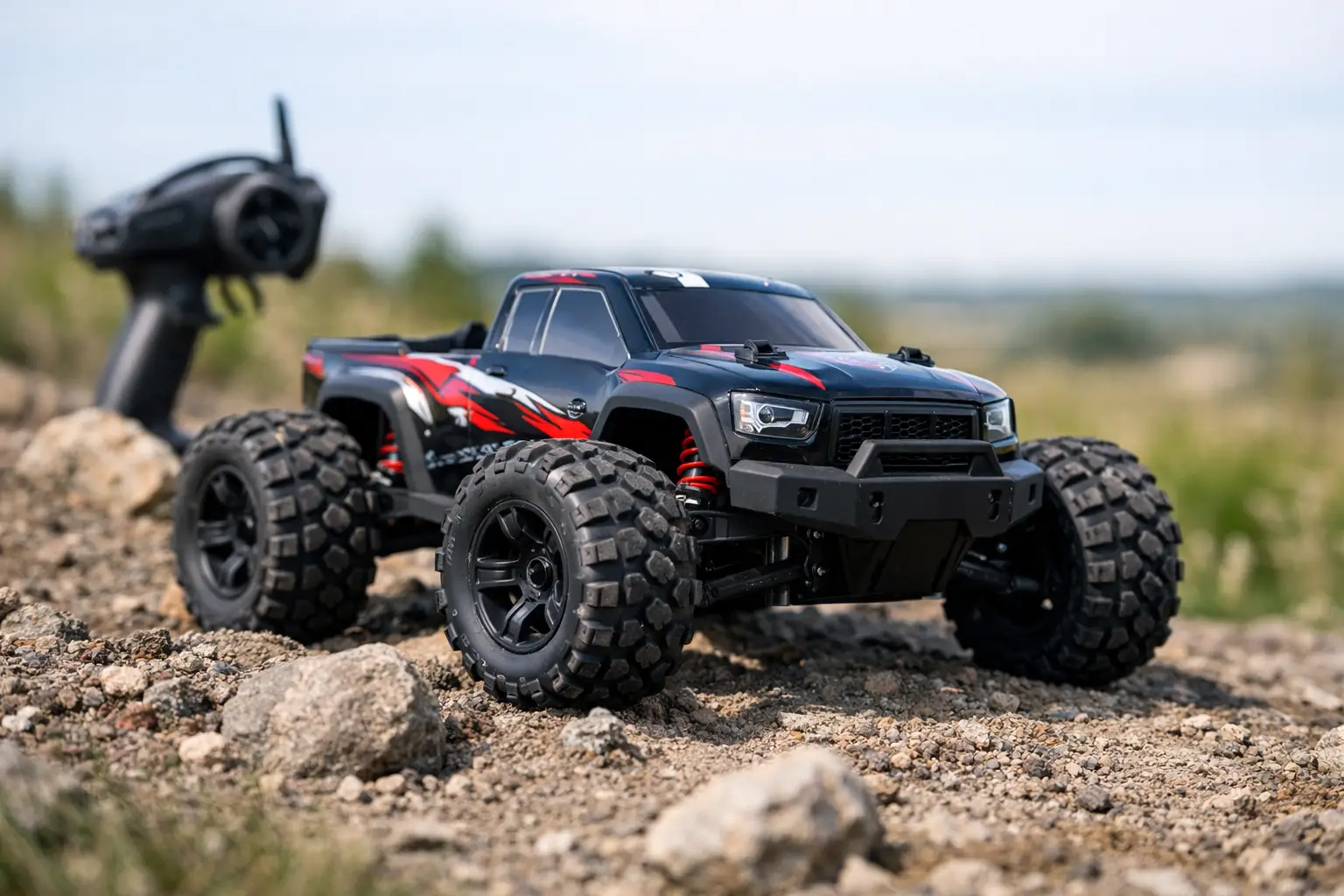
ARRMA Granite Review UK: Mega vs 3S BLX, Batteries, Durability & Who It Suits
A good ARRMA Granite review UK buyers can rely on needs to look beyond the headline speed figure.
The Granite is popular because it delivers the part of the hobby many people actually want: point it at rough ground, pull the trigger and enjoy a proper monster lorry stance without spending every run carefully avoiding puddles, loose gravel and short jumps.
It is quick, entertaining and backed by a strong supply of replacement parts.
It is not, however, a zero-maintenance toy – especially once you start running 3S power.
You can browse the current ARRMA Granite range, parts and related products at RC Model Shop UK.
What the ARRMA Granite is built for
The full-size 1/10 ARRMA Granite 4x4 is a monster lorry designed for bashing.
Its short wheelbase, high ground clearance and large tyres make it happy on compacted dirt, grass, skatepark-style ramps and rough open spaces.
Compared with a lower buggy, it carries more weight over bumps and is less likely to dig its front end into uneven ground.
That does not mean it will float across every field.
Long wet grass puts a considerable load on the motor and drivetrain, while very loose sand and deep mud will shorten the life of bearings and gears if the model is not cleaned afterwards.
The Granite is best on a firm, open surface where there is room to accelerate, turn and land jumps without hitting kerbs, fences or posts.
The body-shell shape and raised chassis give it the look most first-time buyers expect from a monster lorry.
More importantly, the layout is practical.
Access to the battery tray is straightforward, the wheels are easy to remove for cleaning, and common wear items are familiar to experienced ARRMA owners.
ARRMA Granite review UK: Mega or 3S BLX?
This is the decision that matters most.
ARRMA has offered the Granite in different specifications, and the brushed Mega and brushless 3S BLX versions suit very different drivers.
ARRMA Granite Mega
The Granite 4x4 Mega is the gentler starting point.
Its brushed power system is easier to manage, particularly for younger drivers or anyone moving up from a smaller model.
It is still capable of enough speed to make a large garden or local playing field feel small, but it does not punish every heavy throttle input in the way a much faster 3S system can.
Lower initial battery and power-system demands can also make it a sensible choice for a first proper RC car.
The Mega can therefore make sense for:
-
Younger or less experienced drivers
-
Shared family use
-
Smaller running areas
-
Buyers who prioritise control over outright speed
-
Anyone who wants a more manageable introduction to hobby-grade RC
ARRMA Granite 3S BLX
The Granite 4x4 3S BLX is the version for drivers who want the full high-performance ARRMA experience.
On a suitable 3S LiPo, it delivers serious acceleration and enough punch to make throttle control important.
That performance is great fun, but it also reduces the margin for error.
A hard landing while still on the throttle, a full-speed impact or repeated cartwheels can turn what would have been a small mistake at lower speed into a repair job.
For many adult hobbyists, the 3S BLX is the better long-term buy because there is less chance of outgrowing the performance after a few weekends.
For a shared family model, younger teenager or someone who simply wants easier control, the Mega can still be the more enjoyable option.
The right answer depends on where the vehicle will be driven and who will actually be using it.
Battery and charger costs are part of the purchase
Do not judge the price of an RTR model without checking exactly what is included in the box.
RTR means the vehicle is supplied assembled with its radio equipment installed, but battery and charger inclusion can vary depending on the exact package.
Always check the individual product listing before ordering.
2S versus 3S
For a compatible Granite setup, 2S can make a very sensible everyday choice.
It provides strong performance while making the vehicle easier to control.
3S gives the BLX version its much more aggressive character, but it also demands:
-
More open space
-
Better throttle control
-
More attention to drivetrain condition
-
More mechanical sympathy
-
Greater respect for the speed involved
A higher-voltage battery does not simply add speed. It also increases the load placed on the power system and drivetrain.
That is why it is important to stay within the specification of the exact Granite version you own.
Do you need two batteries?
For regular use, a second battery can be worthwhile.
Actual run time depends on:
-
Battery capacity
-
Terrain
-
Temperature
-
Vehicle weight
-
Throttle use
-
Tyre condition
-
Driving style
Having a second pack means an outing is not dictated by one charge.
However, do not simply run pack after pack without checking temperatures.
If the motor, ESC or battery is getting excessively hot, allow the model to cool and investigate the cause rather than immediately fitting another battery.
How does the ARRMA Granite drive?
The Granite feels eager from the first pull of the trigger.
Its relatively short chassis gives it lively steering and makes it easy to change direction around ramps and obstacles.
That short wheelbase is part of what makes the Granite fun, but it also means it is not as planted at higher speed as a longer-wheelbase truggy or truck.
On high-grip surfaces, sudden steering inputs can cause a tall monster lorry to traction-roll.
That is not unique to the Granite. It is a consequence of combining speed, grip, ground clearance and a relatively high centre of gravity.
Use throttle limiting where available
If your transmitter or electronics provide throttle-limiting settings, they can be extremely useful.
This is not only for beginners.
Reducing the available throttle can make the Granite much easier to enjoy in:
-
Wet conditions
-
Smaller spaces
-
Busy bash areas
-
High-grip surfaces
-
Early learning sessions
More controllable power often means more actual driving time and less walking over to recover an upside-down model.
Is the ARRMA Granite good for jumps?
Yes, jumping and bashing are central to the Granite's appeal.
Its monster-lorry tyres and ground clearance help it deal with rough ground and smaller jumps confidently.
But there is an important distinction between being designed for bashing and being indestructible.
Repeated full-throttle launches, large backflips and landing with the drivetrain heavily loaded are hard on any RC vehicle.
The drivetrain, suspension and tyres still have mechanical limits.
Landing with some mechanical sympathy can dramatically reduce running costs.
Try to avoid holding full throttle or full brake as the wheels make contact with the ground after a jump.
That sudden drivetrain load can be much harder on gears and shafts than the jump itself.
ARRMA Granite durability
ARRMA has built a strong reputation in the bashing market because its chassis designs use flexible materials in areas where absorbing impact is useful.
That does not mean nothing breaks.
Hobby-grade RC cars are designed to be repaired and maintained.
Common service and wear areas can include:
-
Suspension arms
-
Body mounts
-
Bumpers
-
Bearings
-
Tyres
-
Driveshaft components
-
Spur and pinion gears
-
Steering components
-
Body shells
The important advantage is that the model is serviceable.
For UK owners, parts availability is a major consideration because a great RC vehicle is much less useful if a routine broken component becomes difficult to replace.
You can search our ARRMA Granite models and parts when maintaining or repairing your vehicle.
Normal wear versus a fault
One of the most important things for new RC owners to understand is that not every broken component represents a manufacturing fault.
The Granite is a high-performance hobby-grade RC vehicle.
Wear and breakage can result from:
-
Impacts
-
Poor landings
-
Debris entering the drivetrain
-
Drivetrain binding
-
Incorrect gear mesh
-
Worn bearings
-
Repeated heavy launches
-
Running through demanding terrain
-
General use over time
Tyres wear out.
Bearings become rough.
Bodies crack after enough tumbles.
Drivetrain components can be damaged by shock loading.
That is normal ownership territory for a powerful basher.
The key is to inspect the model when something changes rather than continuing to drive until a small problem damages several parts.
Maintenance after muddy or wet running
The Granite is exactly the sort of vehicle that encourages drivers to use it in conditions that make a mess.
That is part of the fun, but maintenance afterwards matters.
After a muddy run:
-
Remove the battery.
-
Brush or wipe away loose contamination.
-
Check that all four wheels rotate freely.
-
Inspect the drivetrain for stones, sticks or other debris.
-
Check bearings and exposed components.
-
Allow the vehicle to dry properly before storage.
Water-resistant electronics do not mean the entire vehicle is maintenance-free.
Bearings, screws, gears and other mechanical components still need attention after wet use.
Do not put a wet and muddy RC car straight into a storage cupboard and expect it to remain in good condition.
ARRMA Granite upgrades: what is actually worth doing?
The Granite has plenty of upgrade potential, but a brand-new vehicle does not need to be stripped and rebuilt before its first run.
Drive it first.
Find out what you actually want to improve.
Tyres
Tyres are one of the most practical upgrades because the ideal tyre depends heavily on the surface.
A tyre that works brilliantly on dry dirt may not be ideal on wet grass or loose ground.
Choose tyres around your normal driving conditions rather than appearance alone.
Bearings
Quality bearings can be a worthwhile maintenance or upgrade item, particularly once the originals have seen significant wet or dirty running.
If a bearing becomes rough or starts to bind, replace it rather than continuing to drive and placing extra load on the drivetrain.
Steering components
If steering performance becomes a limiting factor, upgrading specific steering components can make sense.
However, identify the actual weak point before replacing parts.
A steering problem might come from the servo, servo saver, linkage, damaged hub or simply something binding.
Body shell protection
The body takes a lot of punishment on a monster lorry.
Reinforcing or replacing a heavily damaged shell can be more useful than fitting cosmetic upgrades elsewhere on the car.
Should you fit aluminium suspension arms?
Not automatically.
This is a common mistake in RC upgrading.
A plastic suspension arm can flex and absorb energy during an impact.
A rigid metal arm may survive the same impact but transfer the force into a bulkhead, chassis component or other more expensive part.
Aluminium can be useful in certain locations, but replacing every plastic part with metal does not automatically make an RC vehicle stronger.
Upgrade according to a specific problem.
Getting the right ARRMA Granite spare parts
Before ordering a spare part, identify the exact Granite model you own.
Do not rely solely on the word "Granite".
Different generations and specifications can use different components.
Check:
-
Exact model name
-
Model number
-
Generation
-
Mega or BLX specification
-
Manufacturer part number where possible
This avoids the common problem of ordering a component that looks almost identical but does not fit.
RC Model Shop UK can help identify compatible parts if you are unsure which version you have.
You can also browse our current ARRMA Granite range and parts.
Who should buy the ARRMA Granite?
The Granite makes a strong choice for someone who wants a 4WD monster lorry that feels exciting on ordinary outdoor terrain.
It is particularly suited to:
-
Packed dirt
-
Short grass
-
Open car parks
-
Gravel
-
General bashing areas
-
Small to medium jumps
-
Rough open ground
Its combination of acceleration, ground clearance and compact wheelbase makes it entertaining without requiring a purpose-built RC track.
It also makes sense for owners who want a vehicle with a clear route to replacement parts and future upgrades.
Who should not buy an ARRMA Granite?
The Granite is not necessarily the right vehicle for everyone.
A different RC model may be better if you:
-
Only have a very small garden
-
Want slow and realistic scale driving
-
Want the lowest possible maintenance
-
Primarily drive on smooth tarmac
-
Have no suitable open area for a fast RC vehicle
-
Prefer technical crawling to jumping and speed
A smaller-scale model may be easier to use in limited space.
A crawler will be far more satisfying for slow technical terrain.
A lower road-focused RC car will generally feel more stable if almost all of your driving takes place on smooth tarmac.
Buy for the environment you actually have rather than the speed figure printed on the box.
Is the ARRMA Granite good for beginners?
It can be, but the version matters.
A Granite Mega can make a more manageable introduction to hobby-grade RC for someone still learning throttle and steering control.
The 3S BLX can also be suitable for a responsible beginner, particularly if power is initially limited and there is plenty of open space.
What we would not recommend is treating a fast 3S monster lorry like a toy.
The speed and weight mean impacts can damage the vehicle and whatever it hits.
Give a new driver room, start with reduced power where possible and build confidence gradually.
Is the ARRMA Granite worth buying?
For the right driver, yes.
The Granite combines the features many people actually want from a basher:
-
4WD traction
-
Monster-lorry ground clearance
-
Strong acceleration
-
Jump-friendly handling
-
Serviceable construction
-
Good parts support
-
Plenty of upgrade potential
The trade-off is that performance creates maintenance.
The faster and harder it is driven, the more attention it will need.
That is normal for this type of hobby-grade RC vehicle.
Buy the version that matches your available space and confidence level, fit the correct battery and charging equipment, and learn the basic maintenance routine.
Do that and the Granite remains one of the most entertaining ways to get involved in RC bashing.
Frequently Asked Questions
Is the ARRMA Granite good for beginners?
Yes, depending on the version and driver. The Mega specification is generally easier to manage, while the 3S BLX offers much more performance. Where available, reducing throttle output can make a faster model easier to learn with.
What is the difference between the ARRMA Granite Mega and 3S BLX?
The major difference is the power system. Mega versions use a more manageable brushed setup, while 3S BLX models use a much more powerful brushless system designed for higher performance.
Can I run an ARRMA Granite on 2S?
Compatible Granite configurations can be used with 2S, but always check the specification of your exact model and electronics. 2S can provide a useful balance of speed and control.
Can the ARRMA Granite run on 3S?
The Granite 3S BLX is designed around compatible 3S operation. Do not assume a Mega or other Granite version can use 3S without checking its exact electronics specification.
Is the ARRMA Granite waterproof?
Check the specification for the exact vehicle and electronics fitted. Even where electronics have water-resistant or waterproof ratings, the rest of the vehicle still needs cleaning and drying after wet running.
Is the ARRMA Granite durable?
It is designed as a hobby-grade basher and has a strong reputation for rough use, but it is not indestructible. Impacts, bad landings and drivetrain loading can still break parts. Good parts availability is therefore an important advantage.
What should I upgrade first on an ARRMA Granite?
Usually nothing immediately. Drive the model first and identify what needs improving. Tyres, bearings, body protection and specific steering or drivetrain components can all be worthwhile depending on how you use the vehicle.
Where can I buy ARRMA Granite parts in the UK?
You can browse the current ARRMA Granite range, replacement parts and related products from RC Model Shop UK.
Written by RC Model Shop UK
This ARRMA Granite review was written by the team at RC Model Shop UK, specialists in hobby-grade RC cars, crawlers, boats, aircraft, batteries, electronics, replacement parts and upgrades.
ARRMA bashers are exactly the type of vehicles where practical ownership advice matters just as much as the headline specification.
Our team regularly helps customers choose between different power levels, identify the correct batteries and chargers, find replacement suspension and drivetrain parts and work out whether an upgrade genuinely makes sense for the way the vehicle is being used.
We also deal with RC repairs and fault diagnosis, which gives us practical experience of the problems powerful bashers can develop through crashes, drivetrain loading, worn bearings, incorrect gearing and general hard use.
Our advice with a Granite is simple: choose the correct version for the driver, use the right battery, give it enough space and accept that a fast hobby-grade basher will occasionally need maintenance.
That ability to repair and maintain the model is part of what separates a proper hobby-grade RC vehicle from a disposable toy.
Browse our current ARRMA Granite models and parts or contact RC Model Shop UK if you need help choosing a Granite, battery, charger or compatible replacement part.